
Heading to Georgia’s capital for the first time? This Tbilisi itinerary is made for you. It’s simple, fun, and full of iconic sights, hidden corners, cultural gems, and the kind of food you’ll talk about long after the trip.
Tbilisi, the capital of Georgia, greets you with warmth, not just from the people. The city’s very name means “warm place,” taken from the natural sulfur springs that bubble right in its center.
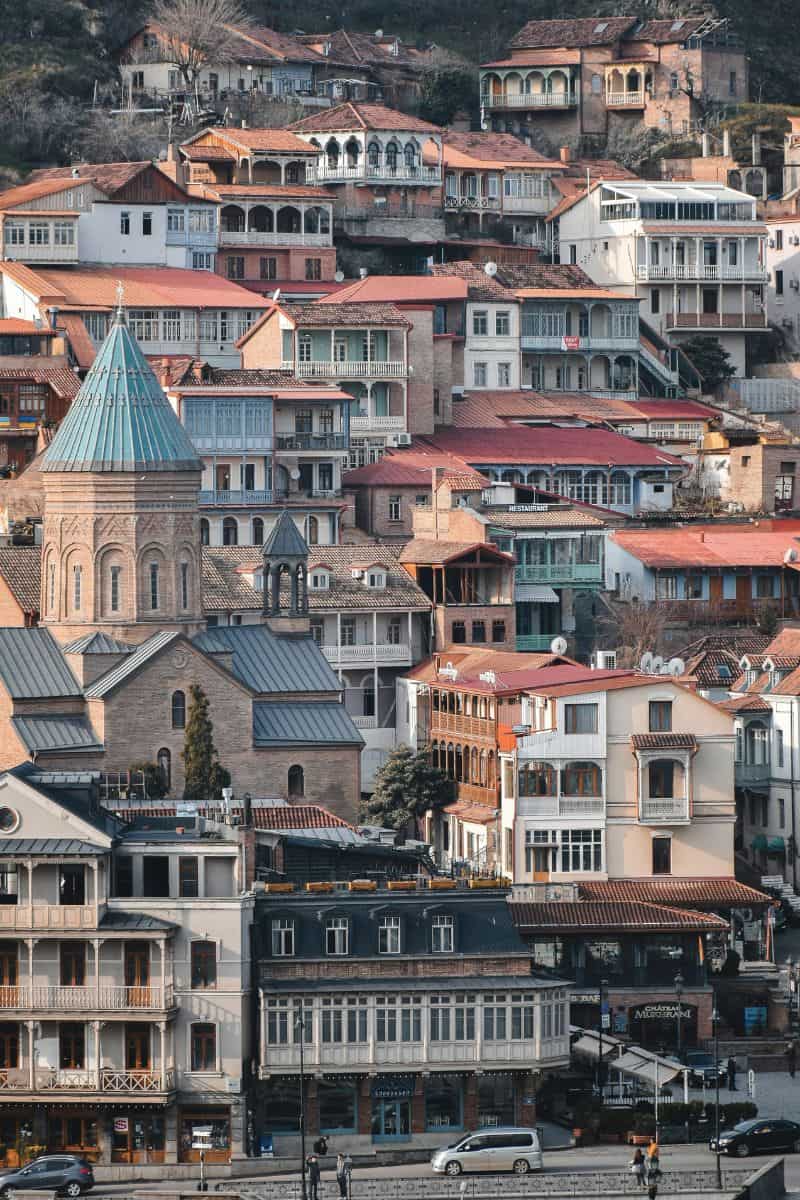
Georgia itself is a small country tucked between Europe and Asia, where the Caucasus Mountains roll down toward the Black Sea. Due to its location, it has long been a meeting point for traders, travelers, and even armies. That’s why, in Tbilisi, you’ll see history layered everywhere, from old stone churches and wooden houses with carved balconies to grand fortresses and modern glass buildings, all sharing the same streets.
This city has been ruled by kings, invaded by empires, and rebuilt many times. Today, it’s a lively capital that takes pride in welcoming visitors. You are sure to feel at home here, because Georgians are renowned for their hospitality. They have a saying that aptly captures this sentiment: “A guest is a gift from God.” If you look up at the statue of Kartlis Deda, or Mother of Georgia, holding a bowl of wine for friends and a sword for enemies, you’ll see that belief carved in stone.
In India, we are familiar with this idea as well. We say “Atithi Devo Bhava,” which means “the guest is like God.” Both cultures share a common heart, where guests are treated with respect, warmth, and kindness.
Location
Tbilisi sits at the crossroads of Europe and Asia, tucked between lush hills and the winding Kura (Mtkvari) River. Georgia’s vibrant capital is well-connected by air and easily accessible from nearby countries, such as Armenia and Azerbaijan. It’s your gateway to the rest of Georgia and the kind of place that pulls you in the moment you arrive. The Old Town, where pastel balconies meet ancient bathhouses, is where most of the charm (and chaos) lives.

Accommodation
Stay in a family-run guesthouse tucked inside Tbilisi’s Old Town, a stylish boutique hotel with mountain views, or go all out with a luxury stay that pampers you from check-in to checkout. These places wrap you in that warm, local vibe where it feels less like you’re renting a room and more like you’ve been invited into someone’s beautiful, lived-in home.
Historical Landmarks
Cultural Experiences
Outdoor Adventures
Unique Spots
Top Restaurants, Cafes, & Bakeries


Top Tips
01. Book your stay in or around Old Town or Rustaveli Avenue. It’s walkable, photogenic, and conveniently located near the best eats and sights.
02. Don’t skip the courtyards. Tbilisi hides its best corners in old courtyards, where wooden balconies, vine-covered staircases, and everyday life unfold in full color.
03. Try the Sulphur Baths on a weekday morning for a quieter soak. Weekends get packed.
You know what’s the best part? You don’t need weeks to feel the spirit of Tbilisi. Two days are enough to see the best of the city. This simple 2-day itinerary for Tbilisi is crafted for first-timer visitors, allowing you to experience the best of Tbilisi without the stress.
If you are short on time or just passing through Georgia, this 2-day Tbilisi itinerary will show you exactly how to make the most of your time.
Tbilisi Itinerary: How to Spend Perfect Two Days in Tbilisi
Tbilisi has a way of surprising you at every corner. One moment you’re looking at a centuries-old church, the next you’re sipping coffee in a courtyard filled with street art. In just two days, you can step into its history, savor its cuisine, and catch the rhythm of everyday life, all without feeling rushed. This itinerary keeps things honest and straightforward, the way you’d explore if a local friend showed you around.
Day 1: Exploring Tbilisi’s Old Town and Classic Sights
Wake up early, grab a strong coffee (or hot chocolate if you’re with kids), and get ready to dive straight into Tbilisi’s heart, the Old Town. This is where the city showcases its age, charm, and a hint of chaos in the best way possible.
Morning: Breakfast and Wandering the Old Town
Start with a Traditional Breakfast at a Local Bakery
Begin your morning the Georgian way, with something warm and cheesy from a neighborhood bakery. Order a megruli khachapuri (cheese-on-cheese bread), the kind of bread that makes pizza feel insecure, and if you see ponchiki (cream-filled doughnuts), grab one too. They’re light, fluffy, and far too easy to finish in two bites.
If you want to go where locals go, head to the tiny Oldest Bakery under Sioni Church, where baker Sasha Jabidze has been pulling fresh puri from the clay oven for decades. For something more modern, Gunda – The Artisan Khachapuri Bakery, located near Besiki Square, experiments with different styles of khachapuri made with local cheese and flour.
Or, if you like a little adventure, duck down the steps to Caravanserai Bakery (Karavanserai Toné), a cellar-style spot across from Sioni Cathedral, where the smell of bread and pastries greets you the moment you push open the door.
Head to Freedom Square
It’s the central hub of the city, a big roundabout with a shiny golden statue of St. George fighting a dragon. Kids usually call it the “golden man on a horse,” which is… not wrong. From here, all roads lead into the Old Town’s winding lanes.
Wander the Old Town
The Sololaki and Kala districts are full of narrow cobbled lanes and hidden courtyards. Head down those narrow alleys and you’ll spot wooden houses with carved balconies, tiny shops, and churches that look like they’ve been standing since dinosaurs roamed (okay, not really, but some are from the 6th century). Don’t miss Sioni Cathedral and Anchiskhati Basilica, two of the oldest churches in the city. Even if you’re not particularly fond of churches, their age and history make them worth a visit.
Stop by the Quirky Clock Tower
By noon, wander over to the Rezo Gabriadze Marionette Theater and its off-the-wall-looking leaning clock tower. Every day at 12 sharp, a tiny puppet angel pops out and rings a bell. It lasts only a couple of minutes, but it’s oddly adorable and makes for a great “we were here” moment.
Midday: Discovering Narikala Fortress and Sulfur Bath District
Across the Peace Bridge
Now it’s time to cross the futuristic Bridge of Peace, a glass bow-shaped bridge that looks like it belongs in a sci-fi movie. On the other side is Rike Park, a family favorite with vast open space where kids can run while you catch your breath.
Up to Narikala Fortress
From Rike Park, hop on the cable car that zips you up to Narikala Fortress. The ride is quick, fun, and the views of the river and red rooftops are stunning. The fortress itself is a mix of ruins and walls you can climb (carefully). From the top, point out the giant statue of Kartlis Deda (Mother of Georgia) holding wine in one hand and a sword in the other. Pretty much sums up the Georgian vibe—welcome with wine, but don’t mess with us. If you’ve got the energy, take a detour (try a zipline down) into the National Botanical Garden, right behind Narikala.
Back Down Through the Bath District
Walk down the hill toward Abanotubani, the famous sulfur bath district. The brick domes look like giant turtle shells, and the smell… well, let’s just say it’s “eggy.” This is where Tbilisi got its name, thanks to the hot springs. You can book a soak if you’d like, but even just walking around and peeking into the Orbeliani Bathhouse, with its blue tile façade, is worth it.
Just behind the bathhouses, follow the path along the creek, and you’ll stumble on the hidden Leghvtakhevi Waterfall, a real waterfall and a fun surprise right in the middle of the city.
Bonus: stalls nearby sell churchkhela, the nutty grape-juice candy Georgians call their version of a Snickers. Try one, it’s chewy but good.
Afternoon: Shardeni Street, Sioni Cathedral, and Metekhi Church
Lunch Time, Bring on the Khachapuri
By now, you’ll be hungry, so head to Shardeni Street or Erekle II Street for lunch. Order khachapuri (cheesy bread boat) and khinkali (soup dumplings). Eating khinkali is messy but fun—bite a small hole, slurp the broth, then eat the rest. Kids usually love it once they get the hang of it. Add a cucumber-tomato salad or a pot of beans (lobio) to eat like a local. Kids can sip on bright green tarragon soda, while adults might enjoy a glass of Georgian wine (it’s the oldest winemaking country in the world, after all).
Sioni Cathedral Stop
After lunch, take a short walk to Sioni Cathedral, right in the Old Town. This church has been rebuilt many times throughout history and is home to a famous relic, the cross of St. Nino (the woman who brought Christianity to Georgia). Even if you’re not into religious sites, its quiet courtyard and ancient frescoes are worth a peek.
Afternoon Stroll to Metekhi
After lunch, take a short walk to Metekhi Church across the river on the cliff, where the statue of King Vakhtang Gorgasali, on horseback, watches over the city. This is the perfect place to retell the story of how his falcon discovered the hot springs that led to Tbilisi’s founding. If you’re traveling with kids, let them run off some energy at nearby Dedaena Park, which has fountains and playgrounds.
Evening: Local Dinner and Tbilisi’s Nightlife
Funicular to Mtatsminda Park & Dinner
For the last part of your day, hop on the Funicular and ride up to Mtatsminda Park. The ride itself is exciting, and at the top, you’ll find rides, bumper cars, and a giant Ferris wheel with the best view of the city. Stay until sunset—the moment when Tbilisi’s lights turn on is something you’ll remember.
You can eat dinner right there. If you’re looking for something quick and easy, try the food stalls and ice cream shops located inside the park. If you’d rather sit down for a nicer meal, the Funicular Restaurant serves tasty Georgian dishes and gives you a fantastic view at the same time.
Now, if you still have some energy left, you can enjoy a softer side of Tbilisi’s nightlife. Walk through the Old Town when it’s all lit up, or stop by one of the city’s cozy art cafés. Art-Café Home and Café Leila are two favorites—they feel more like a friend’s living room than a café, with music, snacks, and a relaxed vibe. Families fit right in, so there’s no need to worry about it being too wild.
If you like culture, you can also pass by the glowing Opera Theater on Rustaveli Avenue. Even from the outside, the building looks beautiful at night.
Where to Stay In Tbilisi? Here are the stays we have shortlisted and saved:
Our Top Pick for Staying in Tbilisi

Stamba Hotel
Location: Vera neighbourhood (at the end of Rustaveli Avenue)
An industrial-chic boutique hotel set in a repurposed Soviet publishing house, where walls are lined with books, and leafy trees rise through a five‑story atrium.
Day 2: Modern Tbilisi, Culture, and Off-the-Beaten-Path Finds
By now, you’ve explored the Old Town, eaten your weight in carbs, and probably considered moving here. Day 2 is your chance to see Tbilisi’s other side—its boulevards, museums, and neighborhoods that give the city its layered personality.
Morning: Rustaveli Avenue and Museum Time
Breakfast First
Before you hit Rustaveli, fuel up with a cozy café breakfast. Coffee Lab in Vera is a favorite for strong brews and simple bites, while Stamba Café near Rustaveli is a good choice for a heartier spread in a stylish, book-filled space. If you’re with kids, grab pastries and fresh juice at Entrée, a local bakery chain that’s everywhere and always reliable.
Explore Rustaveli Avenue
Rustaveli Avenue is the city’s grand boulevard. Walk past the Opera House, statues, and bookstores before stopping at the Georgian National Museum. Even if you’re not a museum person, the treasure gallery with its ancient gold is jaw-dropping.
If you prefer something lighter, you can just stroll, café-hop, and enjoy the atmosphere. Rustaveli is perfect for people-watching.
Midday: Holy Trinity Cathedral (Sameba)
Head to Sameba Cathedral
The golden-domed giant you’ve probably seen shining from afar, Sameba Cathedral is one of the biggest Orthodox churches in the world, and stepping inside feels instantly calm. Even kids go quiet here. Dress modestly (shoulders and knees covered, women with headscarves), and take your time. It’s both spiritual and stunning.
Alternative Option: Vake Park and Turtle Lake
Or you can take it easy in one of Tbilisi’s green spaces. Vake Park is a favorite with local families. There are playgrounds, paths, and even a small lake. If you still want more, continue up to Turtle Lake (Kus Tba). Rent a pedal boat, sit by the shore with a snack, or if you’re brave, try the long zipline that runs from Turtle Lake down to Vake Park. Either way, it’s the perfect place to slow down and enjoy the outdoors.
Afternoon: Vera, Marjanishvili, and Fabrika Neighborhoods
Explore Vera
Switch gears and explore Vera, a trendy neighborhood with leafy courtyards and cafés. Grab a coffee at Coffee Lab or Lumen Café, or just wander through its artsy streets. If you’re with kids, hand them a gelato or a chewy churchkhela (Georgia’s version of a nutty candy bar) and watch them smile.
Explore Marjanishvili and Fabrika
Then wander over to Marjanishvili, with its colorful buildings and theaters, before landing at Fabrika. Long ago, it was a sewing factory, but now it’s a cool hangout spot. The walls are covered with bright murals, there are art studios, cafés, and a big open courtyard full of life. Teens will love the street art, kids can run around safely, and parents can relax with coffee, pizza, or even a cold drink.
Talking about Tbilisi’s creative side, it’s gaining a reputation for its vibrant street art. From Fabrika’s graffiti walls to hidden murals in underpasses, the city uses art to tell stories of its past and present. It’s like an open-air gallery you can stumble into anywhere.
You can take a walk to look for murals created by artists from the Tbilisi Mural Fest. They are massive paintings splashed across building walls, some brand new, others faded, but still striking, each with its own story. If you’re visiting in September, you might even see artists painting live or discover a fresh mural. It’s colorful, fun, free, and showcases a side of the city that many travelers miss.
Alternative Option: The Chronicle of Georgia
If you want something truly striking, detour to the Chronicle of Georgia monument. With massive stone pillars carved with Georgia’s history, it’s dramatic, unusual, and perfect for “wow” photos.
Evening: Riverwalk and Farewell Dinner
Walk Along the Mtkvari
For your final evening, enjoy a leisurely river walk along the Mtkvari. As soon as the sun sets, the Peace Bridge, Metekhi cliffs, and Narikala Fortress light up. It’s the kind of view that makes you stop mid-sentence just to stare.
Dinner
Dinner can be a big, traditional feast in Old Town (bonus points if there’s live folk music), or something modern like Bazaari Food Hall, where everyone can find what they like, from Georgian dishes to global bites.
End with dessert like matsoni (Georgian yogurt with honey), or one more churchkhela, raise a glass, and say “Gaumarjos!” (cheers) to two days of good food, good views, and the warmest city you didn’t know you’d love this much.
Recommended Tours to Explore Tbilisi

Most-Rated Tbilisi Walking Tour
Walk, wine, cable car, khachapuri; Tbilisi in four fun-packed hours. Historic sights, hidden corners, and a guide who knows it all.
Tbilisi Evening Walking & Talking Tour
A breezy city-lights stroll with wine, boat, cable car, and a guide who keeps the stories flowing; Tbilisi in a nutshell, sip by sip.

Tbilisi Food & Drink Walking Tour
A delicious stroll through Sololaki with 9 tastings, chacha, and stories that tie food to Tbilisi’s past and present.
Two days in Tbilisi give you a taste of everything, from old cobbled streets and golden churches to street art, parks, and food that makes you want seconds (and thirds). It’s a city that feels both ancient and new at the same time, and that’s what makes it so special.
Now it’s your turn. What part of Tbilisi would you be most excited to see first? The history, the food, the street art, or the views? Share your thoughts in the comments. I’d love to hear what your perfect day in Tbilisi would look like.
Pin This 2 Days in Tbilisi Itinerary for Later
