
It can be a daunting task to design a perfect itinerary for India owing to the country’s sheer size and diversity. With so much to experience, it’s easy to overplan. Don’t fret. We have done the legwork for you. This 1–4-week India itinerary is designed to help you structure your time realistically so you can explore the best of the country without trying to see everything at once.
India is one of the world’s oldest living civilizations, shaped by centuries of migration, trade, belief systems, conquest and empire, and regional identities. It is geographically vast, religiously, ethnically, demographically, and linguistically diverse, culturally, traditionally, and historically rich and layered, and deeply regional in ways that surprise first-time visitors. Few countries contain this much contrast within one border.
From crowded bazaars and traditional handicrafts to royal palaces, ancient temples, and holy rivers, India shifts constantly. One day you’re looking at Mughal domes against a dusty skyline; another day you’re watching the sun rise over the Himalayas or drifting through Kerala’s backwaters. There are beaches, islands, wildlife reserves, ancient forts, historic monuments, and festivals that fill entire cities with color and sound.
The food alone could justify the trip. It changes from state to state: the flavors, the ingredients, the way a basic meal is prepared, even the way people eat can surprise you.
And then there are moments that don’t make it into any itinerary. You might find yourself sitting on temple steps at dusk, sharing a train seat with a family who insists you taste what they packed from home, accepting an invitation to join a festival procession or even an intimate marriage ceremony, or a cup of masala chai handed to you without ceremony. You don’t plan for those interactions, but they often become the parts you remember most clearly.
It reflects something deeply rooted here: Atithi Devo Bhava, the belief that a guest is God and should be treated with respect and generosity.
India has my heart. Not because it’s my motherland. Because it’s where everyone is loved and accepted, no matter where they come from 🙂
Most people don’t leave India exactly the same as when they arrived. The country stretches your patience at times, but it also widens your perspective in ways you don’t anticipate.
Heads up: some links here are affiliate links. That means if you click and buy something, I may earn a teeny-weeny commission (think chai money, not a private jet) at no extra cost to you. It’s a small way to keep this blog running, the words flowing, and the pages free for you to enjoy. I only recommend things I truly love, use, or secretly wish I invented, because trust matters, and so do good recs. Thanks for supporting the little cozy corner of the internet I call my virtual home.
Why Trust Me on India Itineraries?
I have lived in India my entire life, traveled across it in every season, and seen it through the eyes of someone who grew up here, which means I’ve seen the version of it that most visitors never get to. The crowded local trains, the roadside dhabas with no signboards and extraordinary food, the festivals that don’t make it onto any tourist calendar, and the shortcuts, literal and figurative, that only come from years of moving through a place you call home.
The itinerary suggestions on this page are based on personal experience. I have visited each destination mentioned here, most of them multiple times, across different seasons and different circumstances. Nothing here has been copied from a guidebook or put together from behind a desk. The recommendations, the routes, the warnings, and the honest opinions are all mine, earned through years of travel, a fair share of mistakes, and firsthand knowledge that only time in a place can give you.
After years of traveling across different regions of India, I’ve learned what works and what doesn’t. These itineraries reflect both experience and careful research, strengthened by years of building and fine-tuning routes, removing what looks good on paper and keeping what actually works on the ground.
That said, I want to be upfront about something. These itinerary suggestions are, for now, written from a local’s perspective. And while that gives them a depth and authenticity that I’m proud of, I also know from my own travels abroad that local advice only goes so far. When I travel to a foreign country, I don’t just want to know what the locals love; I want to know what it feels like to arrive there for the first time, navigate it without context, and experience it fresh. Those are two very different perspectives, and both matter equally.
Which is why I’m working on adding a traveler’s perspective to all my India content, what it actually feels like to land here as a first-time visitor, what surprises you, what confuses you, and what takes your breath away when you have no idea what’s coming. Because India deserves to be written about from both sides of that experience.
For now, trust that what you’re reading here is deeply personal and rooted in a genuine love for this country, not the love that puts it on a pedestal and calls it perfect, but the love that knows its roads, its moos, its chaos, and exactly when to tell you to leave early.
Before You Choose Your Route
When to Visit India
Look at your travel dates first. The weather varies widely across regions, and it can shape your entire experience.
Winter (mid-October to mid-February) is my absolute favorite time to travel anywhere in India, and I recommend it to most first-time visitors. The days are clear, the light is beautiful, the weather is pleasant, the air is cold enough in the mornings to need a layer, and the country is simply at its best.
Spring (March and April) is short but lovely, catching the tail end of the cool weather before the heat sets in.
Summer (April to June) is brutal across most of the plains and northern India, though it’s exactly when Indians escape to the mountains, which come alive and are genuinely beautiful during these months.
Monsoon (July to September) transforms the south and the Western Ghats into something extraordinary, green and dramatic, and half the price, but makes several northern destinations genuinely difficult to travel through.
If you’re planning your trip around a festival, such as Diwali, Holi, Durga Puja, Navratri, Dev Deepawali, Onam, or any of the dozens of regional celebrations that make India what it is, always verify the exact dates for your year before booking, as most follow the lunar calendar and shift annually. I’m writing a complete guide to festivals in India, covering every major festival month by month, the best cities to experience each one, what to expect, and practical tips for planning around them.
For a detailed month-by-month breakdown of the best time to visit India, I’m putting together a complete seasonal guide separately (coming soon).
Do You Need a Visa for India?
Most nationalities require a visa to enter India. India offers visa-free entry only to citizens of Bhutan, Nepal, and the Maldives. Passport holders from most other countries, including the US, UK, EU, Australia, and most of Asia, are required to obtain an e-visa or a visa in advance.
The e-visa is straightforward, done entirely online through the official Indian government portal, and typically processed within 72 hours. Apply at least 4 to 5 days before travel and always use the official portal to avoid third-party sites that charge unnecessary fees for the same service.
For the most current visa fees, validity, and entry conditions for your specific nationality, check the official Indian e-visa portal directly before applying.
One practical thing to know: India requires registration for foreign nationals. If you’re staying at a hotel or registered guesthouse, they handle this automatically on your behalf when you check in, which is why your passport is collected at reception. It’s called the C-Form registration, and it happens in the background without you needing to do anything. If you’re staying with friends or family or in an unregistered property, you may need to register yourself at the local Foreigners Registration Office. For most travelers following a standard hotel-based itinerary, you never need to think about this, but it’s worth knowing it exists.
Where to Start Your India Itinerary
Decide on your arrival and departure cities before building the rest of the route. This one decision shapes everything that comes after it.
Most international flights land in Delhi or Mumbai, and starting there usually makes the most sense. Both are major international hubs with direct connections from most parts of the world and excellent onward domestic connections to the rest of the country.
Beyond Delhi and Mumbai, India has around 36 international airports, so depending on where you’re flying from, you may have more options than you think.
Major cities like Kochi, Chennai, Kolkata, Bengaluru, Hyderabad, Thiruvananthapuram, Ahmedabad, and Amritsar all have international airports with varying levels of connectivity. Check if your home country has a direct or manageable connection to any of these before building your route. If it does, it might save you a long transit and let you start your itinerary closer to where you actually want to begin.
Delhi is the natural gateway to North India, Rajasthan, and the Golden Triangle. Mumbai opens up the west coast, Goa, and the south. Kochi makes a brilliant entry point if your itinerary is south-focused. Chennai serves Tamil Nadu and the southeast. Bengaluru sits at the gateway to both Kerala and Karnataka. Kolkata is the entry point for East India, the Northeast, and Darjeeling. Hyderabad connects central and southern India. Ahmedabad is worth considering if Gujarat is on your list. Amritsar has direct connections from the UK and a few Gulf destinations, making it a good starting point if you want to begin in Punjab.
The general rule is simple: fly into the city closest to where your itinerary begins and out of the city closest to where it ends. Avoid doubling back unless you have a very good reason.
How Long Should You Spend in India?
Here is the truth that most Indian travel guides won’t tell you: no matter how many days you have, you will leave feeling like you needed more. That’s not a planning failure. That’s just India.
A week is enough to get a taste but not enough to settle in. India is unlike most Western countries in ways that no amount of reading fully prepares you for: the food, the noise, the crowds, the pace, the sheer sensory overload of arriving somewhere this alive for the first time. You’ll spend a good chunk of that first week just adjusting. By the time you find your rhythm, it’s time to go home.
Two weeks is where it starts to make sense. You can do one region properly or two regions at a fast pace with some long travel days built in.
Three weeks is when India starts to feel generous. It’s also the point where India stops feeling overwhelming and starts feeling navigable.
Four weeks is when it starts to feel like you’re actually traveling rather than ticking things off. You have time to linger, to take the slow train instead of the fast one, to spend an extra day somewhere simply because you don’t want to leave. That’s when the real India shows up.
Whatever your timeframe, build in at least one or two buffer days. Not because things will necessarily go wrong, but because something will unexpectedly go right: a conversation, a festival, a place that refuses to let you leave on schedule, and you’ll want the freedom to say yes to it.
How to Get Around India?
How you move between cities and states shapes the entire feel of your trip, so it’s worth thinking about this before you finalize any itinerary.
India is vast and has one of the most extensive transport networks in the world: roads, railways, flights, and buses connecting even the most remote corners of the country. It is generally reliable, but it takes time, and that time adds up faster than most first-time visitors expect. Factor in travel days, or your itinerary will start falling apart on day two.
For long distances, fly. India has a well-developed domestic aviation network, and flights between major cities are affordable when booked in advance. IndiGo, Air India, and Vistara are the main carriers. If your itinerary involves covering large distances, e.g., Jaisalmer to Kochi, or Delhi to Goa, flying saves you a full day of travel and is worth every rupee. Book early, prices rise significantly closer to the date.
Trains are the soul of Indian travel, and the option I’d always choose where time allows. The rail network is enormous, the routes are scenic, and a long train journey in India: the chai vendor walking through the carriage, the landscape shifting outside the window, is an experience in itself. Book on IRCTC well in advance, particularly for popular routes and peak season. The Vande Bharat Express is the fastest and most comfortable option on many routes. For overnight journeys, a 3AC or 2AC berth is the sweet spot between comfort and cost. Read my complete guide to booking trains in India (coming soon).
Private transfer is the most flexible option, particularly for families or groups. A private car with a driver gives you complete control over your schedule, lets you stop wherever you want, and removes the stress of navigating an unfamiliar transport system. For shorter distances, such as Agra to Jaipur, Kochi to Munnar, it’s often the most practical and comfortable choice. A good driver doubles as an informal local guide, which is worth more than it sounds.
Self-driving in India is possible but requires a specific kind of confidence. Traffic rules are loosely interpreted, road conditions vary enormously, and city driving in particular is not for the faint-hearted. If you are a confident, experienced driver and don’t mind the chaos, hiring a self-drive car gives you enormous flexibility and opens up routes that scheduled transport doesn’t easily reach. If you have any doubts, hire a car with a driver instead. It’s not significantly more expensive and considerably less stressful.
One important note: avoid driving on unfamiliar roads after dark whenever possible. Highway driving at night carries real risks, and mountain roads after dark are best avoided entirely.
State buses are cheap and go everywhere, but are slow and not particularly comfortable on long journeys. Private AC buses are a step up and worth considering for routes where trains aren’t available or are fully booked. Overnight buses on certain routes, like Goa to Hampi, are a good example. They are practical and save you a hotel night if you can sleep on the move.
To get around cities, use Ola or Uber rather than hailing taxis or auto rickshaws on the street. Both apps work well across most major Indian cities, show you the fare upfront, and eliminate the need for negotiation. Street taxis and autos are unmetered in many cities, and navigating them can be difficult if you don’t know the going rate. In smaller towns where apps don’t work as well, agree on a price before you get in, and don’t be afraid to walk away if it doesn’t feel right.
For certain destinations and sites outside a major city, an organized day trip or pre-booked transfer is often the most practical and stress-free option. Even if you’re not generally a tour person, it’s worth considering for the more complex legs of your itinerary. I personally always check Get Your Guide and Viator first. Both have reliable operators across most Indian destinations, and the reviews tend to be honest enough to tell you what you actually need to know.
The rule of thumb here is: Fly for distances of six hours or more. Train or private transfer for two to five hours. Private transfer for anything under two hours. Mix and match by leg, and you’ll find a flow that works surprisingly quickly.
How Long Does It Actually Take to Get Around India?
Be realistic about travel time between cities. First-time visitors frequently underestimate the distances between places. India might look compact on a map, but distances and traffic can stretch your day. After all, it’s the world’s seventh-largest country.
A journey that looks like three hours on Google Maps can easily become five on the ground. Roads vary widely: some are excellent highways, others are still under construction. Traffic in and around cities adds time that no map can accurately predict. Getting in and out of a major city can add an hour to your journey without any warning, and once you’re inside, you’re at the mercy of the traffic, the autos, the bikes, and the general organized chaos that Indian cities run on.
And trains, as much as we love them, have improved significantly over the last decade. The Vande Bharat and other express services are genuinely punctual and comfortable, but delays are still part of the experience on older routes and longer journeys. Factor in some buffer time, and you won’t be caught off guard.
The practical rule is this: whatever travel time you’ve estimated, add at least an hour. For road journeys over four hours, consider whether a domestic flight might be worth the cost. Never plan anything important immediately after a long travel day in India.
Is India as Overwhelming as Everyone, Including Me, Says?
Yes. And also no. And also yes again.
India is overwhelming in the way that the best things in life tend to be, not because it’s unpleasant but because it’s so completely, relentlessly, unapologetically alive that your senses need time to catch up. The noise, the color, the crowds, the smells, the traffic, the chai vendor, the temple bells, the auto rickshaw horn, all of it happening at full volume all at once. It’s a lot. I won’t pretend otherwise.
But here’s what I’ve also seen, having traveled across this country more times than I can count and having watched first-time visitors go through the exact same arc every single time. Day one is sensory overload. Day three is cautious curiosity. Day five is the beginning of something that looks a lot like love. And by the end of the trip, the overwhelming quality that felt like a warning at the start has somehow become the thing they miss most when they get home.
So come with the right mindset. It’s the most important thing you’ll pack for this trip.
Stay flexible. India will not always go to plan. Trains will occasionally run late, roads will surprise you, and there will be at least one moment where everything feels like too much all at once. That’s not a flaw in the itinerary. That’s just India being India. The travelers who enjoy it most are the ones who can laugh when things go sideways and find the story in the inconvenience.
Choose fewer places and stay longer. The biggest mistake first-time visitors make is trying to cover too much in too little time. India reveals itself to people who linger, not to people who sprint. Pick the destinations that genuinely excite you, give them proper time, and resist the urge to add one more stop just because it’s nearby.
Arrive with curiosity. India will challenge your assumptions about almost everything; you name it. Let it. The country is not trying to be difficult. It’s just being itself, which happens to be one of the most fascinating things on earth.
Leave room for the unexpected. Not just literally with buffer days in your itinerary, but mentally. The best moments of any India trip are almost never the ones you planned. Let go of the expectation that things will work the way they do at home. They won’t, and once you genuinely make peace with that, India opens up in ways that will surprise you. It always does. In a good way, mostly.
Read my India Travel Guide for everything else you need to know before you land, from what to pack and what to eat to how to stay safe and what to expect on the ground, every tiny detail in detail.
You’ll also want to read:
India Itineraries for 1–4 Weeks of Travel
Below, I’ve mapped out four realistic route options based on how long you plan to spend in India, from 1 week to a full month. They’re shaped around how travel actually works here, especially once you factor in distances and logistics between cities.
One Week in India
(India’s Golden Triangle: Delhi, Agra, and Jaipur)
The Golden Triangle works well if you have one week to spare. The cities are well-connected and easy to travel between. This iconic route covers the major highlights while giving you a feel for northern India’s culture, history, and food. It’s a solid introduction to the country.
Days 1–2: Delhi
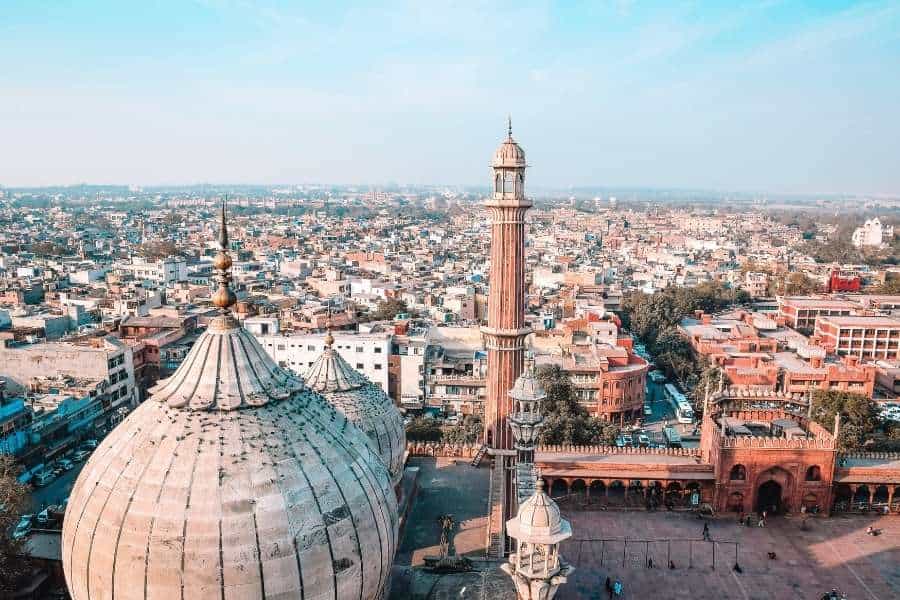
Delhi, the capital, the chaos, and the contradiction that almost every Indian itinerary begins with, is unlike any other city on earth. It’s not the most beautiful city in India, and it will be the first to tell you so. What it is is layered in a way that takes more than one visit to fully appreciate.
Delhi contains multitudes and makes no apologies for any of them. It is loud, occasionally maddening, endlessly fascinating, and the perfect place to begin.
Old Delhi and New Delhi are not just two parts of the same city; they are two different centuries coexisting on the same map.
Old Delhi is unapologetically alive and magnificently medieval: narrow lanes that haven’t changed in 400 years, mosques that hold thousands, spice markets that have been trading since before most countries existed, and a street food culture so deeply embedded in the city’s identity that eating here is less a meal and more an event.
New Delhi is colonial, planned, and wide-avenged, built by the British as a statement of permanence and inherited by a nation that made it entirely its own.
Divide your time between Old Delhi and New Delhi.
Spend your first day in the historic heart of the city. Visit the Red Fort in the morning, walk through Jama Masjid, and then step into the chaos of Chandni Chowk.
If you’re curious about local food, consider a guided street-food walk, but be mindful of hygiene. Delhi belly is common for first-time visitors, so choose carefully.
On your second day, focus on New Delhi. Visit India Gate, drive past Rashtrapati Bhavan, and explore Humayun’s Tomb. Qutub Minar is worth the detour if you’re interested in early Indo-Islamic architecture. Add Lodhi Gardens or Lodhi Art District if you want a break from monuments.
If you’re traveling with kids or teens, plan to visit at least one museum. There are quite a few interesting ones in this part of Delhi. The National Museum is ideal for teens interested in Indian history, while the National Rail Museum is a better choice for younger children.
Two days won’t cover everything, and that’s okay. Choose a handful of places, move at an easy pace, and most importantly, leave room for good food. Connaught Place, Gole Market, and Pandara Road have reliable options, whether you’re in the mood for something casual or a proper sit-down meal.
Khan Market, Defense Colony Market, Hauz Khas Village, and Lodhi Colony (Meherchand Market) are also dependable choices, home to some of Delhi’s most loved cafés and restaurants. For a beautifully bohemian café scene, you can head to Champa Gali.
For a day-by-day plan covering 1 to 4 days in Delhi, see my detailed Delhi itinerary.
You’ll also want to read:
Where to Stay in Delhi
Delhi has accommodation across every budget and every neighborhood. Delhi is a big city, and where you stay matters more here than in most cities. Your pick decides how much energy you use to get around. Get this right, and the city feels manageable. Get it wrong, and you’ll spend half your time in traffic.
Avoid booking in areas you’re unfamiliar with based purely on price. Delhi’s neighborhoods vary enormously, and a cheap hotel in the wrong part of the city can add unnecessary stress to what should be a straightforward first day.
Stay in New Delhi rather than Old Delhi as it’s better connected, more comfortable for first-time visitors, more peaceful and safe, and puts you within easy reach of everything. Here are my picks across different budgets.
Budget: Minimalist One Hauz Khas Village in Hauz Khas, formerly LetsBunk Poshtel, now rebranded but still the same stylish, well-located property with a rooftop, good vibes, good value, and Hauz Khas Village right on its doorstep. I also like Bloom Boutique GK-1 in Greater Kailash for its chic, well-priced offerings, in one of South Delhi’s most enjoyable neighborhoods.
Mid Range: Radisson Blu Marina Hotel at Connaught Place is well-located in the heart of New Delhi, with metro access to everywhere, and offers reliable, comfortable accommodations without the luxury price tag. A practical, pleasant, and perfect base for exploring the city.
Boutique: The Manor in Friends Colony, Delhi’s original boutique hotel, built in the 1950s and set in nearly an acre of garden in one of South Delhi’s most peaceful neighborhoods. Just twelve rooms, which means it never feels busy and always feels personal. The interiors blend terrazzo flooring, natural textures, and rich wood in a way that feels considered rather than decorated. The restaurant INJA, a Japanese-Indian fusion, is reason enough to stay, and the Ayurvedic spa is something you’ll wish you’d booked more time for.
Luxury: The Oberoi, Delhi’s most celebrated hotel, and for good reason. Sitting between the lush greens of the Delhi Golf Course and the UNESCO-listed Humayun’s Tomb, the views alone justify the address. The 220 rooms are bathed in natural light with Italian marble bathrooms and picture windows that frame one of the two views. Wake up to kite hawks circling over the golf course in the early morning, and you’ll understand why guests keep coming back. The rooftop bar Cirrus 9, the Michelin-starred dining, the 25-meter pool that somehow feels private even when it isn’t, and service that anticipates things before you’ve even thought to ask for them raise the bar for everywhere else you stay after it.
For a full breakdown of Delhi’s neighborhoods and where to base yourself depending on your itinerary, read my complete Delhi accommodation guide.
Days 3–4: Agra

Agra is a city that exists almost entirely in the shadow of one monument, which is both its blessing and its slight misfortune. The Taj Mahal is so extraordinary, so completely and unarguably the most beautiful building most people will ever stand in front of, that everything else Agra has to offer tends to get overlooked in the rush to see it and leave.
But Agra is more than the Taj. It was the capital of the Mughal Empire at its peak, the city where Akbar, Jehangir, and Shah Jahan each left their mark in stone, marble, and red sandstone. The fort, two kilometers from the Taj, is one of the most significant Mughal structures in India. The Baby Taj predates the Taj Mahal and, in many ways, surpasses it in delicacy. The ghost city of Fatehpur Sikri, just 40 kilometers away, is one of the most haunting and undervisited places in North India.
Two days here is the right amount. Enough to see the Taj properly, twice if you can manage it, and enough to discover that Agra has more going on than the postcard suggests.
Travel to Agra by train or private car. High-speed trains like Vande Bharat and Gatiman Express now make the journey in around 2 hours, while a road transfer can take 4 to 5 hours, depending on traffic and stops.
If you take a morning train, you’ll usually reach by midday. Check in, have lunch, and spend the evening viewing the Taj Mahal from across the river at Mehtab Bagh or from Taj View Point (ADA).
Wake up early for sunrise at the Taj Mahal. It’s when the crowds are lighter, and the weather is more pleasant. After your visit, head out for a traditional breakfast: bedai or bedmi poori with aloo sabzi is a local favorite.
Later, explore Agra Fort and, if time allows, visit Itmad-ud-Daula, often called the Baby Taj. Leave some time for souvenir shopping, especially if you’re interested in marble inlay work. Stick to government-approved showrooms for authenticity.
✦ For detailed logistics, ticket tips, sunrise strategy, and practical advice from someone who has visited Agra more times than she can count, read my detailed Agra itinerary.
Where to Stay in Agra
In Agra, splurge on the stay if you can. Waking up to the Taj Mahal outside your window or even within walking distance of it is not a small thing. The monument looks different every hour, and being close enough to see that firsthand is worth more than any upgrade anywhere else on this trip.
Budget: The Grand Imperial, a heritage property that has been welcoming guests since 1890, sits in the heart of the city, featuring classic Indian-style rooms with four-poster beds, high ceilings, antique furnishings, a lovely courtyard garden, a rooftop terrace where you can actually see the Taj Mahal without leaving the hotel, and the old-world charm that Agra’s newer hotels simply can’t manufacture. About 10 minutes by auto rickshaw to the monument itself, which in Agra terms is perfectly close.
Mid Range: Crystal Sarovar Premiere, a solid five-star at a very reasonable price, with Taj Mahal views from the higher floors and a rooftop dining area that makes the most of that proximity. Good value for what it delivers.
Boutique / Homestay: Aman Homestay, a four-storey family home just 400 meters from the Taj Mahal’s eastern gate, run by Ranjana and her family, who cook every meal themselves, know every tuk-tuk driver on the street by name, and treat guests the way you’d want to be treated everywhere but rarely are. The rooftop terrace offers a direct view of the Taj Mahal. The rooms are spotless. The home-cooked vegetarian meals make you cancel dinner plans elsewhere. For the price, nothing in Agra comes close.
Luxury: The Oberoi Amarvilas is the only hotel in Agra where every room (all 95 rooms) overlooks the Taj Mahal. Just 600 meters from the East Gate, with a private golf buggy to take you there at sunrise. Candlelit dinner on your balcony with the Taj in silhouette behind it. There is no competition at this level, and there never will be. If the Oberoi Amarvilas is beyond the budget, ITC Mughal is the next best thing and a remarkable property in its own right. The only Indian hotel to have won the Aga Khan Award for architectural excellence, it sits across 23 acres of Mughal-inspired gardens, about 2 kilometers from the Taj. No direct Taj views from the rooms, but the Jharoka-e-Taj observatory on the property gives you a stunning vantage point over the monument. Peshawri, the restaurant serving North West Frontier cuisine, is one of the best dining experiences in Agra and is worth visiting even if you’re not staying here. Kaya Kalp, the spa, is exceptional.
Days 5–6: Jaipur

The pink-washed facades, the auto rickshaws weaving through bazaars selling everything from block-printed fabric to silver jewelry, the forts rising on the hills above the city, and the smell of pyaaz kachori frying somewhere on every second street corner: this is the Pink City, the capital of Rajasthan, and the third point of India’s Golden Triangle.
Founded in 1727 by Maharaja Jai Singh II, it was one of the first planned cities in India, laid out in a grid that still largely holds today beneath the organized chaos of modern life. The old walled city has been a UNESCO World Heritage Site since 2019, a recent recognition of something extraordinary for three centuries.
I’ve been here five times, and I’m still not done with it. Every visit, I find something I missed the last time: a lane in the old city, a rooftop I hadn’t noticed, a sweet shop that’s been there for decades and somehow never made it onto any list. That’s the thing about Jaipur. The monuments are the obvious reason to come, and they’re worth it. But the city underneath them is the reason you keep coming back.
But before you get there, the road from Agra has one more thing to offer.
Leave Agra early and stop at Fatehpur Sikri on the way to Jaipur. This former Mughal capital, now a UNESCO World Heritage Site, is a remarkably preserved 16th-century city built by Emperor Akbar and abandoned soon after due to water shortages. It’s worth a short visit before continuing onward.
You’ll likely reach Jaipur by early evening. Check in, rest, and head out for dinner. For a special meal, 1135 AD at Amber Fort or Peacock Rooftop Restaurant are reliable choices. If you’d rather sample local snacks, try pyaaz kachori at Rawat Mishthan Bhandar or explore Masala Chowk for a casual spread of Rajasthani favorites
The next day, keep your sightseeing intentional. Jaipur has many attractions, but with just one day, you can’t see everything. Hawa Mahal, City Palace, Jantar Mantar, and Albert Hall Museum sit close to each other, making them easy to cover together. Some of them make it to the top of the best places to visit in Jaipur.
If you decide to visit Amber Fort, focus on that circuit instead. Amber is outside the main city, and combining it with Panna Meena Ka Kund, Jaigarh Fort, Nahargarh Fort, and possibly the evening sound-and-light show makes more sense than rushing back and forth.
Plan wisely. Even after five visits to Jaipur, I still haven’t seen it all. The longest I stayed was three days, and that’s when I finally shaped a balanced route without repeating earlier mistakes. I’ve shared that detailed plan in my full Jaipur itinerary.
You’ll also want to read:
Where to Stay in Jaipur
Jaipur has some of the finest hotels in Rajasthan, and staying in a heritage haveli or palace property here adds a layer to the trip that a standard hotel simply can’t.
Budget: Pearl Palace Heritage in Gopalbari, a family-run boutique guesthouse on Ajmer Road with individually themed rooms decorated with Rajasthani artifacts, hand-painted murals, and antique-style furniture that makes each room feel different from the last. The same family runs the famous Peacock Rooftop Restaurant, two blocks away, at their original Pearl Palace Hotel, featuring romantic lighting, live Rajasthani music in the evenings, and a menu that ranges from local Rajasthani classics to global comfort food. One of the most consistently well-reviewed stays in Jaipur, regardless of budget, and it’s easy to see why.
Mid Range: Narain Niwas Palace is a 1928 royal hunting retreat still run by the same family that built it. Carved wooden doors, vintage furnishings, family portraits on the walls, and a garden that belongs to another era entirely. Real heritage rather than manufactured nostalgia.
Heritage: Samode Haveli, a 175-year-old royal family manor within the walled city, with hand-painted arches, mirror-mosaic ceilings, antique-furnished rooms, and a rooftop pool that feels almost absurdly wonderful given the price. Still owned by the Samode royal family. One of the finest heritage stays in Jaipur at a price that sits well below what it should cost. Alternatively, Alsisar Haveli in Bani Park is a restored 19th-century haveli with original Rajasthani frescoes, a garden courtyard, and a pool. Quieter neighborhood than the walled city, a short auto ride to everything, and the unhurried atmosphere that makes you want to extend your stay by a day.
Boutique: The Johri is a merchant’s mansion from the gem-trading era, sitting right in Johri Bazaar in the heart of the walled city. Each suite is named after a gemstone and designed accordingly. The restaurant puts a refined spin on Rajasthani vegetarian food and is worth visiting even if you’re not staying here.
Luxury: Rambagh Palace, the former residence of the Maharaja of Jaipur, is now a Taj hotel and spans 47 acres of manicured Mughal gardens. The rooms are adorned with rich textures, hand-painted motifs, and detailing that takes years to produce. The Jiva Grande Spa, the vintage horse-drawn carriage rides at dusk, and the sheer scale of the place make it one of the great palace hotel experiences in India.
Day 7: Return to Delhi

Before leaving Jaipur, take a short detour to Patrika Gate. It’s one of the most ornate gates in the city, adorned with colorful murals depicting Rajasthan’s culture and history. It won’t take more than an hour, and it’s an easy final stop before heading out.
From Jaipur, you can return to Delhi either by train or by road. The Vande Bharat train takes around 3 hours and 30–40 minutes, while a road journey can take 5 to 6 hours, depending on traffic and stops. Choose based on your comfort level and flight timing.
If you’re flying internationally, plan to arrive at Delhi airport at least 4 hours before departure. Traffic in and around Delhi can be unpredictable, especially during peak hours, so build in buffer time. It’s better to arrive early and wait comfortably than to rush through security.
You’ll also want to read:
Two Weeks in India
(India’s Golden Triangle and the Highlights of Rajasthan)
If you have two weeks, you can move beyond the Golden Triangle and experience Rajasthan more fully. This route builds gradually, from Delhi and Agra into the desert landscapes, forts, and smaller towns of western India.
Days 1–6: Delhi, Agra, and Jaipur
Begin with the same foundation as the one-week route: Delhi, Agra, and Jaipur.
The first six days mirror the one-week Golden Triangle route.
Spend two days in Delhi, two days in Agra, and two days in Jaipur, including a stop at Fatehpur Sikri on the way. By the end of Day 6, you’ve covered the historical backbone of North India and are ready to continue further into Rajasthan.
Day 7: Jaipur to Udaipur (en route Nathdwara and Haldighati)

From Jaipur, travel south toward Udaipur on NH48, the fastest and most well-maintained route, passing through Kishangarh, Bhilwara, and Chittorgarh before descending into Udaipur. It’s a long but scenic drive, and you can break it with meaningful stops.
The first meaningful stop is Nathdwara, one of the most important Krishna pilgrimage sites in India and home to the famous Shrinathji Temple. The town is also known for its Pichwai paintings, large, intricate cloth paintings depicting scenes from Krishna’s life, and the lanes around the temple are worth a slow walk even if you’re not particularly religious.
Further along, Haldighati marks the site of the famous 1576 battle between Maharana Pratap and the Mughal forces of Akbar. It’s a significant historical stop, and the museum here does a decent job of telling the story of one of Rajasthan’s most celebrated warriors.
If you want to add a third stop, and it’s worth it, if Rajasthan’s fort trail has captured you by now, Chittorgarh Fort is one of the largest and most historically layered forts in India. A UNESCO World Heritage Site perched on a 180-meter-high hill, it tells the story of Rajput pride, sacrifice, and resilience better than almost any other site in Rajasthan. The Vijay Stambha, the Tower of Victory, built by Rana Kumbha; the haunting Rani Padmini Palace; and the sprawling ruins of palaces and temples spread across the hilltop make this a stop that deserves at least 2 to 3 hours. Factor this in if you leave Jaipur by 7 am.
These stops add cultural depth and turn a long travel day into part of the experience rather than just a transfer between cities.
The drive from Jaipur to Udaipur takes around seven hours on its own, and once you add Nathdwara, Haldighati, Chittorgarh, and a proper lunch stop, it turns into a full-day journey.
You’ll likely reach Udaipur by late evening. Check in, freshen up, order dinner in your room, and keep things simple. After any long road journey, the smartest plan is no plan at all, so take an early night so the next day actually feels enjoyable.
Where to Stay in Udaipur
In Udaipur, where you stay is part of the experience. A lake view from your window or a rooftop looking out over the City Palace changes the mood of the entire trip. Try to stay as close to Lake Pichola and the old city as possible; the difference between waking up there and commuting to it every morning is significant.
Budget: Jaiwana Haveli, a traditional haveli in the old city with rooms that have direct lake-facing balconies and a rooftop restaurant where you can eat dinner with Lake Pichola stretching out below you. Staying here sure makes you feel like you’ve made the right choice. One of the best value stays in Udaipur.
Mid Range: Jagat Niwas Palace Hotel, an 18th-century haveli on the banks of Lake Pichola, with rooftop views of the lake and the City Palace. Rooms are simple, but the location and the heritage atmosphere punch well above the price. Alternatively, Chunda Palace, a heritage property with hand-painted interiors showcasing the rich Mewar tradition, breathtaking views of Lake Pichola and the City Palace, two pools, and vintage car transfers. It feels like staying inside a painting.
Boutique: Madri Haveli, formerly the private residence of the Maharaj of Madri, this restored haveli sits in the old city, with elegant rooms featuring original stained-glass windows, stone-carved archways, and architectural details that have accumulated over centuries. The area around it has been conserved as a heritage walk, which means stepping outside is an extension of the experience rather than a departure from it. Gorgeous, Intimate, well-reviewed, and authentic.
Heritage: Amet Haveli here, a nearly 300-year-old haveli sitting right on the western banks of Lake Pichola, built during the reign of Maharana Jagat Singh II from the same white stone used to construct the Lake Palace across the water. Twenty-two rooms, most with direct lake views, spacious and traditionally furnished with marble floors and antique-style fittings. The Ambrai Restaurant in the garden by the water, with the City Palace and Lake Palace both lit up across the lake in the evening, is one of the most romantic dining settings in Udaipur and is worth booking even if you’re not staying here. Good value for what it offers and a genuinely special address.
Luxury: Taj Lake Palace, built entirely on a small island in the middle of Lake Pichola in the 18th century, originally as a royal summer palace. Arriving by boat, stepping out onto white marble terraces above the water, dining under the stars with the City Palace lit up across the lake, there is nothing else quite like it in India. If there is one hotel on this entire itinerary worth every rupee, this is it.
Day 8: Udaipur

Udaipur is a lake city where the water shapes the skyline.
The old town sits close to Lake Pichola, and the palaces rise straight from its edge. Everything feels close and manageable, which makes it easy to explore without overplanning.
Lake Pichola is the most celebrated among lakes. A short boat ride on Lake Pichola is enough to understand why Udaipur is always counted among Asia’s most beautiful cities.
In two days, focus on the main highlights. Spend a few hours at City Palace, one of the most elaborate royal complexes in Rajasthan, built across several centuries by successive Maharanas and still partially in use today.
Walk down to Jagdish Temple afterward and then lose yourself in the old city lanes at your own pace. In the evening, the Dharohar dance show at Bagore Ki Haveli is the best introduction to Rajasthani folk performance in the city: beautifully cultural, intimate, well-presented, and genuinely worth an hour of your evening.
Add Saheliyon Ki Bari, a drive around Fateh Sagar Lake, and the Maharana Pratap Memorial to round out the experience. If you have half a day to spare and haven’t already visited Chittorgarh Fort on the way down from Jaipur, this is a good day to make that excursion. It’s about 115 kilometers from Udaipur and one of the most powerful historical sites in all of Rajasthan.
If you fall in love with the place and want to stick around a little longer, I’ve already put together a full 4-day Udaipur itinerary for you separately.
You’ll also want to read:
Day 9: Udaipur to Jodhpur (via Kumbhalgarh and Ranakpur)

Again, this is not a quick drive-through day. The road from Kumbhalgarh to Jodhpur takes 6 to 7 hours if you’re stopping properly, and you should be. You’re visiting two places that genuinely deserve your full attention.
Start early.
Your first stop will be Kumbhalgarh Fort. The drive to reach it passes through the Kumbhalgarh Wildlife Sanctuary, and if you leave early enough, this stretch of road through dense forest is worth savoring. Leopards, wolves, sloth bears, and nilgai move through here and occasionally across the road in front of you. It’s an unexpectedly wild prelude to one of Rajasthan’s most powerful forts.
The fort itself is one of Rajasthan’s stars. Built in the 15th century by Rana Kumbha, it has the second-longest continuous wall in the world after the Great Wall of China. Walking along its ramparts with the Aravalli hills stretching out around you, you’ll understand why it was never easy to conquer.
Hire a government-approved guide here. Maharana Pratap was born inside these walls. The fort was built, defended, and held through stories of Mewar that most people never get to hear. A guide changes everything. Without one, you’re just looking at old stone. With one, the whole place comes alive.
From there, continue to Ranakpur Jain Temple.
The feeling here is completely different. Where Kumbhalgarh feels powerful and defensive, Ranakpur feels almost delicate and weightless. Built in the 15th century and dedicated to Tirthankara Adinatha, the temple is famous for its 1,444 marble pillars, each carved in a different style. The detailing is so fine that it almost looks like lace carved in stone.
One thing most visitors don’t know until they arrive: no leather of any kind is permitted inside the temple. Not just shoes, but belts, bags, leather wallets, anything. There are lockers at the entrance for this purpose, so plan accordingly. Non-Jains are warmly welcome, but the dress code and the leather rule are observed strictly and respectfully.
The main temple is open to visitors from 12 pm to 5 pm. If you arrive before noon, you’ll need to wait, but the complex has smaller shrines and open courtyards where you can walk around and absorb the atmosphere.
Since both places demand time and attention, expect to reach Jodhpur by late evening.
Our simple rule for arrival days applies here: check in, freshen up, order room service, and put your feet up. Or better, sit together and talk about what you’ve seen so far on this Rajasthan trip. The battles, the resilience, the artistry, the faith. By now, the history starts connecting in your head.
Where to Stay in Jodhpur
In Jodhpur, the closer you are to Mehrangarh Fort, the better. The blue city stretches below it, and waking up to that view, or even just being within walking distance of the old city lanes, makes the whole experience richer. Stay inside or near the old city if you can.
Budget: Pal Haveli, a restored 18th-century mansion right beside Sardar Market in the heart of the old city. The rooms are traditional and characterful, and the rooftop restaurant Indique is famous for its sunset views of Mehrangarh Fort. One of the best-value stays in Jodhpur, with a location that more expensive hotels can’t match.
Heritage: Ajit Bhawan, India’s first heritage hotel, built in 1927 as the residence of Major General Maharaj Dhiraj Ajit Singh Ji and still run by the same family. Tented cottages in the garden, antique furnishings, evening cultural performances, and a warmth of hospitality that comes from a family that has been welcoming guests for decades. Not a palace hotel trying to feel personal, it genuinely is.
Boutique: RAAS Jodhpur, the city’s first boutique hotel, built around an original 18th-century haveli in the old city with direct views of Mehrangarh Fort from nearly every corner of the property. The architecture is a confident blend of ancient red sandstone and contemporary design that shouldn’t work as well as it does. Five dining options, a heated pool, a spa, and a location that puts the fort practically in your living room.
Luxury: Umaid Bhawan Palace, one of the last great palaces built in India, completed in 1943 and still partly home to the Jodhpur royal family. The Taj-managed wing has 64 rooms spread across 26 acres of manicured gardens with an Art Deco interior that is genuinely extraordinary. The heritage museum inside the palace tells the story of the Jodhpur royal family in a way that makes the whole stay feel like a history lesson you actually wanted to take.
Out of the City: Mihir Garh, a privately owned fort resort about 45 minutes outside Jodhpur in the Thar Desert, with nine individually designed suites, private terraces, an infinity pool, and the calm and starry sky that the city can’t offer. Not convenient for sightseeing, but one of the most extraordinary places to sleep in all of Rajasthan. Worth the detour if you have a night to spare.
Day 10: Jodhpur

Jodhpur is Rajasthan’s second-largest city and one of its most visually striking. The old city clusters around the base of Mehrangarh Fort, painted in the particular shade of indigo blue that gives it its name, and the contrast between the fort’s red sandstone rising above and the blue rooftops spreading below is uniquely beautiful.
One day here is never enough, but one good day is absolutely possible.
If you want someone to show you around and actually tell you what you’re looking at, book a morning Blue City walking tour. We did a 2.5-hour early tour that took us through the old lanes, the Toorji Ka Jhalra stepwell, and clusters of blue houses around areas like Navchokiya.
The homes here are painted blue because the color was traditionally linked to Brahmin families and later believed to help keep interiors cooler and repel insects.
The walk also included stops for fresh makhaniya lassi and shahi samosa, which easily doubled as breakfast. By 9 or 9:30 am, you’re done, fed, and have already seen a meaningful chunk of Jodhpur.
Go back to your hotel, freshen up, rest a bit, then head to Mehrangarh Fort.
It rises dramatically above the blue houses and is one of the most impressive forts in India. The museum inside is well curated, and the views from the ramparts are unforgettable. Just below it sits Jaswant Thada, a white marble cenotaph that feels peaceful and refined, with views over the city.
Later in the day, you can choose between Umaid Bhawan Palace Museum, which offers a glimpse into royal life and still functions partly as a residence and hotel, or Mandore Gardens, known for its historic cenotaphs and older Marwar-era structures.
When it comes to food, the area near the Clock Tower is packed with small eateries and street food stalls. From mirchi vada to makhaniya lassi, this part of Jodhpur is as much about taste as it is about architecture.
We actually spent two full days here and still felt like we could have stayed longer. If you want to plan it in detail, you can refer to my detailed two-day itinerary.
You’ll also want to read:
Day 11: Jodhpur to Jaisalmer
The drive from Jodhpur to Jaisalmer takes around 4 to 5 hours, depending on breaks. At some point along the way, you’ll notice the land just… opening up. The green thins out, the colors shift to sand and dust. By the time Jaisalmer comes into view, you already know you’ve arrived somewhere different.
Jaisalmer is Rajasthan at its most iconic. A true desert city rising in golden sandstone, looking exactly like something you’d imagine rather than something that actually exists. And yet, here it is.
Realistically, Day 11 will mostly be spent on the drive. If you still have energy after reaching, head to Gadisar Lake on the southern edge of the city. Built in the 14th century as a water reservoir when water in the Thar Desert was quite literally a matter of survival, the lake is now ringed with temples, chhatris, carved sandstone ghats that reflect in the water at golden hour, which is just breathtaking.
The elaborate entrance gate, Tilon Ki Pol, carved entirely in yellow sandstone by a royal courtesan of the Jaisalmer ruler, is one of those details that catches your attention. There’s no entry fee, and sunset here is a genuinely beautiful way to arrive in Jaisalmer for the first time.
If you’re traveling with kids or teens, I’d suggest checking into your hotel, freshening up, resting, eating, and saving your energy for the next day.
Where to Stay in Jaisalmer
In Jaisalmer, staying inside or near the fort is recommended. The golden city glows differently at night when the day visitors have left, and being close enough to walk its lanes after dark is worth more than any hotel amenity.
Budget: Hotel Garh Jaisal Haveli, a heritage property inside the fort walls with carved jharokha windows, traditional Rajasthani décor, rooftop dining with panoramic desert views, and hosts who treat guests like family. Exceptional value for the location and atmosphere it delivers.
Heritage: WelcomHeritage Mandir is a heritage property set in a historic building just outside the fort walls, with ornate interiors, well-appointed rooms, and the regal atmosphere for which Jaisalmer is known. Close enough to the fort to walk, far enough to feel like a proper hotel rather than a guesthouse.
Boutique: The Gulaal is a beautifully designed boutique haveli carved from yellow sandstone just outside the fort, with intricate Mughal jali architecture, pillar carvings, and jarokha-style rooms that feel completely authentic without sacrificing comfort. One of the most consistently praised boutique stays in Jaisalmer.
Luxury: Suryagarh, a privately owned palace resort on the outskirts of Jaisalmer, built in the style of a Rajput fortress, with 77 rooms spread across beautifully curated spaces, a spa, two pools, and an art collection that makes every corridor worth walking slowly. The best luxury option in Jaisalmer that isn’t a desert camp.
Desert Camp in Sam Sand Dunes: SUJAN The Serai, an hour east of Jaisalmer in the Thar Desert, is the finest desert camp in Rajasthan by some distance. Twenty-one canvas-tented suites raised on honey-coloured sandstone plinths, six with their own private walled gardens and heated plunge pools, and one royal-tented suite with its own spa and outdoor pool. Private dining under an ink-dark sky, camel safaris at dawn, birdwatching for the endangered Great Indian Bustard, and stars that have no competition. Book well in advance.
Desert Camp in Khuri Dunes: JCR Desert Safari Camp. For a quieter, more authentic desert experience away from the crowds at the Sam Sand Dunes, Khuri is the alternative worth knowing about. The dunes here are gentler, the atmosphere is more peaceful, and the experience feels less commercial, with comfortable tents, camel safaris, Rajasthani meals, and a sky full of stars, without the tour-bus convoys. Better for families and anyone who wants the desert without the performance.
Days 12-13: Jaisalmer

Jaisalmer is a medieval desert city built entirely from yellow sandstone: the fort, the havelis, the temples, the lanes, even the surrounding landscape. Everything is the same golden color, which gives the whole place an otherworldly quality, especially at sunrise and sunset when the stone seems to glow from within.
Founded in 1156 by Rawal Jaisal, it grew wealthy on the camel trade routes connecting India to Central Asia and Persia, and that merchant wealth is still visible in the extraordinary havelis that line its streets.
Start where the city itself started: the fort.
Explore Jaisalmer Fort, one of the few living forts in the world where people actually live, work, and run businesses inside its walls. It doesn’t feel like a monument. It feels like a town that happens to be 800 years old and made entirely of golden sandstone. Walk the narrow lanes slowly. Step into the Jain temples inside the fort; they are intricately carved and surprisingly serene, tucked inside all that sandstone.
From the fort, make your way to Patwon Ki Haveli and Salim Singh Ki Haveli. The sandstone carving on these facades makes you stop and wonder how anyone had the patience for it. These were merchant homes built by families who got very rich off the old trade routes and didn’t exactly hide it.
Reserve your evening for sunset at Gadisar Lake, and if you already watched the sun go down here on arrival day, watch it again. It holds up. Or head to Bada Bagh instead, where the royal cenotaphs catch the last light in a way that makes the whole place look like it was designed specifically for this hour.
Start your day 13 slow. Maybe visit a local market or try local food. Food here is distinct. Try dal pakwan, a crisp lentil flatbread topped with spiced chana, commonly eaten for breakfast in local eateries.
Also look for ker sangri, a traditional desert vegetable dish made from wild berries and beans that grow in arid conditions. It reflects how communities adapted to desert life using what the land provided.
By late afternoon, head out toward the Thar Desert for a safari and camp experience. A camel ride at sunset across the dunes is part of the Jaisalmer experience. The desert evening, the clear starry sky (if you are lucky), the endless stretch of sand, the folk music playing: this is where you experience real Rajasthan.
If you have a bit of extra time to explore beyond the city, there are a few places worth knowing about. Kuldhara is an abandoned 13th-century village linked to local legends of a sudden overnight exodus. Lodurva was once the ancient capital before Jaisalmer and is known for its beautifully carved Jain temple ruins. If you have extra time, you can visit the Longewala War Memorial near the Indo-Pak border, which commemorates the 1971 battle and adds a different historical layer to the trip.
If you’d rather take it slow in Jaisalmer and see everything properly, I’ve laid it all out in my full three-day Jaisalmer itinerary.
You’ll also want to read:
Day 14: Fly from Jaisalmer to Delhi
It’s time to leave Jaisalmer and, eventually, India for home.
Take a direct flight from Jaisalmer to Delhi. The city has a small airport with a single runway. It operates as a civil enclave on an Indian Air Force base, which means flight options are limited.
Currently, Air India and IndiGo operate direct flights to Delhi, with the journey taking about 1 hour and 30 minutes. Plan it according to your onward international departure from Delhi so you’re not rushing at the last minute.
Rajasthan alone can easily fill two weeks if explored well. If you’d like a version focused entirely on the state, I’ve shared a complete Rajasthan itinerary separately.
Three Weeks in India
(India’s Golden Triangle, Highlights of Rajasthan, Highlights of Kerala, and Mumbai)
Three weeks in India allows you to cover multiple regions in one trip. This itinerary takes you through the Golden Triangle, into the vibrant cities of Rajasthan, through Ranthambore for wildlife, and then all the way south to Kerala’s backwaters before ending in Mumbai.
It’s a route that covers a lot of ground without feeling forced. The north and the south of India are almost like two different countries, and this trip lets you experience both without cutting corners.
It is still an active trip. India is vast, and distances matter. But with thoughtful routing and a few well-placed flights, three weeks can let you see both the iconic sights and the regional contrasts that make the country so compelling.
Days 1–2: Delhi
Your trip begins in Delhi, and this part of the itinerary remains the same as in our one-week and two-week routes. The capital offers the right introduction to India, so there’s no reason to change what already works well. Follow the Delhi plan already outlined earlier, then continue the journey from there.
Days 3–4: Jaipur
We’re spending two days in Jaipur again, just like in the one-week and two-week routes, so the plan remains the same here. There’s no need to reinvent it. Pick the attractions that interest you most from the list of Jaipur highlights and structure your days around them.
Getting to Jaipur is simple. By road, it’s roughly a five-hour drive from Delhi, depending on traffic. By train, it takes about 3.5 to 4 hours. If you prefer an early start, the Daurai Shatabdi Express, which runs around 6 am, is a convenient option. Vande Bharat and Swarna Rajdhani are faster but operate later in the day, so they suit evening departures better.
Day 5: Jaipur to Bikaner

The drive from Jaipur to Bikaner takes about 5–6 hours by road.
I’ve deliberately kept Bikaner on this route. It’s often skipped, but I find it special.
I first heard the name as a child because of Bikaneri bhujia, which I’ve been eating for years. It sounds silly, but that was my first introduction to the city.
When I finally visited, I realized it was far more than a snack label. The culture and heritage, the architecture, the richly decorated havelis, and the scale of Junagarh Fort completely won me over.
Junagarh Fort is one of the few major forts in Rajasthan not built on a hill. The interiors are detailed and layered with history.
But what truly surprised me in Bikaner were the Rampuria Havelis. Built by wealthy merchant families, these red sandstone mansions are intricately carved and unbelievably detailed. The colorful, ornate facades alone are worth visiting for.
The old town lanes are lively, colorful, characterful, and full of local eateries. Even with just one night, you get a strong sense of a city that many travelers overlook.
Keeping Bikaner at this point also makes practical sense. It breaks the long journey between Jaipur and Jaisalmer, turning what could be a tiring travel day into something worthwhile.
That said, Day 5 is flexible. If Bikaner doesn’t appeal to you, you can choose Pushkar instead.
Pushkar is a small temple town built around a sacred lake, known for its ghats, narrow lanes, and sunset views. It’s calmer than Jaipur and works well if you’d like a spiritual pause and slower evening walks before heading into the desert. The town is known for Jagatpita Brahma Mandir, one of the only major temples in India dedicated to Lord Brahma, the creator in Hindu belief. That alone makes Pushkar distinct.
If you’re more interested in art and heritage, consider exploring the Shekhawati region instead. Often described as the world’s largest open-air art gallery, its old merchant havelis are covered in painted frescoes and sit in peaceful, semi-arid towns that see far fewer visitors. It’s a good choice if you prefer offbeat history over temple towns.
If you prefer not to change base too often and want a relaxed pace, you can stay in Jaipur and take a half-day trip to Chand Baori and/or Bhangarh Fort. Located in Abhaneri, Chand Baori is one of India’s oldest and deepest stepwells, built over a thousand years ago. Its precise geometric steps descending into the earth make it one of the most photographed architectural sites in Rajasthan.
Bhangarh Fort, on the other hand, is known for its legends. Often described as one of India’s most “haunted” places, it draws visitors less for its ruins than for the folklore surrounding it. Whether you believe the stories or not, the setting between the hills gives it a dramatic atmosphere.
You’ll also want to read:
Where to Stay in Bikaner
Bikaner is not a city where you need to agonize over location. It’s compact enough that most heritage properties put you within easy reach of the fort and the old city. What matters more here is choosing a property that adds to the experience rather than just providing a bed for the night.
Budget: Bhanwar Niwas, the only Rampuria Haveli converted into a hotel, located within the walled city, with 25 rooms built around the original family mansion. Ornate facades, carved wooden furniture, a vegetarian restaurant serving traditional Bikaner dishes, and the real haveli vibe.
Luxury & Heritage: Lallgarh Palace and Laxmi Niwas Palace, both commissioned by Maharaja Ganga Singh and designed by Sir Samuel Swinton Jacob, sit within the same sprawling complex on the edge of the city. Lallgarh came first in 1896, its red sandstone exterior covered in impossibly fine Mughal and Rajput carving. Laxmi Niwas followed in 1904 when the royal family needed more space, built in the same style and sharing the same peacock-visited gardens, indoor pool, and sense of a world that has been carefully preserved rather than reconstructed. Stay at either and dine at both; the restaurants are open to guests of the whole complex, and the food at Laxmi Niwas is the better of the two. Together, they make up one of the finest royal estates you can actually sleep inside in Rajasthan.
Boutique: Narendra Bhawan, the former residence of Bikaner’s last maharaja, Narendra Singh Ji, converted into one of the most thoughtfully designed boutique hotels in Rajasthan. Each floor tells a different chapter of his life and travels, the dining is exceptional across six distinct restaurants and experiences, including White Nights under the stars and sundowners in the desert, and the overall effect is a hotel that feels genuinely personal rather than simply decorated.
Out of the City: Gajner Palace, a former royal hunting lodge 32 kilometers from Bikaner on the banks of Gajner Lake, now run by the HRH Hospitality Group. Peacocks on the lawns, boating on the lake, a wildlife sanctuary surrounding the property, and rooms that feel more like a retreat than a hotel stay. If you want one night of total quiet after the noise of Rajasthan’s cities, this is where to find it.
Day 6: Bikaner to Jaisalmer
The drive from Bikaner to Jaisalmer takes about 5–6 hours. The roads are generally good, but this stretch is pure desert terrain.
The landscape turns flatter, drier, and more open as you move west. It’s beautiful in its own way, but long hours through arid surroundings can feel more tiring than expected, especially if you’re traveling in less active months.
No matter what, plan an early start. The desert heat builds as the day progresses, and even with air conditioning, the journey can feel draining.
Once you reach Jaisalmer, don’t rush into sightseeing. Check in, freshen up, eat properly, and allow yourself to reset. Desert travel has a way of exhausting you like anything. Or is it just me?
If you still have energy by evening, head to Gadisar Lake. Sunset here is genuinely special. The temples and chhatris around the lake glow in warm light, and the reflections on the water make it one of the prettiest corners of the city.
Even a self-taught, still-learning photographer like me manages to get satisfying shots here. Over the years, my photography has definitely improved, and places like Gadisar make it easy. The light does half the work for you.
Next, find a rooftop cafe with a view over the fort and the city. Jaisalmer at golden hour looks like it was designed specifically for that light. Order a chai, relax, sit with it for a while, and don’t rush to leave.
For dinner, the dal baati churma here is the meal to order, a hearty Rajasthani classic of baked wheat balls, spiced lentils, and sweetened crushed bread that tastes exactly like the desert feels. Pair it with ker sangri and chapati.
Day 7: Jaisalmer

Start your day with Jaisalmer’s main sights. It’s easy to fall into the trap of trying to “do it all.” I’ve done that before, and it only leaves you tired. Structure the day realistically. Pick the maximum of two or three sights to keep the exploration practical and enjoyable.
The plan for the first half of the day is the same as Day 12 in the two-week itinerary. First off, head straight into Jaisalmer Fort. After that, explore Patwon Ki Haveli and Salim Singh Ki Haveli. And then Bada Bagh if time permits.
By early afternoon, leave for the Thar Desert.
There are two primary areas where desert safaris operate: Sam Sand Dunes and Khuri. Sam is closer to town and far more developed, with larger camps and heavier tourist movement. Khuri, on the other hand, feels quieter and more spread out. The setting is more peaceful, and the experience is generally less commercial.
We chose Khuri, and I’m glad we did. It still gives you the classic desert landscape, but without the amplified crowd energy that Sam is increasingly known for.
If curious, you can plan a stop at Lodurva, about 15 kilometers from the city. This was the ancient capital before Jaisalmer existed, and its Jain temple ruins are beautifully carved and peacefully set.
From there, you can make a short detour to Kuldhara, the abandoned 13th-century village that was apparently evacuated overnight and never reoccupied. Nobody quite agrees on why. Walking through its empty stone houses and deserted lanes in the morning light is strange and atmospheric, and the experience is hard to describe without sounding dramatic. So we won’t try.
Once in the desert camp, enjoy the local meal, rest for a while after lunch, and then head out. Camel rides usually happen around sunset, followed by cultural performances and dinner at the camp.
By night, step away from the camp lights and look up. The desert sky feels endless, scattered with more stars than you’re used to seeing. If you’re lucky and the night is clear, you might even catch a shooting star. Sleep under that vast sky, and you’ll understand why slowing down was the right choice.
Day 8: Jaisalmer to Jodhpur
The drive from Jaisalmer to Jodhpur takes about 4 to 5 hours by road. Start at a comfortable time after breakfast and allow for a few short breaks along the way. The terrain gradually shifts from deep desert tones to more settled landscapes as you approach Jodhpur.
Once you arrive, check in and take a little time to freshen up. In the evening, head toward the Clock Tower area in the old city. The market lanes here are lively and full of character, with spice shops, textile stores, and street food stalls lining the narrow streets.
Day 9: Jodhpur
This day follows the same plan as outlined earlier. Refer to the Day 10 Jodhpur section in the two-week itinerary above. You can plan your itinerary based on your interests, but Mehrangarh Fort is non-negotiable.
Day 10: Jodhpur to Udaipur (via Ranakpur & Kumbhalgarh)
Refer to Day 9 of the two-week itinerary above. It’s just the reverse of the Udaipur–Jodhpur route we covered there.
Day 11: Udaipur
Refer to Day 8 of the two-week itinerary above and shape the day based on what interests you most.
Day 12: Udaipur to Ranthambore National Park (Via Chittorgarh and Garadia Mahadev)

Day 13 is different. It’s your chance to see a different side of Rajasthan.
Leave early and build in two beautiful stops along the way.
The first is Chittorgarh Fort. It’s one of the largest forts in India, and the history attached to it is heavy in the best way. Jauhar, sieges, Rajput honor, this fort carries a lot. Even a few hours here will add a different sort of depth to everything you’ve already seen on this trip.
Further along, stop at Garadiya Mahadev. The view of the Chambal River cutting through deep ravines is striking and very different from the forts and cities you’ve seen so far. There’s a small Mahadev temple right on the edge of the gorge. The peaceful Shiva temple and the vast canyon-like landscape surrounding it: this is uniquely beautiful.
With both these halts, you’ll reach Ranthambore by night. Grab dinner on the road if the timing works, or eat at the hotel when you arrive.
Either way, get to bed early. Tomorrow, the forts are behind you.
Ranthambore is a world entirely different: lush forest, open grassland, old ruins within the park as they’ve always belonged there, and wilderness at its best. This is one of India’s best national parks to spot the Royal Bengal tiger in the wild, and if you do see one, nothing quite prepares you for it. A tiger moving through dry forest on its own terms is unlike anything else on this trip.
Where to Stay in Ranthambore
Book your accommodation and safari slots in Ranthambore at the same time, as the two are connected and the best properties arrange both. Don’t leave either to the last minute, especially during peak season between October and April.
Budget: Khem Villas is an eco-friendly jungle retreat in the buffer zone with private cottages and modern tents with outdoor showers and wildlife views. The staff arrange safari bookings, pack refreshments for early morning game drives, and genuinely care about the wildlife experience. One of the most consistently praised budget stays near the park.
Mid Range: Sawai Madhopur Lodge, originally built as a hunting lodge by the Maharaja of Jaipur, now managed by Taj, sits two kilometers from the railway station and close to the park gates. Colonial charm, royal hospitality, a pool, and the Taj’s trademark service at a price considerably below their palace properties elsewhere on this itinerary.
Boutique: SUJÁN Sher Bagh, twelve luxury tents on the edge of the national park, run by a family that has been involved in Ranthambore’s conservation efforts since 1974. The guides here are among the finest naturalists in India, and the difference between a Sher Bagh safari and an ordinary one is significant. Book the full board package, it’s worth it.
Luxury: The Oberoi Vanyavilas, 25 luxury tents set across 20 acres of manicured gardens, minutes from the park entrance, inspired by royal Mughal caravans, with hand-embroidered canopies, four-poster beds, and private decks overlooking the forest. Private jeep safaris with expert naturalists, an Oberoi spa, and candlelit dinners under the stars. The finest wildlife resort in Ranthambore by some distance.
Unique Stay: Six Senses Fort Barwara, a restored 14th-century fort near Ranthambore, converted into one of the most extraordinary hotel properties in India. Ancient stone walls, a Shiva temple still in use inside the fort complex, holistic wellness at the Six Senses spa, and a level of architectural drama that no purpose-built hotel can match. Not the closest property to the park, but worth the short drive for an experience unlike anything else on this itinerary.
Day 13: Ranthambore

I’m sure you are excited for today! More so, if wilderness is your thing. Anyhow, Ranthambore runs on its own schedule, and today you follow it.
Safaris here happen twice a day: an early morning drive that starts before sunrise, and an afternoon drive that goes until dusk.
Most visitors book both on a single day, and if you’re only here for one day, that’s exactly what you should do.
The park operates in zones, and your experience depends partly on which zone you’re allocated. Some zones have historically had higher tiger-sighting rates, but there are no guarantees. That’s wildlife.
The morning drive is better. The air is cool, the animals are active, and the morning light makes everything look like a photograph. You’re in an open jeep, moving slowly through dry deciduous forest, past lakes and grasslands, with a naturalist who knows how to read the forest.
Even if you don’t spot a tiger, the park delivers. Sambar deer, sloth bears, leopards, crocodiles along the water, and hundreds of bird species. Ranthambore is never empty.
What makes this park unusual is Ranthambore Fort, which sits right in the middle of it. A 10th-century fort rising out of the forest, with temples and step wells reclaimed by trees and wildlife. Tigers have been photographed walking through their ruins. It’s a strange and beautiful thing to see.
Between the two safaris, you’ll have a few hours at the hotel. Eat, rest, merry, and don’t fight the tiredness. Early mornings and open jeeps take it out of you more than you’d expect.
The afternoon drive has different light and a different stillness. Worth doing even if the morning was good.
By evening, you’ll be back at the hotel, dusty and secretly hoping you saw what you came for. Sometimes you do. Sometimes the forest keeps its secrets. Either way, Ranthambore leaves an impression.
Day 14: Ranthambore to Agra (via Fatehpur Sikri)

The drive from Ranthambore to Agra takes around 4 to 5 hours, and you’re breaking it up with one of the most underrated stops on any North India itinerary.
Leave after your morning safari if you’ve booked one, or right after breakfast if not.
About 40 kilometers before Agra, Fatehpur Sikri was built by Mughal Emperor Akbar in the 1570s as his new capital. He poured everything into it: red sandstone palaces, courtyards, a massive mosque, audience halls, and a city that was meant to last forever.
Then, roughly 15 years after it was completed, it was abandoned. Historians still debate exactly why. Water scarcity is the most widely accepted reason. Whatever the cause, the entire city was simply left behind, almost perfectly intact.
Walking through it today feels genuinely odd in the best way. The scale is imperial, but the silence is complete. There are no crowds spilling through bazaars, no city noise around it. Just these enormous sandstone structures sitting in the middle of nowhere, still standing after 400 years.
The Buland Darwaza is the gateway that hits you first, one of the tallest gateways in the world, built to commemorate Akbar’s victory over Gujarat. You walk through it, and suddenly the whole complex opens up in front of you.
Inside, the Panch Mahal is a five-storeyed open pavilion that catches the wind beautifully. Jodha Bai’s Palace is large and elegant. Diwan-i-Khas, Akbar’s private audience hall, has a single dramatic pillar in the center that branches out into a circular platform. The architectural detailing makes you stop and stare at it for a while.
The Dargah of Salim Chishti sits within the mosque complex and is an active place of worship. People tie threads at the marble lattice windows and make wishes.
If you have extra time, or nature pulls you more than history, and you’re traveling between October and March, add or swap a stop at Bharatpur Bird Sanctuary, officially Keoladeo National Park, sitting right on your route between Ranthambore and Agra. A UNESCO World Heritage Site with over 366 bird species, it began life as a royal duck-hunting reserve for the Maharajas of Bharatpur before someone had the good sense to protect it.
From Fatehpur Sikri or Bharatpur, it’s a short drive to Agra. You’ll likely arrive late afternoon, which is actually a good time. Check in, freshen up, rest, and if the energy is there, head to Mehtab Bagh across the river for a sunset view of the Taj Mahal from the opposite bank.
Save the Taj itself for the morning. Every person who has visited will tell you the same thing: the Taj Mahal at sunrise is worth setting an alarm for, no matter how tired you are.
Day 15: Agra + Return to Delhi
Start early. You have half a day to explore Agra.
The Taj Mahal opens at sunrise, and that first hour is the one you want. The light is soft, the crowds are thin, and the whole place feels almost calm for something that draws millions of visitors a year.
No amount of photographs or descriptions really prepares you for standing in front of it. It’s one of those rare places that actually lives up to everything said about it.
From there, head to Agra Fort. Part royal residence, part military stronghold, and eventually a prison where Shah Jahan, the man who built the Taj, spent the last years of his life under house arrest by his own son, inside this fort. The fort adds context to everything you’ve just seen. From its balconies, you can spot the Taj in the distance and understand how closely the two monuments are connected in Mughal history.
By late morning or early afternoon, you’ll be done with Agra. Grab lunch in the city before leaving. I’d recommend bedmi puri aloo at Deviram Sweets.
If you’re flying out of Delhi to Kochi the same evening, leave Agra no later than noon, especially if you’re driving. The Yamuna Expressway is smooth; the outskirts of Delhi might cause a delay, so factor in 3 to 4 hours. Delhi traffic is unpredictable, and you don’t want to be cutting it close at the airport.
Alternatively, fast train options like the Gatiman Express and Vande Bharat Express cover Agra to Delhi in under 2 hours. Worth considering if they align with your flight timing. Just check the current timetable and book in advance as seats fill up quickly.
If you have a night in Delhi before your flight, breathe easy. Either way, Agra is your last stop on this northern loop. Tomorrow, India changes completely.
Day 16: Fly to Kochi

Today, you’re leaving the north behind and flying into a completely different India.
The flight from Delhi to Kochi takes roughly 3 to 3.5 hours. Try to get a morning or early afternoon flight so you land with enough daylight to actually step out and feel the city rather than just check in and sleep.
Kochi airport is in Nedumbassery, about 30 kilometers from Fort Kochi, where you’ll likely be staying. The drive takes around an hour, depending on traffic. Pre-book your transfer. Kochi traffic can be slow and unpredictable in the evening.
Once you’re checked in and freshened up, head straight to Fort Kochi.
The change in atmosphere hits you almost immediately. After the pace and intensity of the north, Fort Kochi feels like someone turned the volume down. Portuguese, Dutch, and British history layered over a small, walkable neighborhood of narrow lanes, old churches, spice-scented air, and fishing nets hanging over the sea.
Walk down to the Chinese Fishing Nets at dusk. These enormous cantilevered nets have been here since the 14th century, and watching them dip into the waters of the Arabian Sea against a setting sun is one of those beautifully iconic Indian moments.
Wander the lanes around Jew Town and the Mattancherry area if you have the energy. Antique shops, art galleries, old synagogues, and street food tucked between colonial buildings.
End the evening with dinner in Fort Kochi. The seafood here is fresh, and the restaurant options are genuinely good. Eat outside if you can. The air is different here: warm, coastal, unhurried, and.
After three weeks of early alarms and long drives, Fort Kochi feels like the trip is exhaling.
If you want a proper guide to making the most of your time here, I’ve put together a full list of the best things to do in Kochi, going deeper into every neighborhood and experience worth knowing about. And you can plan your day with this one-day Kochi itinerary.
You’ll also want to read:
Where to Stay in Kochi
Stay in Fort Kochi, not Ernakulam. The modern city has its conveniences, but Fort Kochi is where the experience actually is: the colonial lanes, the Chinese fishing nets, the art galleries, the restaurants tucked into old spice warehouses. Being here on foot is a different trip from commuting into it every morning.
Budget: Fort House Hotel is a simple, family-run property right on the waterfront with sixteen rooms opening onto a shaded terrace overlooking lush gardens. Nothing fancy, everything right. The heritage attractions of Fort Kochi are on the doorstep, and the hosts are exactly the type of people you want pointing you toward the best fish curry in the neighborhood.
Mid Range: Malabar House is a beautifully restored 300-year-old Portuguese mansion on Peter Celli Street in the heart of Fort Kochi, with a pool, an excellent restaurant that has been pioneering Kerala fusion cuisine for years, and rooms that feel genuinely individual rather than hotel-standard. One of the most consistently praised mid-range stays in all of Kerala.
Boutique: Xandari Harbor, a restored spice warehouse on the harbor with contemporary interiors, a river-facing pool, and a restaurant that serves some of the best food in Fort Kochi. Feels far more design-forward than anything else at this price point in the city.
Heritage: Brunton Boatyard, a CGH Earth property built on the site of a 19th-century boatyard overlooking the harbor, designed to recreate the layered architectural history of Kochi: Portuguese, Dutch, and British influences all visible in the structure. The restaurant serves extraordinary Kerala seafood, and the sunset views from the terrace over the harbor are among the best in the city.
Luxury: The Postcard Mandalay Hall. Tucked into a historic building on Synagogue Lane in Mattancherry, a short walk from Fort Kochi, this is one of the most singular hotel experiences in India. Each of the five rooms (yes, you read it right, five rooms, not five hundred) is called a gallery for good reason. Every one is a three-dimensional installation designed by a different artist, curated annually, so no two stays are ever quite the same. The experimental Kerala-cuisine restaurant AAh, the antique-jewelry boutique on the ground floor, the freestanding bathtubs, and a level of personal service that guests consistently describe as the finest they’ve encountered anywhere in India make this a stay that belongs in a different category entirely. Book well in advance, with only five rooms, it fills up fast.
Day 17: Kochi to Backwaters (Alleppey or Kumarakom)

You’ve probably heard about the Kerala backwaters long before you started planning this trip. Everyone has. Yet, when the day actually arrives, and you’re stepping onto that houseboat, it still feels like nothing you quite expected.
The drive from Kochi to Alleppey takes about 1.5 hours. Kumarakom is roughly the same distance, just in a slightly different direction. Neither is far, but there’s no rush today. That’s almost the point.
Now the central dilemma! Alleppey or Kumarakom: which one?
Both sit on Kerala’s backwater network, and both offer the houseboat experience. The difference is mostly in feel.
Alleppey, often called the Venice of the East, is busier and more developed for tourism. The canal network is extensive, the houseboat options are wider across every budget, and the town itself has a certain lived-in charm with old canals running through it. If this is your first backwater experience and you want variety and easy logistics, Alleppey wins.
Kumarakom is quieter. It sits on the edge of Vembanad Lake, Kerala’s largest lake, and has a more secluded atmosphere. Fewer houseboats, more stillness, and some genuinely beautiful lakeside resorts if you’d rather stay on land and take shorter boat rides. It suits people who want the backwater experience without the bustle.
If you’re doing a houseboat, check in by noon. Most houseboats begin their drift around midday and return to the dock by the following morning. What happens in between is one of the most peaceful stretches of any India trip.
You move slowly through narrow canals lined with coconut palms, passing villages where daily life plays out right at the water’s edge. Women washing clothes on the steps, kids jumping off small wooden bridges, fishermen casting nets in the early light, and old men sitting in the shade watching the water go by. It’s laid-back in a way that feels almost radical after the north’s pace.
Your houseboat comes with a cook, and the food is part of the experience. Fresh Kerala fish curry, rice, and coconut-based vegetables, eaten on the deck while the water moves underneath you. Relish. You have nowhere to be.
As the afternoon stretches into evening, the light on the water turns golden and then pink. There are no forts here, no monuments to photograph, no history to absorb, nothing to tick off a list. Just water, palm trees, birds, and the occasional other houseboat drifting past in the opposite direction.
Nights on the houseboat are something else. The engine goes off, the boat moors somewhere quiet, and the only sounds are water and insects. Sleep with the windows open if you can.
If you’d rather stay on land, a lakeside resort in Kumarakom offers a backwater atmosphere with a little more comfort and space. You can arrange shorter boat rides through your property, explore the bird sanctuary nearby, visit a village nearby, and still get that slow Kerala feeling without spending the night on the water. It’s a valid choice, especially if a full houseboat night isn’t your thing. Though honestly, I’m doubtful why it wouldn’t be.
Where to Stay in the Backwaters
In the backwaters, the accommodation is the experience. You come here to sleep on the water, wake up to birdsong and still canals, and eat meals cooked fresh on board while the paddy fields drift past. A houseboat is not optional here; it’s the whole point. If the budget and time allow, combine one night on a houseboat with one night at a backwater resort, and you’ll have seen both sides of what Kerala’s waterways offer. But if you have to choose, choose the houseboat every time.
ALLEPPEY
Alleppey is busier, more affordable, and the better choice if you want variety, with more houseboats, more price points, and the energy of Kerala’s most active backwater town around you.
Budget / Heritage Homestay: Emerald Isle, a family-run heritage property sitting on its own island in the Alleppey backwaters, accessible only by a short boat ride from the road. Traditional Kerala architecture, home-cooked meals, free bicycle hire to explore the surrounding area, and peace that only comes from being surrounded by water on all sides. One of the most characterful and genuinely affordable stays in the backwaters and consistently well reviewed for exactly that reason.
Mid Range: Punnamada Resort, sitting on the banks of Punnamada Lake with traditional Kerala architecture, an Ayurvedic center, a pool, and their own houseboat packages that combine a night on the water with a night on shore. Good value and well-positioned for exploring the backwaters.
Houseboat: Spice Routes Luxury Houseboats is Kerala’s original premium houseboat operator, with a well-regarded fleet ranging from 1 to 5 bedrooms. The crew cooks every meal on board; the interiors feature traditional Kerala craftsmanship; and the experience of spending a night moored on the backwaters, with no sound but water, is exactly what you come to Kerala for.
KUMARAKOM
Kumarakom is quieter, more refined, and significantly more expensive, offering wider lake views, a slower pace, and an exclusive experience. If Alleppey is Kerala’s backwaters at full volume, Kumarakom is the same experience with the sound turned down.
Heritage / Boutique: Coconut Lagoon by CGH Earth is a heritage resort accessible only by boat, set on the banks of Vembanad Lake with traditional Kerala tharavad mansions, an antique furniture collection, a heritage walk through the property, and a working organic farm. One of the finest eco-heritage properties in India.
Luxury: Taj Kumarakom Resort & Spa, sprawling across 25 acres of Vembanad Lake waterfront with pool villas, a world-class Jiva spa, Ayurvedic wellness programs, and the Taj’s trademark service in one of Kerala’s most serene settings. The lake-facing pool villas are extraordinary.
Houseboat: Backwater Routes Houseboats. We’ve stayed here and would book again. The route across Vembanad Lake is beautiful, the food cooked on board by chef Mr. Ranjith is genuinely excellent, and the evening mooring at Vechoor village, a temple, a walk through coconut-lined lanes, ordinary Kerala life happening around you, is worth the trip alone. Read our full review here.
Also Consider: Xandari Riverscapes. With a fleet of beautifully designed houseboats sailing along Vembanad Lake, operated by the same family behind the much-loved Xandari properties in Kerala, their houseboats are docked near Pallathuruthy Bridge and sail between Kumarakom and Alleppey, which means you get both backwater experiences in one overnight journey. Consistently praised for exceptional food, attentive crew, and taking guests through quieter stretches of the lake away from the busier tourist routes.
You’ll also want to read:
Day 18: Backwaters to Thekkady

After breakfast, leave the serene waterways behind and drive toward the wilds of Thekkady.
The drive from Alleppey or Kumarakom to Thekkady takes around 3.5 to 4 hours, and the road itself is worth staying awake for. You leave the flat, watery landscape of the backwaters behind and start climbing into the Western Ghats. The air gets cooler, the road gets narrower and windier, and everything around you turns green in a way that feels almost excessive as you come closer to the spice country.
This region grows some of the finest cardamom, pepper, cinnamon, clove, and vanilla in the world, and walking through a working spice plantation is one of those experiences that changes how you think about your kitchen forever.
A guided plantation walk takes you through rows of pepper vines climbing up trees, cardamom plants growing in the shade, and cinnamon bark being peeled by hand. It gives context to Kerala’s long-standing spice trade history. You’ll smell everything before you see it. Most plantation walks last about an hour and can be arranged through your hotel or directly at the entrance. It’s a must-do thing!
Another not-to-be-missed experience in Thekkady is exploring the Periyar Wildlife Reserve. It’s one of India’s well-managed wildlife reserves, set around a large artificial lake created by a dam built during British rule. The most popular way to experience it is by boat: a cruise on Periyar Lake that takes you through the forest edge where animals come down to drink. Elephants, bison, sambar deer, and, if you’re fortunate, a leopard moving through the treeline.
If you want something more immersive, opt for a bamboo rafting experience or a guided jungle walk with a forest department guide. These get you deeper into the reserve and closer to the sounds and textures of the forest in a way the boat ride doesn’t.
Thekkady also has a small but lively spice market town around it. Worth a slow evening walk, the shops sell everything from raw spices to homemade oils and preserves, and the prices are genuine compared to what you’d find in the cities.
Have dinner at your hotel or a local restaurant and eat Kerala style if you get the chance, a full meal served on a banana leaf with rice, sambar, and more little bowls of things than you can keep track of.
Thekkady is cool at night, and the place where your accommodation actually matters. We stayed at Greenwoods Resort, and it added a lot to the experience. If you’re curious, I’ve written a Greenwoods Resort Thekkady review with everything you’d want to know before booking.
Also, if you want a proper breakdown of how to spend your time here, I’ve mapped out a complete one-day Thekkady itinerary that covers everything from the plantation walk to the best spots inside the reserve.
Where to Stay in Thekkady
The best properties in Thekkady sit close to the forest, which is exactly where you want to be. Book early, especially during peak season between October and March.
Budget: Aranya Nivas, the only hotel located inside Periyar Tiger Reserve, run by KTDC. Basic, well-maintained, and with an extraordinary location. Deer and wild boar are occasionally spotted on the path to the property, and booking the boat ride and jungle safari directly from the hotel saves significant time.
Mid Range: Niraamaya Retreats Cardamom Club is a plantation-style cottage set amidst cardamom and spice gardens in the Idukki mountains with sweeping views and a restaurant serving Kerala specialties. It smells as good as it looks.
Boutique: Amritara Shalimar Spice Garden Resort, a mountain stream runs through the property at the edge of Periyar Tiger Reserve, surrounded by spice plantations and dense greenery. European and Indian décor, a pool, a fireplace lounge, and beautiful surroundings make this one of the most atmospheric stays in the area.
Luxury: Spice Village by CGH Earth, the finest property in Thekkady by some distance, reimagining a traditional mountain tribal village on a misty ridge 2,000 feet above sea level. Thatched cottages with handmade furniture, organic gardens, a naturalist-led program into Periyar, Kerala cuisine made from ingredients grown on the property, and CGH Earth’s trademark commitment to responsible tourism woven into every detail. If Thekkady has one must-stay property, this is it.
You’ll also want to read:
Day 19: Thekkady to Trivandrum

The drive from Thekkady to Trivandrum (aka Thiruvananthapuram) takes about 4 to 5 hours. Winding down from the hills back towards the coast with a gradual descent, the views on the way down are lovely: forest giving way to rubber plantations, then paddy fields, then the flat coastal stretch as you approach the city.
Trivandrum, officially Thiruvananthapuram, is Kerala’s capital and one of its oldest, most layered cities. It doesn’t always make the top of traveler lists, which is exactly why it tends to surprise people.
If there is one reason to stop in Trivandrum, it’s Sree Padmanabhaswamy Temple. One of the most sacred Vaishnava temples in India, dedicated to Lord Vishnu in his reclining form, the temple sits in the heart of the old city and is as much a part of Trivandrum’s identity as anything else here.
The architecture is stunning, with a long corridor of carved pillars and a towering gopuram rising above the complex. There’s a deeply rooted devotion in the air that you sense the moment you step inside.
A small but important note: the temple follows a traditional dress code. Men must wear a dhoti and enter bare-chested. Women must wear a saree or salwar kameez. Non-Hindus are not permitted inside the main sanctum. Plan accordingly, and if entry isn’t possible, the temple’s exterior and the surrounding old city lanes are worth walking through regardless.
End your day at Kovalam. About 16 kilometers from the city center, it’s one of Kerala’s most famous beaches. If you want to just sit, stare at the water, read a book, and do absolutely nothing after days of moving through forests, plantations, and backwaters, Kovalam is the place for exactly that.
Kovalam has three connected beaches separated by rocky headlands. Lighthouse Beach is the most popular and lively, with small restaurants and cafés lining the shore. Hawah Beach is slightly quieter.
Eat at one of the beachside restaurants as the sun goes down. Fresh catch, Kerala style, with the sound of waves, and salt in the air. It’s a simple evening, but after everything this trip has thrown at you, simple feels exactly right.
Where to Stay in Trivandrum
Stay in the city if you want to be close to the Padmanabhaswamy Temple, the museums, and the bazaars. Stay at Kovalam if you want to end the trip with your feet in the sand and the Arabian Sea in front of you. Both are valid and only about 16 kilometers apart.
Budget: Graceful Homestay is a well-reviewed, family-run homestay close to the city center, with clean, comfortable rooms, home-cooked Kerala meals, and hosts who know the city well enough to save you time and avoid bad decisions. Exactly a stay that makes a last city feel personal rather than perfunctory.
Mid Range: Vivanta Thiruvananthapuram, a Taj property in the heart of the city with rooftop views, an outdoor pool, and the reliable comfort of the Taj brand at a price well below their palace properties earlier on this itinerary. Central location, walking distance to the main sights, and consistently well reviewed.
Boutique (Kovalam): Niraamaya Retreats Surya Samudra, a cluster of traditional Kerala heritage homes perched on a rocky headland above the sea between Kovalam and Poovar, with the Arabian Sea below and paddy fields behind. With the infinity pool looking directly out to the horizon, and the Ayurvedic spa that’s among the finest in Kerala, the whole property feels like the right place to decompress at the end of a month in India.
Luxury (Kovalam): The Leela Kovalam is a clifftop resort above Kovalam Beach with 183 rooms spread across tiered gardens leading down to the sea, an infinity pool, a full-service Ayurvedic spa, and one of the best sunset views on the Kerala coast. A fitting finale to the whole itinerary.
You’ll also want to read:
Day 20: Trivandrum to Mumbai

Today is your last full day in India, and it’s a good one to go out on.
The flight from Trivandrum to Mumbai takes around 2 hours. Try to get a morning flight so you land in the afternoon. Mumbai deserves more than just an airport transit and a goodbye.
✦ If you have even a little extra time, this 1 to 4-day Mumbai itinerary will help you see the city properly before you leave.
The City of Dreams hits differently from everything else on this trip. After the serene backwaters, the cool hills of Thekkady, and the ancient temples of Trivandrum, the city’s energy is immediate, loud, layered, unapologetic, and completely alive in a way that only Mumbai can be.
Check in, leave your bags, and step out.
Head to Colaba. This is old Mumbai at its most walkable: the Gateway of India sitting grandly by the water, the Taj Mahal Palace Hotel across from it, street vendors, pigeons, and the Arabian Sea all in the same frame. Sit by the waterfront for a bit or try a ferry ride.
From there, walk through Colaba Causeway. It’s a busy street lined with small shops, street stalls, and cafés where you can find everything from antiques to cheap jewelry to a decent cup of filter coffee to the iconic cutting chai. It’s chaotic and charming in equal measure and very Mumbai.
If you have the energy, the nearby Leopold Café is one of those old Bombay institutions worth stepping into, not just for the food but for the vibe. It’s been around since 1871 and feels like it.
As the sun starts to go down, make your way to Marine Drive. This sweeping seaside promenade curves along the Arabian Sea and is one of those spots where Mumbai shows you its softer side. The city’s skyline on one end, the open sea on the other, and a long stretch of pavement where everyone from office workers to young couples to old men in white kurtas comes to just breathe.
Sit on the sea wall and watch the city settle into the evening. This is a good place to let the trip wash over you softly.
Dinner in Mumbai can go in many directions. The city has everything from tiny Irani cafés serving keema pav to rooftop restaurants with skyline views. Eat something that feels like a proper last meal in India. You’ll know what that means when you see the menu.
Where to Stay in Mumbai
Mumbai is a sprawling city, and where you stay determines how much of it you actually see versus how much time you spend in traffic. South Mumbai (Colaba, Marine Drive, Fort) is where most of the sights are and where the character of old Bombay still lives. Stay here if you can. The further north you go, the more you’re in a different city entirely.
Budget: Abode Bombay, a boutique guesthouse in Colaba, a hundred meters from the Gateway of India, with tiled floors, antique furnishings, a library stocked with books on India, and a spa. Thoughtfully designed, genuinely characterful, and one of the most loved affordable stays in Mumbai. It’s that one place that feels like someone actually thought about it.
Mid Range: Gordon House Hotel is a boutique hotel in Colaba with themed floors ranging from Mediterranean to Scandinavian, warm staff, a popular Asian canteen, and Havana Café for late evenings. Unbeatable access to the sights of South Mumbai and enough personality to make it memorable.
Also consider: Residency Hotel Fort. Sitting in the heart of the Fort heritage precinct, 100 meters from CST station and within walking distance of the Gateway of India, Marine Drive, and Colaba. Rooms are on the smaller side, as is standard in South Mumbai, but the staff are consistently praised across every platform, the complimentary breakfast is good, and Lonely Planet has called it the best-run mid-range hotel in Mumbai. Well-received, reliable, well-located, and fairly priced for the city.
Boutique: Le Sutra in Khar, each of the 14 rooms is designed around an Indian myth or cultural custom, making it one of the most original hotel concepts in the country. An art museum hotel that is a creative collaboration between artists, designers, and philosophers. Worth the short distance from South Mumbai for something genuinely unlike anywhere else.
Luxury: The Taj Mahal Palace, built in 1903, stands opposite the Gateway of India and is still the most iconic address in Mumbai. Ten dining options, an art collection that belongs in a museum, a pool garden, and 285 rooms that blend Mughal, Asian, and Florentine architectural styles. This is not just a hotel, it is a piece of Mumbai’s history and one of the world’s great hotels.
Also Consider: The Oberoi Mumbai, perched above Marine Drive with floor-to-ceiling views over the Arabian Sea and the Queen’s Necklace, five dining options, an outdoor heated pool, and the Oberoi’s trademark precision of service. A strong alternative to the Taj for travelers who prefer modern luxury over heritage grandeur.
Day 21: Fly Back Home
If your flight is late afternoon or evening, Mumbai gives you one last morning to make the most of.
Dabbawalas delivering lunchboxes across the city, the fish market at Sassoon Docks loud and alive before 8 am, if you want to see Mumbai at its most unfiltered, early morning is when it happens. It’s chaotic, fascinating, and completely worth the early alarm.
If that’s not your pace, Dharavi is one of the world’s most misunderstood neighborhoods. A guided walk here reveals a thriving, self-sufficient community of craftsmen, recyclers, and small businesses that will completely shift how you think about the place
And if you’d rather end culturally, the Chhatrapati Shivaji Maharaj Vastu Sangrahalaya, Mumbai’s finest museum, sits in a beautiful colonial building in Colaba and holds an impressive collection of art, sculpture, and artifacts that could easily book your morning.
Eat one last proper Mumbai meal before you head to the airport. Vada pav from a street stall, a slow breakfast at an Irani café, or whatever you didn’t get to try yesterday. Then it’s time.
Three weeks. Endless emotions. Wordless feelings. India does something to you that’s hard to explain until you’ve been there. Even then, you’ll struggle to put it into words.
Incredible India, it’s called. It has a way of filling you up and leaving you slightly unsettled at the same time, like you saw a lot and still somehow only scratched the surface. That feeling is normal. It means you did it right.
Four Weeks in India
(India’s Golden Triangle, Highlights of Rajasthan, Highlights of Kerala, Mumbai, and Goa)
If you have four weeks for India, you are in for something that will genuinely change how you see the world.
This is the most complete version of an India itinerary I can put together in a single month, and it still leaves things out, because that’s just the nature of this country. What it does cover is substantial. Four distinct regions, twelve cities and towns, two UNESCO World Heritage Sites, one desert, one set of ancient forts, one coastline, and one stretch of backwaters that will become the highlight of the entire trip for most people who do it.
The route moves from north to south: Delhi, Agra, and Jaipur: the classic Golden Triangle, plus Varanasi in the north, deep into Rajasthan, across to the west coast, and then into Kerala for a full final week.
It’s a trip that covers a lot of ground. But it’s been put together so that each place gets enough time to actually mean something rather than just become another name on a list.
Delhi → Varanasi → Agra → Jaipur via Fatehpur Sikri → Shekhawati → Bikaner → Jaisalmer via Lodurva & Kuldhara → Jodhpur → Udaipur via Ranakpur & Kumbhalgarh → Mumbai → Goa → Kochi → Munnar → Thekkady → Alleppey or Kumarakom → Munroe Island → Trivandrum via Varkala
Days 1–2: Delhi
Days 1 and 2 follow the same path as the one-week itinerary above: Delhi in all its layered, chaotic, vibrant, magnificent detail. If you haven’t read through those days yet, start there before continuing.
Days 3–4: Varanasi

Some cities you visit. Varanasi, you experience, and there’s a difference.
This is one of the oldest continuously inhabited cities in the world, and it feels like it. Not as something preserved behind glass, but as something alive: loud, layered, sometimes intense, and very real.
The Ganges moves through it like a spine, and everything, the ghats, the temples, the rituals, the smoke from the cremation fires, organizes itself around the river.
Most itineraries give Varanasi a single day. This one gives you two, and you’ll be grateful for it.
Arrive from Delhi and give yourself the evening to simply walk down to the ghats. Don’t plan too much on your first night here. Just go and sit by the river and watch the city do what it does. The Ganga Aarti at Dashashwamedh Ghat happens every evening at sunset and is one of those rituals that stops you mid-thought. Priests, fire, chanting, hundreds of people gathered on the steps, it’s deeply ceremonial and completely alive at the same time.
Eat dinner in the old city lanes afterward. Get slightly lost. That’s not a mistake here, that’s just how Varanasi works.
The next day, beat the sun to it.
A boat ride on the Ganges at dawn is an experience that people who’ve done it struggle to describe properly without sounding like they’re exaggerating. The light comes up slowly, the ghats emerge from the mist, and the city begins its morning in a way that feels ancient and immediate all at once. Pilgrims bathing, priests performing rituals, flowers floating downstream, the distant sound of bells. It’s a lot to take in and somehow completely calm at the same time.
After the boat ride, walk the ghats on foot. Manikarnika Ghat is the main cremation ghat and is not a tourist attraction; it’s a functioning sacred site where cremations happen around the clock. Approach it with respect and observe silently from a distance if you choose to. It’s humbling and difficult in equal measure, and most people walk away from it changed in some small way they can’t quite explain.
Before you head into the old city, stop for local snacks at one of the small eateries near the ghats. Kachori sabzi, crisp-fried bread with spiced potato curry, is the Varanasi breakfast, and you’ll find it at tiny stalls that have been serving it the same way for decades.
Wash it down with a kulhad chai, the thick milky tea served in a small clay cup that you’re meant to smash on the ground after finishing. Very Varanasi, very necessary.
After a fulfilling meal, head into the old city, the narrow lanes known as the gallis. This part of Varanasi is a labyrinth. Temples tucked into corners, chai stalls, silk shops, cows wandering through alleys barely wide enough for two people.
Kashi Vishwanath Temple, one of the most sacred Shiva temples in India, sits here. The new corridor built around it has made access easier, but the surrounding lanes still carry the old city’s chaos and character.
In the afternoon, if the energy allows, Sarnath is just 10 kilometers away, the place where Buddha gave his first sermon after attaining enlightenment. It’s utterly peaceful, well-kept, and has a completely different atmosphere from Varanasi’s intensity. A good place to decompress before the evening.
End your second evening at the ghats again. Varanasi looks different at night, and you’ll notice things you missed the first time.
Two days here will not feel like enough. They rarely do. But you’ll leave with something that stays with you long after the rest of the trip has faded into a pleasant blur.
Where to Stay in Varanasi
In Varanasi, where you stay shapes how much of the city’s soul you actually experience. The ghats are the heart of everything here: the morning rituals, the boat rides, the evening aarti, and being within walking distance of them means you can step into that world at 5 am without negotiating a taxi in the dark. Stay as close to the ghats as possible.
Budget: Kedareswar Bed & Breakfast is a well-run, family-friendly guesthouse near Kedar Ghat and Harishchandra Ghat, with clean rooms, a rooftop terrace, helpful staff who arrange boat rides and local tours, and the honest hospitality that makes Varanasi feel less overwhelming for first-time visitors. One of the most consistently well-reviewed budget stays in the city.
Mid Range: BrijRama Palace is an 18th-century palace sitting directly on Darbhanga Ghat, one of the most atmospheric addresses in Varanasi. You reach it on foot through the ghat lanes or by boat. Shehnai music plays at dawn, the rooftop restaurant overlooks the Ganges, and the heritage rooms are as beautiful as the location. One of the most consistently praised mid-range stays in Varanasi.
Boutique: Guleria Kothi is a restored riverside haveli on the banks of the Ganges with just a handful of rooms, a terrace that looks straight out over the water, and intimate, personal hospitality that only a small property can offer. Peaceful, beautifully maintained, and a world away from the chaos of the ghats, despite being minutes from them.
Luxury (In the City): Taj Nadesar Palace is the oldest operating hotel in India, built in 1830 as a royal guesthouse for the Maharaja of Varanasi, set in six acres of private gardens in the Cantonment area. Just 24 rooms, butler service, a heritage spa, and the serene grandeur that the ghat-side hotels can never offer. The distance from the ghats is the only trade-off, about 20 minutes by car, but for travelers who want palace luxury alongside Varanasi’s spiritual experience, nothing else comes close.
Luxury (On the Ganges): Taj Ganges, for travelers who want five-star comfort closer to the action, sits three kilometers from Dashashwamedh Ghat and offers vast gardens, a pool, a spa, and the Taj’s trademark service. Not as historically extraordinary as the Nadesar Palace, but significantly more convenient for the ghats and a strong luxury choice in its own right.
Day 5: Varanasi to Agra
Getting from Varanasi to Agra is one of those legs that needs a little planning.
Driving takes up to 10 hours, which is practically an entire day gone. The bus is even longer and more tiring. The Vande Bharat is the best train on this route, but it departs late afternoon and pulls into Agra around 11 pm, so the day is largely lost again. There’s no perfect option here, but there are two sensible ones.
The first option is to take a late evening flight from Varanasi to Delhi (there are no direct flights from Varanasi to Agra) on Day 4, after you’ve had your full day in the city. It’s a short one-hour flight. You sleep in Delhi that night and catch an early morning Vande Bharat or Gatiman Express to Agra on Day 5, arriving with the entire day ahead of you. You essentially swap your last Varanasi night for a night in Delhi, which involves a bit more travel but gives you almost two full days in Agra.
The second option is to take the late afternoon Vande Bharat on Day 5. This means you get a slow morning in Varanasi, one last walk by the ghats, a proper breakfast, and head to the station around 1 or 2 pm. The train reaches Agra around 11 pm. Day 5 is largely a travel day, but it doesn’t feel wasted. You arrive, check in, sleep, and have Day 6 fully free for the Taj and Agra Fort.
Both work. The first gives you a cleaner start to Agra. The second saves you an extra hotel night in Delhi. Pick whichever suits your pace and budget.
If you take the first option and reach Agra by 8 am, you’re in luck: the city is still warming up, and the crowds are mostly headed straight for the Taj.
Start with breakfast before anything else. Bedami puri with aloo sabzi is the Agra morning, and you’ll find it at the old city stalls that have been serving it the same way for generations.
Then head out exploring. Agra Fort first: it opens early, the morning light is beautiful, and without the midday rush, it feels like you almost have the place to yourself.
From there, make your way to Itimad-ud-Daulah, often called the Baby Taj. It’s smaller, more intimate, and in many ways more intricate than the Taj itself. The marble inlay work here actually inspired what came later at the Taj Mahal, which makes it worth seeing in that order.
Chini Ka Rauza, a largely overlooked Persian-style tomb with stunning tile work, is a five-minute detour that most people skip entirely. Don’t.
By early afternoon, you’ve covered more of Agra than most visitors see in a full day, and you’ve done it without the heat and the crowds. Have lunch at Pinch of Spice or Esphahan at the Oberoi Amarvilas if you want something more special; both are reliable and good.
As the afternoon cools, make your way to Mehtab Bagh or to the ADA-run Taj View Point for sunset. The Taj Mahal from across the river at that hour, with the light going golden and then pink, is something else entirely. You’re not inside the monument, you’re watching it from a distance, and somehow that makes it even more striking.
Dinner at Peshawri at ITC Mughal is worth the splurge on your last proper evening in Agra. It’s been around for decades, and the dal and kebabs are so delicious that you’ll bring them up in conversation for months. If you’d rather eat local and simple, the lanes near Sadar Bazaar have small dhabas that do honest Mughal-influenced food at a fraction of the price.
Sleep well tonight. Tomorrow you’re up before dawn.
And if you choose option 2, Day 6, then it becomes your full Agra day, and you’ll want to make every hour count.
Day 6: Agra
If you took option 1, you’ve already covered a lot of ground yesterday: Agra Fort, the Baby Taj, Chini Ka Rauza, and the sunset view from Mehtab Bagh. Today is simpler and better for it.
Wake up before dawn and get to the Taj Mahal at sunrise. You deliberately saved this for today, and it pays off. Every person who has ever been will tell you the same thing, and they’re all right. The crowds are thin, the light is extraordinary, and without the pressure of a packed itinerary ahead of you, you can actually just be there.
Stay longer than you think you need to, and resist the urge to spend the whole time photographing it. At some point, put the camera down and just look at it. It takes your breath away. Even when you’re fully expecting it to.
After the Taj, breakfast. Head back to the old city stalls for bedami puri and aloo sabzi, you’ve earned a second round. Then spend the rest of the morning at Kinari Bazaar and the craft lanes around it. Marble inlay work, leather goods, and Agra petha in every flavor. Buy what calls to you. By early afternoon, you’re done and ready to move on to Jaipur.
If you took option 2 and arrived late last night, today is your one full day, and you need to work harder.
Same start: Taj Mahal at sunrise, no compromises. Breakfast at the old city stalls after. Then move through the rest of Agra with intention: Agra Fort, the Baby Taj, Chini Ka Rauza, if time allows, and the sunset view from Mehtab Bagh or the Taj View Point to close the day. Squeeze in the craft lanes around Kinari Bazaar before the light goes.
Days 7–8: Agra to Jaipur via Fatehpur Sikri | Jaipur
These two days follow the same path as Days 5–6 in the one-week itinerary above: Fatehpur Sikri on the way out of Agra, and then Jaipur doing what Jaipur does best.
If you haven’t read through those days yet, start there before continuing. Every detail, every suggestion, and every reason is already laid out for you.
Day 9: Jaipur to Shekhawati

Most people leave Jaipur and head straight to Jodhpur or Jaisalmer. This itinerary doesn’t, and that’s exactly what makes it different.
Shekhawati sits about 2 to 3 hours north of Jaipur and is one of those regions that travel writers have been calling a secret for decades, without it ever quite losing that quality. It’s still unhurried, still largely unvisited, and still home to some of the most extraordinary open-air art you’ll find anywhere in India.
This was a merchant country. Between the 18th and early 20th centuries, the Marwari trading families of this region grew enormously wealthy through trade routes connecting Central Asia to the rest of India.
And when they got rich, they built havelis: grand townhouses with elaborate facades, internal courtyards, and walls covered floor to ceiling in frescoes. Paintings of gods and goddesses, Mughal emperors, British soldiers, early motorcars, and steam trains all sit side by side on the same wall, painted by local artists who had clearly heard about the modern world but hadn’t quite seen it yet. The result is bizarre and beautiful in equal measure.
The main towns to cover are Mandawa, Nawalgarh, Fatehpur, and Ramgarh, each with its own cluster of havelis worth stepping into.
Mandawa is the most visited and the easiest base. Nawalgarh has some of the finest frescoes. Fatehpur’s Nadine Le Prince Haveli has been beautifully restored by a French artist and is worth visiting for the restoration work alone. And Ramgarh, the quietest of the lot, feels like you’ve wandered somewhere nobody else thought to look.
You won’t need a packed schedule here. Just walk. Wander into open courtyards, peer through doorways, let a local guide attach himself to you, and show you paintings you’d never find alone. Just walk slowly and let the place reveal itself.
Stay overnight in Mandawa if possible. There are some lovely heritage properties here that were once havelis themselves. Eating dinner in a converted courtyard under the stars after a day of walking through painted walls is one of those travel moments nobody warned you this would be a favorite part of the trip, but here you are.
Where to Stay in Shekhawati
Shekhawati is a region, and most travelers base themselves in either Mandawa or Nawalgarh for the night. Both work well. Mandawa is more compact and easier to navigate on foot. Nawalgarh has more havelis and a slightly more authentic feel away from the tourist trail. Either way, stay in a heritage property; that’s the whole point of being here.
Budget: Hotel Shekhawati in Mandawa is a 100-year-old haveli built by the Mandawa rulers for their royal musician families, with original Rajasthani frescoes still covering the walls. The rooftop restaurant has views over the fort, the town, and the temples below, and is full of character.
Heritage / Boutique: Castle Mandawa is the actual Mandawa Fort, converted into a hotel with painted rooms, a heritage pool, and a vibe that a purpose-built hotel can never create. Camel and horse safaris through the surrounding villages, cultural evenings, and walls that have stood for three centuries make it one of the most complete heritage experiences in Rajasthan.
Boutique (Nawalgarh): Roop Niwas Kothi is a royal estate in Nawalgarh with spacious rooms, a heritage pool, horse safaris through the Shekhawati countryside, and a dining room that serves traditional Rajasthani thalis in a setting that feels genuinely royal. A strong alternative to Mandawa for travelers who want the region’s calmer, less touristed side.
Day 10: Shekhawati to Bikaner
Before you pack your bags this morning, here’s something worth knowing.
If Shekhawati has gotten under your skin and it has a way of doing that, you can absolutely stay one more day and skip Bikaner entirely. Another morning of wandering painted courtyards, another slow breakfast, another haveli you hadn’t noticed the day before, and the good thing is nobody would blame you 😉
But here’s why this itinerary includes Bikaner, and why I think it’s worth the move.
The direct drive from Shekhawati to Jaisalmer is long. Around 6 to 7 hours of desert road with not much in between. Bikaner sits almost exactly halfway, which means stopping here doesn’t just add a destination; it breaks that journey into two very manageable and enjoyable halves. You’re not sacrificing time, you’re spending it better.
Plus, Bikaner itself is genuinely worth it. This is one of Rajasthan’s most undervisited cities, which in a region as heavily touristed as this one is saying something. The Junagarh Fort is one of the finest in all of Rajasthan, never conquered, meticulously preserved, and without the crowds that follow you around Jaipur or Jodhpur.
Then there’s Rampuriya Haveli, which, IMO, is the best thing in Bikaner and the one I keep coming back to.
A cluster of ornate havelis built by the Rampuriya merchant family, they sit in the old city lanes and stop you mid-stride the moment you see them. The sandstone facades are elaborately carved, the balconies are delicate and layered, and the whole complex has a grandeur that feels completely out of proportion with the narrow lane it sits on.
In the best possible way. Unlike some of the more visited havelis in Rajasthan, these aren’t heavily commercialized or crowded. You can stand in front of them, take your time, actually look, and photograph to your heart’s content.
The old city lanes are chaotic and characterful. The Karni Mata Temple in Deshnoke, nearby and famous for its thousands of sacred rats, is either fascinating or deeply unsettling, depending on your disposition, but either way it’s unlike anything else on this trip.
Bikaner is also famous for its bikaneri bhujia and namkeens, the snacks that the whole country eats, but few people realise originated here. Buy some directly from the source before you leave. It makes for excellent company on the road to Jaisalmer tomorrow.
So yes, staying in Shekhawati longer is a valid choice. But Bikaner is two things at once: a destination worth visiting and a sensible travel decision. That combination doesn’t come along very often.
The only real con is having to change hotels. Which, honestly, is a small price to pay.
Day 11: Bikaner to Jaisalmer
Everything you need to know about this day is already waiting for you in Day 6 of the three-week itinerary. Read it, savor it, and show up early, arrive hungry in every sense of the word.
Day 12: Jaisalmer
It’s all mapped out for you in Day 7 of the three-week itinerary. The only thing left to do is get out there.
Day 13: Jaisalmer to Jodhpur
Everything you need for this day is laid out in Day 11 of the two-week itinerary. The direction is reversed: Jodhpur to Jaisalmer rather than the other way around
Day 14: Jodhpur
It’s all mapped out in Day 10 of the two-week itinerary.
Day 15: Jodhpur to Udaipur
Everything about this day is already detailed in Day 9 of the two-week itinerary. The direction there is reversed: Udaipur to Jodhpur rather than the other way around, but the stops, the drive, the timing, and the stories behind both places remain exactly the same.
Day 16: Udaipur
It’s all waiting for you on Day 8 of the two-week itinerary.
Day 17: Udaipur to Mumbai
Today, the trip shifts gear completely.
You’re flying into one of the most celebrated, most alive, most layered, most gloriously overwhelming cities in the world. It’s a significant change, and it happens fast. That’s part of the thrill.
Udaipur has a small but well-connected airport, with direct flights to Mumbai that take about 1 hour and 15 minutes. Book in advance, aim for a late-morning or early-afternoon departure, and you’ll land in Mumbai with the afternoon still ahead of you.
The drive from Udaipur city to the airport is about 20 minutes. Don’t cut it too close; small airports can occasionally surprise you.
The moment you step out of the airport, Mumbai announces itself. The air is different: humid, coastal, carrying that particular mix of salt and city that belongs only to this place. The vibe is immediate. The traffic is immediate. The noise is immediate. Everything is immediate.
It takes about twenty minutes to stop noticing and another twenty to start loving it. Really!
The drive from Chhatrapati Shivaji Maharaj International Airport to most hotels takes anywhere from 45 minutes to 1.5 hours, depending on traffic and where you’re staying. Mumbai traffic is its own entity, operating on its own logic. Factor in the time, pre-book your transfer, and don’t make any plans that require you to be somewhere the moment you land.
Check in, leave your bags, splash water on your face, and step outside.
If you’re staying in or around Colaba and for a first visit to Mumbai, you probably should be; you’re already in the right part of the city.
Walk down to the Gateway of India first. It sits right on the waterfront, grand and colonial, slightly incongruous against the chaos of the city behind it, with the Taj Mahal Palace Hotel across from it, as if it has all the time in the world. Sit by the water for a bit. Watch the boats, the pigeons, the tourists, the locals who walk past it every day without looking up. It’s a good place to arrive.
From there, wander through Colaba Causeway. This is old Mumbai at its most walkable and most chaotic: street stalls, small shops, antique dealers, budget restaurants, and the occasional cow navigating the whole thing with more confidence than anyone else. You’ll find everything from silver jewelry to vintage cameras to leather goods to things you didn’t know you needed until you saw them.
If the energy allows, duck into Leopold Café for a drink or a late lunch. It’s been here since 1871 and has that worn-in atmosphere that only decades of the same tables and the same ceiling fans can produce. It’s ancient, it’s loud, it’s busy, and it’s very Mumbai.
As the sun sets, make your way to Marine Drive. This is where Mumbai exhales.
The sweeping promenade curves along the Arabian Sea for three kilometers, and in the evening, it fills up with everyone: office workers loosening their ties, young couples, old men in white kurtas, families with children running ahead of them. The city skyline curves along one end, the open sea stretches out on the other, and the light goes from gold to pink to the particular deep blue that only coastal cities get at dusk.
Sit on the sea wall. Let the breeze come in off the water.
Mumbai’s food scene is enormous and can be paralyzing if you try to think too hard about it. For your first night, keep it simple and keep it local.
Bademiya near Colaba is a Mumbai institution, a street-side kebab stall that has been feeding the city since 1946. The seekh kebabs and roomali roti eaten standing on the pavement at night are one of those meals that cost almost nothing and taste like everything.
If you’d rather sit down, Britannia and Co in the Fort area is one of Mumbai’s oldest Irani cafés, and the berry pulao, a Parsi rice dish made with dried berries and caramelized onions, is worth going specifically for.
Sleep well tonight. Mumbai has more to give tomorrow, and you’ll want to be ready for it.
Day 18: Mumbai

To be frank, Mumbai doesn’t know how to do mornings gently. It’s already at full volume by the time you wake up, and the best thing you can do is match its energy.
If you can manage an early start, head to the Dabbawala operation around 9 am. Every day, an army of dabbawalas, lunchbox delivery men, collect home-cooked meals from suburban households and deliver them to office workers across the city with an accuracy that has been studied by business schools around the world. Watching it happen in real time at a railway station is one of those only-in-Mumbai moments that no guided tour can fully replicate. Just show up at Churchgate or CST station in the morning and watch the choreography unfold.
From there, walk to Chhatrapati Shivaji Maharaj Terminus, the railway station everyone calls CST or VT. It’s a UNESCO World Heritage Site and looks more like a Gothic cathedral than a train station, which is exactly what the British intended. Stand across the road and just look at it for a while before going inside. The fact that hundreds of thousands of people pass through it every single day without noticing how extraordinary it is says everything about Mumbai.
The Fort area of Mumbai is the city’s colonial heart and one of the most rewarding neighborhoods to walk through slowly. The architecture here is a glorious, slightly mad mix of Victorian Gothic, Indo-Saracenic, and Art Deco that somehow holds together as a coherent cityscape. The Bombay High Court, the University of Mumbai, and the Flora Fountain all sit within easy walking distance of each other, and each one stops you mid-stride.
Wander into the Horniman Circle Gardens, a peaceful, circular garden surrounded by heritage buildings that feels like a secret the rest of the city has agreed not to tell anyone about. Believe me, you sit in for twenty minutes here and then realize an hour has passed.
Before you leave the Fort area, stop at one of the old Irani cafés for a mid-morning chai and bun maska, a soft white bread roll slathered in butter that has been the Mumbai breakfast since before anyone can remember. Kyani and Co or Yazdani Bakery are the ones worth going to. Both have been around for over a century, and both still do it exactly the same way.
This is the part of the day that most tourists skip, and most people who’ve done it say it changed how they saw the city.
Dharavi is one of the world’s most densely populated neighborhoods and one of the most misrepresented. A guided walk here, always with a responsible, community-based guide, reveals something completely different from what films and headlines suggest. This is a working, thriving, self-sufficient ecosystem of small industries. Pottery, leather tanning, recycling operations, garment workshops, bakeries. An estimated $1 billion worth of goods is produced annually in lanes barely wide enough for two people to pass.
It’s humbling, energizing, and one of the most interesting two hours you’ll spend in India. Book in advance with a reputable operator, and go with an open mind, with no camera unless specifically told it’s acceptable.
Take a cab or the local train up to Bandra in the late afternoon. This is Mumbai’s most interesting neighborhood right now: a mix of old Portuguese bungalows, art galleries, independent cafés, street art, and the energy that comes from a place that hasn’t quite decided what it wants to be yet and is the better for it.
Walk along Carter Road by the sea. Stop at Bandstand and look out over the Arabian Sea. Wander the lanes around Hill Road and Chapel Road, where the old bungalows sit behind overgrown gardens next to new restaurants that are always inexplicably full.
If you have any interest in street art, the lanes around Bandra are covered in murals, some commissioned, some not, all worth slowing down for.
For the evening, you have two options, depending on where the day has taken you.
If you’re back in South Mumbai, Marine Drive at sunset is as good on the second evening as it was on the first. The light changes every time.
If you’re still in Bandra, Worli Sea Face gives you the same open water feeling with the added drama of the Bandra-Worli Sea Link, the cable-stayed bridge that connects the two neighborhoods and looks particularly striking once the lights come on after dark.
About dinner, Trishna in the Fort area has been serving some of Mumbai’s finest seafood since 1981, and the butter garlic crab is one dish people fly into Mumbai specifically to eat. It’s not cheap, but it’s not something you’ll forget either.
If seafood isn’t your thing, Britannia and Co. has the berry pulao if you didn’t make it yesterday, or Mahesh Lunch Home has coastal Mangalorean seafood that is somehow even better than it sounds.
And if the evening takes you somewhere completely different and you end up eating vada pav from a street stall outside a railway station at 10 pm, that’s not a consolation prize. That’s Mumbai doing what it does best: feeding you well, regardless of your budget, your plan, or the time of night.
Tomorrow you’re flying to Goa. But tonight, let Mumbai have its moment. It’s earned it.
You’ll also want to read:
Day 19: Mumbai to Goa

Some travel transitions are just logistics. This one feels like a reward.
The flight from Mumbai to Goa takes around 1 hour, and there are multiple departures throughout the day. Aim for a morning flight, ideally before 11 am, so you land with the full afternoon ahead.
Goa’s two airports, Mopa in the north and Dabolim in the south, serve different parts of the coast, so book according to where you’re staying. North Goa gets Mopa. South Goa gets Dabolim. Get this right, and you’ll save yourself an unnecessary hour in a cab.
Book in advance. Mumbai to Goa is one of the most traveled routes in India, and flights fill up fast, especially on weekends.
The moment the plane descends, and the coastline comes into view, that particular shade of green against blue that only the Konkan coast produces, something shifts. You can feel it even before you land.
Goa moves differently from everywhere else you’ve been on this trip. The pace is slower, the architecture is Portuguese and sun-bleached and beautiful, the roads are lined with coconut palms, and nobody seems to be in a particular hurry about anything.
After Delhi’s chaos, Varanasi’s intensity, Agra’s iconic marble, Mumbai’s relentless energy, and Rajasthan’s grand historical weight, Goa feels like the trip letting out a long breath. BTW, let it. You’ll love it.
Check in and resist the urge to immediately plan the rest of the day. Give yourself an hour to just arrive. Sit on the balcony if you have one, order a cold Kingfisher if that’s your thing, and let Goa’s particular ease wash over you.
Where you stay in Goa shapes your entire experience of it. North Goa (Calangute, Baga, Anjuna, Vagator) is livelier, more commercial, and better for nightlife and beach shacks. South Goa (Palolem, Agonda, Colva) is quieter, more scenic, and better if you want to actually hear yourself think. Decide which Goa you want before you book, and you won’t be disappointed.
Before you surrender entirely to beach mode, spend the afternoon in Old Goa.
This is where the Portuguese left their most lasting mark, and it shows. The Basilica of Bom Jesus holds the mortal remains of St. Francis Xavier and is one of the finest examples of Baroque architecture in Asia. It’s genuinely beautiful and genuinely moving regardless of your faith. The Se Cathedral next to it is the largest church in Asia and has a grandeur that the tourist crowds somehow don’t manage to diminish.
Walking through Old Goa’s churches and ruins in the afternoon light is one of those experiences that sits oddly and wonderfully against everything else this trip has thrown at you. You’ve walked through Hindu temples, Mughal forts, Jain temples, desert villages, and now a Portuguese colonial cathedral. That’s India in a single trip.
Give Old Goa a couple of hours and don’t rush it. And then, finally, the beach.
Whichever stretch of coast is closest to where you’re staying, get there before sunset. Take your shoes off, walk to the water’s edge, and just stand there for a moment. The Arabian Sea is warm, and the sand is soft, and after eighteen days of moving hard through one of the most intense travel experiences on the planet, this is what your feet have been waiting for.
The beach shacks that line Goa’s coast are one of its great pleasures: plastic chairs, fairy lights, cold drinks, fresh seafood cooked simply and served without ceremony. Find one that feels right, sit down, unwind, and don’t move until the sun is well below the horizon.
Goa takes its sunsets seriously, and so should you.
Vagator and Chapora in the north have dramatic cliff views over the sea. Palolem, in the south, offers a perfect crescent bay that turns gold, then deep orange, as the light fades. Anjuna has a beach flea market in the evenings that adds color and chaos to the whole affair.
Pick one. Be there. The Goa sunset is not something to experience from a hotel room window, especially on your first visit. I spent seven evenings on the beach watching the sun go down when I first came to Goa, and I’d do it again without a second thought. You don’t know when you’ll be back. Don’t waste a single one.
For dinner, eat seafood tonight. This is non-negotiable. After all, you are in
Goa’s seafood is fresh, simply prepared, and deeply good. Prawn balchão, fish recheado, clam caldine: these are Goan dishes built on Portuguese technique and local spice that taste like nowhere else in India. Any decent beach shack will do them justice, but if you want something more specific, Vinayak in Fatorda for authentic Goan home cooking, Fisherman’s Wharf for a more relaxed setting by the water, or simply the most crowded local shack on your stretch of beach, because in Goa, the crowds are usually right.
Finish dinner slowly. Order one more drink than you planned. Listen to the sea.
Tomorrow, Goa gives you a full day, and it has a lot to offer beyond the beach, though the beach, it must be said, is also very much worth your time.
Where to Stay in Goa
Goa naturally divides into two versions of itself. North Goa is louder, livelier, more varied, and more unpredictable: better beaches for people who want energy around them, more nightlife, more choice, and the chaos that either delights or exhausts, depending on your temperament. South Goa is quieter, greener, and more refined, and considerably more forgiving: longer stretches of emptier beach, fewer crowds, better food, and a pace that feels closer to what Goa used to be before everyone found it. Which one you choose depends entirely on what you want from the two days.
NORTH GOA
Budget: Cavala Seaside Resort in Baga is a Goa institution that has been doing things right since 1969. Comfortable cabins, a pool, a good restaurant, and the unpretentious hospitality that newer properties spend a lot of money trying to recreate. Walking distance from Baga Beach and one of the most consistently well-reviewed affordable stays in North Goa.
Mid Range: Hyatt Centric Candolim is well-located in Candolim with a dedicated children’s pool, a playground, multiple dining options, and a reliable four-star comfort that works well for families. Close to the beach and a solid base for exploring North Goa without any fuss.
Boutique: Storii by ITC Hotels, Calangute, is a charming boutique property blending Portuguese and Indian architectural influences in the heart of Calangute, with beautifully designed rooms, a pool, and ITC’s trademark attention to detail at a price well below that of its full luxury properties.
Luxury: Taj Fort Aguada Resort & Spa is a 17th-century Portuguese fort that has been converted into one of Goa’s most celebrated resorts, perched on a rocky headland above Sinquerim Beach, with views over the Arabian Sea. Five dining options, a spa, an outdoor pool, and 73 acres of grounds that make the fort itself feel like the least remarkable thing about the stay.
SOUTH GOA
Budget / Boutique: Mansao Curtorim by CGH Earth is a recently opened, restored Portuguese mansion in the village of Curtorim, surrounded by paddy fields and coconut groves, with free bicycles, a garden restaurant serving Goan cuisine, and the quiet that South Goa does best. CGH Earth’s commitment to responsible tourism means this is a stay that feels genuinely connected to the place rather than imposed on it.
Luxury: Taj Exotica Goa, 800 meters of private beach on Benaulim’s coastline, a nine-hole golf course, a Condé Nast India-recommended spa, six restaurants, and rooms that look out over either the Arabian Sea or the manicured gardens. The finest full-service luxury resort in South Goa and one of the best beach properties in India.
Also consider: Alila Diwa Goa, a Hyatt property near Gonsua Beach with sweeping paddy field views from the infinity pool, three dining options, shuttle service to the beach, and a level of design and service that makes it one of South Goa’s most loved luxury stays at a price below the Taj Exotica.
Day 20: Goa

Let’s get one thing straight before this day begins: Goa is not just a beach destination. Anyone who tells you otherwise has spent their entire visit horizontal on a sunlounger, which, to be fair, is also a completely valid life choice. But you’re here for a full day, and Goa has more layers than most people give it credit for. Today you’re going to find them.
Start late. This is Goa. You don’t leap out of bed here. You ease into the day.
Breakfast at a local Goan café before anything else. Café Bhonsle or any small neighborhood joint that’s been there longer than the tourist crowd: order poee, the soft hollow Goan bread that looks like a pillow and tastes like one too, with butter and jam, or with a bowl of xacuti on the side if you’re feeling adventurous at 8 am. Wash it down with strong filter coffee. Sit outside if you can. Watch the morning happen.
After breakfast, head to Fontainhas, Goa’s Latin Quarter in the capital Panaji, and one of the most quiescently beautiful neighborhoods in all of India.
Narrow lanes, houses painted in ochre and yellow and terracotta and blue, window sills with potted plants, old Portuguese tiles on the facades, a small chapel tucked into a corner. It looks like someone took a piece of Lisbon, left it in the tropics for 400 years, and forgot to pick it up. Walking through it in the morning before the heat sets in is one of those travel experiences that asks nothing of you except to show up and look.
Wander without a map. Peer into open doorways. Stop at Viva Panjim for a mid-morning snack if it’s open; it’s a tiny restaurant in a heritage house that serves some of the most honest Goan food in the city. The prawn rissoles are worth whatever detour they require.
From Fontainhas, walk along the Mandovi River waterfront. It’s not dramatic, but it’s pleasant in the way that only small, unhurried capital cities can be.
Drive up to Chapora Fort in North Goa. You’ve seen enough forts on this trip to have opinions about them, and Chapora is a different beast entirely. It’s ruined and atmospheric, sitting on a headland above the sea, with views stretching across the coastline in both directions.
It’s also the fort that a generation of Indians know primarily from a certain Bollywood film, which means you’ll probably have the Dil Chahta Hai scene playing in your head the entire time you’re up there. That’s fine. Everyone does.
Just below the fort, Vagator Beach is one of Goa’s most dramatic stretches of coast: red laterite cliffs dropping down to dark sand and clear water. It’s calmer than the more famous beaches further south and the better for it.
By now, you’re hungry, and Goa is very good at lunch.
Ritz Classic in Panaji for Goan fish thali, a meal that arrives in multiple small bowls and keeps surprising you. Or head to one of the beach shacks at Vagator and eat with your feet in the sand because sometimes the setting is half the meal.
Order the fish curry rice. It’s Goa’s soul food: a simple, deeply spiced coconut curry with rice that locals eat every single day and never get tired of. You’ll understand why after the first bite.
Beach time, now! This is non-negotiable. You are in Goa, and you will go to the beach this afternoon, and you will not feel guilty about it for a single second.
Anjuna, if you want character and a slight edge. Ashwem, if you want space and peace and the feeling that you’ve found somewhere not everyone knows about yet. Palolem in the south, if you want the most picturesque crescent bay on the entire coast, and don’t mind the drive.
Take a book. Take nothing. Swim if the sea allows it. Order a fresh lime soda from the shack behind you. Watch the afternoon stretch out long and golden and unhurried. This is what Goa is actually for.
If lying on the beach for three hours sounds like too much of a good thing, and if that’s you, I have questions: consider a spice plantation tour in the late afternoon. Ponda, in central Goa, is surrounded by working plantations where you can walk through cardamom, pepper, vanilla, and nutmeg growing in the shade of tall trees, have a traditional Goan meal on a banana leaf, and watch a brief cultural performance if the plantation arranges one. It’s a completely different side of Goa that most beach visitors never see, and it’s worth the hour’s drive.
Back to the beach for sunset? Always back to the beach for sunset.
If you were at Vagator in the morning, Ozran Beach just below it catches the last light beautifully. If you’re in South Goa, Palolem at sunset is one of those views that makes you want to stay in Goa longer than you planned. Which, now that I think about it, is a feeling that Goa specializes in.
IMO, you must explore one of the night markets here. If it’s a Wednesday or Saturday evening, the Anjuna Flea Market or the Arpora Saturday Night Market are worth experiencing at least once. The night market, especially food stalls, live music, craft vendors, fairy lights strung between trees, and the particular festive atmosphere that only Goa can produce on a Saturday night. Buy something you don’t need. Eat something you didn’t plan to. Stay longer than you intended. Goa has a way of messing with your schedule.
For dinner tonight, go all in.
Gunpowder in Assagao for bold, beautifully cooked South Indian and Goan food in a gorgeous garden setting. Cantare in Panaji for live music and Goan classics in a heritage setting. Or simply back to your favorite beach shack, because by now you have one, and that’s exactly as it should be.
Day 21: Goa to Kochi
Today, you cross an invisible line that every traveler who has done this route knows about, but nobody quite warned you about.
You’re leaving the West Coast and flying into the South. And the south of India is not a continuation of everything you’ve seen so far. It’s a reboot. You’re in the south now. Everything changes from here, and it changes beautifully.
The flight from Goa to Kochi takes around 1 hour 15 minutes, and there are usually a handful of departures throughout the day. Aim for a late-morning flight so you’ll land in Kochi with the afternoon comfortably ahead of you.
Kochi’s airport is in Nedumbassery, about 30 kilometers from Fort Kochi, where you’ll want to be. The drive takes around an hour, depending on traffic, and it’s a good introduction to Kerala, green in a way that Rajasthan and Goa simply aren’t, with roads lined with rubber trees, banana plants, and coconut palms so tall they look like they’re trying to reach a different sky entirely.
Pre-book your transfer. Kochi traffic in the afternoon can be unpredictable, and you don’t want to be negotiating with a cab driver after a flight with your bags at your feet.
Stay in Fort Kochi if at all possible. This matters more than it might sound.
Fort Kochi is a neighborhood unlike anywhere else in India: a small, walkable, layered little peninsula where Portuguese, Dutch, British, Jewish, Chinese, and Kerala history have quietly coexisted for centuries without making a fuss. The streets are lined with old colonial bungalows, many of which have been converted into heritage homestays and boutique hotels. Staying here rather than in the main city is the difference between visiting Kochi and actually feeling it.
Check in, freshen up, change out of your travel clothes, and gulp down a cup of tea, coffee, or whatever keeps you going, then step outside. BTW, the cardamom tea here will make you forget you ever had a preference.
Start at the Chinese Fishing Nets on the waterfront. These enormous cantilevered nets have been here since the 14th century, brought by traders from the court of Kublai Khan, and watching them dip into the water in the late afternoon light is one of those images that stays with you long after the trip is over. The fishermen still use them, still haul them up by hand, and will still sell you whatever they’ve just caught if you’re interested. A few nearby stalls will cook it on the spot. Fresh fish, caught minutes ago, eaten by the sea. That’s a yes.
From the fishing nets, walk into the lanes of Fort Kochi proper.
Santa Cruz Basilica, with its pastel facade and ornate interior, sits a short walk from the waterfront. St. Francis Church, the oldest European church in India, is just beyond it — Vasco da Gama was originally buried here before his remains were taken back to Portugal, a detail that stops you in your tracks. The Dutch Cemetery nearby is overgrown and atmospheric, the sort of place you wander into without planning to and end up staying longer than expected.
The streets around Jew Town and Mattancherry are a short walk or tuk-tuk ride away and worth every minute. The Paradesi Synagogue, the oldest active synagogue in the Commonwealth, sits at the end of a lane lined with antique shops and spice traders whose families have been doing business here for generations. The smell alone, cardamom, pepper, dried ginger, is worth the detour.
Walk slowly here. Look into the antique shops even if you have no intention of buying anything. The carpets from Persia, the furniture from colonial estates, the old maps, brass lamps, and things that have passed through more hands than anyone can account for.
As the afternoon winds down, consider catching a Kathakali performance at one of the cultural centers in Fort Kochi. Kathakali is Kerala’s classical dance-drama: elaborate costumes, dramatic makeup that takes hours to apply, and a performance style that tells stories from Hindu epics through precise, codified movements of the eyes, hands, and face. It’s unlike anything you’ve seen on this trip, and unlike anything you’ll see anywhere else.
If Kathakali doesn’t call to you, a Kalaripayattu demonstration might. This is one of the world’s oldest martial arts, originating in Kerala, and watching practitioners perform it is somewhere between athletics, dance, and something without an English name. Either way, book in advance, as good performances sell out.
Come back to the fishing nets for sunset. You were here this afternoon, but the evening version is different: the light is lower, the crowd is smaller, and the silhouettes of the nets against the darkening sky over the water are one of those images that ends up as the photograph you show people when you’re trying to explain why India got under your skin.
Tonight you eat Kerala, and you don’t apologize for ordering too much.
Kashi Art Café for a relaxed, creative dinner in a heritage space that doubles as an art gallery. The food is good, and the setting is better. Dal Roti for honest, simple Kerala home cooking that feels like someone’s mother made it. Or Nimmy Paul’s, if you can book in advance, a legendary home chef who cooks traditional Syrian Christian Kerala food in her actual home for a small number of guests, and an experience that people talk about for years afterward.
Order the karimeen pollichathu, pearl spot fish marinated in spices and roasted in a banana leaf, if you see it anywhere. It’s Kerala’s most iconic dish, and Fort Kochi is one of the best places to eat it.
Relish. Sit outside if you can. The air in Fort Kochi at night is warm and carries the faint smell of the sea, the spice warehouses, and something else that’s harder to name but is essentially just Kerala being itself.
Day 22: Kochi to Munnar
The drive from Kochi to Munnar takes around 3 to 4 hours, and it is, without any exaggeration, one of the most beautiful drives in India.
You start at sea level in the humid, coconut-lined flatlands of Kerala and spend the next few hours climbing steadily into the Western Ghats as the world outside the window transforms completely. The air gets cooler, the roads get narrower and windier, the vegetation gets impossibly green, and somewhere around the halfway mark, you round a bend, and suddenly, there are tea plantations stretching up the hillsides in every direction as far as you can see.
This drive will make you ask the cab driver to slow down, which he will, and then speed up again almost immediately, which he will, too.
Stop at Cheeyappara Waterfalls on the way up; it’s right on the road, and in the monsoon months it’s thundering and spectacular, while in the drier months it’s still pretty enough to stop for ten minutes and stretch your legs.
The other stop worth making is at one of the small tea stalls that appear on the roadside as you climb higher. Pull over, order a glass of the strong, sweet tea, and just look around you for a moment: hills, mist, silence, and tea growing on every surface. It’s a good moment.
Munnar sits at around 1600 meters above sea level, and the temperature difference from Kochi is sudden and welcome. After the coastal humidity, the cool hill air feels like a gift. Breathe it in.
Check in, and if you have any say in your accommodation, choose somewhere with a view over the tea estates. Waking up to mist rolling over green hills outside your window is one of those small travel luxuries that costs very little and stays with you for a long time. Windermere Estate, Chandy’s Windy Woods, or any of the smaller plantation homestays on the outskirts of town are worth considering over the hotels in the town centre itself.
Munnar town is small, slightly chaotic, and not particularly beautiful. Don’t linger there longer than you need to.
Instead, drive out to Mattupetty Dam in the late afternoon. The reservoir sits at a higher elevation with the hills reflected in the still water, and it’s the view that makes you understand immediately why people come all the way up here. The road to the dam passes through more tea estates and a stretch of shola forest that feels ancient and undisturbed.
Just beyond Mattupetty is Echo Point, named for the obvious reason, where the lake opens up, and the surrounding hills create a natural acoustic phenomenon that delights children and secretly delights adults, too. It can get crowded on weekends, so time it accordingly.
On the way back, stop at one of the tea factory shops and buy some Munnar tea to take home. The single estate teas here, particularly the white tea and the silver tips, are exceptional and significantly cheaper than you’d find them anywhere else. Buy more than you think you need. You’ll wish you had.
Dinner in Munnar is best kept simple. The town has a handful of good restaurants serving Kerala meals, and the cool evening air makes eating on a terrace or balcony particularly pleasant. Rapsy Restaurant is reliable and local, and a place that does one thing well and doesn’t try to be anything else.
Sleep with the windows open if the temperature allows. The sound of the hills at night in Munnar is its own kind of luxury.
Where to Stay in Munnar
Tea estate properties that wake you up to mist and the smell of fresh leaves, colonial bungalows surrounded by cardamom, plantation stays where the garden is the whole point, staying in the right place in Munnar adds an entire layer to the trip. Book a property outside the town center if you can. The views are better, and the whole experience feels more like Munnar.
Budget: Windermere Estate, a family-run plantation bungalow set in a private tea and cardamom estate 8 kilometers from Mattupetty Dam, with mountain views from every room, a barbecue terrace, and the calm that reminds you why you came to the Western Ghats in the first place. Consistently praised for its genuine hospitality and exceptional value for what it delivers.
Mid Range: Chandy’s Windy Woods, perched in the hills above Munnar with sweeping valley views, comfortable rooms with private balconies, an outdoor pool, and a warm family-run atmosphere that makes it feel significantly more personal than a standard resort. One of the most loved mid-range stays in Munnar and consistently well reviewed for its views and staff.
Boutique / Tea Estate: Blanket Hotel & Spa is a beautifully designed boutique property set amidst tea gardens above Munnar town, with an infinity pool overlooking the valley, a full-service spa, and rooms that balance contemporary design with the natural surroundings. The rooftop views at sunrise are worth waking up for.
Luxury: Scenic Munnar by IHCL SeleQtions, a Taj Curated property opened in 2024, situated 14 kilometers from Munnar town, with an outdoor pool, a spa, a kids’ club, and the IHCL group’s trademark service, in one of the most beautifully located properties in the Western Ghats. The newest and most complete luxury option in Munnar.
Tea Estate Stay: KDHP Viriparai Tea Bungalow is a British-era plantation bungalow built in the early 1900s inside the Letchmi Estate on the Munnar-Mankulam road, owned by Kanan Devan Hills Plantations and managed through Voye Homes. Three bedrooms, a private caretaker, home-cooked Kerala meals, pepper vines and coffee shrubs growing alongside the tea, and utter tranquility that comes from being 18 kilometers from town and surrounded by the Western Ghats on all sides. The peaceful estate, the mist, the sound of wind through the tea bushes, exactly what Munnar is supposed to feel like.
Day 23: Munnar

Today has no agenda. That is the agenda.
Munnar is one of those rare places on a long itinerary where the right thing to do is slow down completely and let the landscape do the work. You’ve been moving hard for three weeks. The hills are asking you to stop. Listen to them.
Wake up early. The mist in the Munnar valley in the early morning is something that no photograph has ever quite captured accurately, which means the only way to really see it is to be standing in it before 7 am with a cup of tea in your hand.
If your accommodation is in a plantation property, just walk outside. The estate will be waking up around you: workers heading out into the rows of tea bushes, the sound of birds that live only at this altitude, the smell of damp earth and green things. It’s the most peaceful hour of the entire trip, and it costs nothing.
After breakfast, head to Top Station, the highest point in Munnar at around 1700 meters, right on the Kerala-Tamil Nadu border. On a clear day, the views from here stretch across the Western Ghats in both directions, and you’ll understand immediately why the British built their hill stations up here. On a misty day, which is more likely, you’ll be standing in a cloud, and that turns out to be just as good in a completely different way.
On the way to Top Station, drive through the Rajamala area where the Eravikulam National Park is located. This is the habitat of the Nilgiri Tahr, an endangered mountain goat that is so unbothered by human presence that it will walk up to within a few feet of you and stare at you with the mild disdain of an animal that knows it lives somewhere more beautiful than you do. The park also has some of the best views in Munnar and is worth the entry fee entirely on those grounds alone.
If you happen to be visiting between August and October of a year ending in a multiple of twelve, the next bloom is 2030: the Neelakurinji flowers will cover the hillsides in a purple so dense and vivid it looks painted. This phenomenon happens once every twelve years and turns Munnar into something that belongs in a nature documentary. If the timing is right, everything else on this day becomes secondary.
If the timing isn’t right (such is life, and also mathematics), the hills are still extraordinary. The Neelakurinji is just a bonus, the size of a miracle.
This afternoon belongs to you entirely. A walk through the tea estates, if the weather is kind, most plantation properties can arrange a guided walk that takes you through the different varieties of tea, shows you how the leaves are plucked, and ends at a tasting session that will permanently change how you think about your morning cup. It’s one of those experiences that is both genuinely educational and genuinely enjoyable, which is a rarer combination than it sounds.
Lakkam Waterfalls is a short drive away and worth the trip if you want to stretch your legs, and the falls are running well. The path to the falls goes through the forest and is pleasant, even if the waterfall itself is modest.
Or, and this is a completely legitimate option, find a comfortable chair on your hotel terrace, wrap yourself in a blanket because it will be cool, order tea, read a book, or chit-chat with your crew while the mist rolls in and out across the valley below you.
Nobody who has done that in Munnar has ever regretted it, including me.
Drive up to Lockhart Gap for sunset. This viewpoint looks out over a dramatic valley, with the hills layered in silhouette against the evening sky, and on a clear evening, the light show that happens in the last thirty minutes before dark is one of a kind.
Come back slowly. Stop if something catches your eye on the road. The drive back into Munnar in the dark with the tea estates on either side, the temperature dropping, and the smell of woodsmoke from the villages below is one of those small, incidental travel moments that somehow ends up being a favorite.
Tonight, if you’re staying in a plantation property, eat in. Most of these properties serve a set Kerala meal in the evening, whatever is fresh, whatever is seasonal, cooked simply and served with rice and the particular warmth of somewhere that feels like home even though you’ve never been there before.
If you’re eating out, Saravana Bhavan for a proper South Indian thali that arrives in so many small bowls you’ll lose count, or simply back to wherever you ate last night, because when something is good in Munnar, it tends to stay good.
Day 24: Munnar to Thekkady
The drive from Munnar to Thekkady takes about 3 to 4 hours, and it’s another one of those Kerala roads that make you want to put your phone away and just look out the window. You’re still in the Western Ghats, still climbing and descending through forest and plantation, but the landscape gradually shifts from tea to spice: cardamom and pepper replacing the neat rows of tea bushes as you descend towards Thekkady.
Somewhere along the way, the air changes, too. It gets warmer, denser, and carries a green, slightly wild something that tells you you’re getting close to forest country.
About halfway between Munnar and Thekkady, Bison Valley is a stretch of road that passes through some of the most dramatic scenery of the entire drive. Shola forests on either side, mist hanging in the valleys below, and the occasional Nilgiri Tahr or elephant spotted from the roadside if the morning is kind. Ask your driver to slow down here. This is not a section of road to sleep through.
As you descend towards Thekkady, stop at one of the spice gardens that line the road. Not the overly commercialized ones with gift shops the size of warehouses, but one of the smaller working gardens where a knowledgeable guide walks you through rows of cardamom, black pepper climbing up trees, cinnamon bark being stripped by hand, vanilla orchids, and nutmeg splitting open on the branch to reveal the mace inside.
It’s an hour that changes how you think about your home’s spice rack forever. Everything you’ve been cooking with for years, growing right in front of you. The cardamom alone, the smell of it fresh off the plant, is worth the stop entirely.
Buy spices here before you leave. The quality is exceptional, the prices are honest, and you’ll never find cardamom this fresh anywhere else. Buy twice what you think you need. You’ll be giving it away as gifts for months and wishing you’d bought more.
Thekkady sits on the edge of the Periyar Tiger Reserve, and the town has a completely different energy from Munnar. Where Munnar is open and airy and spread across hills, Thekkady is denser, greener, and has the particular atmosphere of a place that exists because of the forest next to it. Everything here centers on Periyar: the hotels, the activities, the food, the conversation.
Check in and, if possible, choose accommodation close to the forest edge rather than in the town center. Waking up to the sounds of the forest in the morning rather than the sounds of tourist traffic is a choice you won’t regret.
Head to Periyar Lake in the afternoon for a boat ride through the reserve.
The lake was created in 1895 when the British built a dam across the Periyar River, and the submerged tree trunks still standing in the water give it a slightly eerie, prehistoric quality that adds to rather than detracts from the experience. The boat moves slowly along the forest edge, and the idea is simple: watch, wait, and see what the forest decides to show you.
Elephants come down to the water. Bison stand at the bank looking thoroughly unbothered. Otters appear and disappear. Kingfishers sit on submerged branches doing what kingfishers do, which is look impossibly beautiful while appearing to do nothing at all. Occasionally, if the day is generous, a movement in the treeline that makes everyone on the boat go very quiet very suddenly.
The boat ride is not guaranteed to be a wildlife spectacle. It never is. But Periyar Lake has a stillness and a beauty that makes the journey worthwhile regardless of what you see, and that’s a rare quality in any wildlife experience.
Book the early morning ride for tomorrow if you want the best chance of sightings. The afternoon ride is gentler and still good, but the forest is most alive at dawn.
As the afternoon cools, head to the Kadathanadan Kalari Center for a Kalaripayattu performance. You may have seen this in Kochi already, but Thekkady’s version is more intimate and more intense: a small space, performers who have been training since childhood, and a demonstration of the martial art that gets close enough to make you instinctively lean back in your seat.
It’s extraordinary to watch. The flexibility, the speed, the weapons work, all of it performed with a precision that makes it look simultaneously dangerous and beautiful. Go in without expectations and come out slightly in awe.
Thekkady’s small spice market comes alive in the early evening, and it’s worth a slow wander before dinner. Cardamom, pepper, cinnamon, clove, star anise, dried ginger: all of it piled high and sold by vendors who know exactly what they have and price it accordingly. It smells extraordinary. It looks extraordinary. And unlike the tourist-facing spice shops on the main road, the market has a genuinely local quality that makes the whole experience feel real.
Bargain gently and respectfully. These are not people overcharging you; they’re people who grow and harvest what they sell and deserve a fair price for it.
Thekkady’s food scene is smaller than Kochi or Munnar, but it is equally delicious.
Ebony’s Restaurant for Kerala classics done with care, the fish curry here makes you want to ask for the recipe, which they won’t give you, which is fair enough. Chrissie’s Kitchen for a more relaxed, homestyle meal that feels like eating at someone’s house, which is essentially what it is.
Order the Kerala prawn curry if it’s on the menu. Or the pork vindaloo, if the restaurant is a Christian-owned one, Kerala’s Syrian Christian community makes a version of this dish that is completely different from the Goan original and arguably better, though that’s a conversation best had over a second helping rather than in print.
Day 25: Thekkady to Kumarakom or Alleppey
You’ve probably heard about the Kerala backwaters long before you started planning this trip. Everyone has. And yet, when the day actually arrives, and you’re stepping onto that houseboat, it still feels like nothing you quite expected.
But first, the morning belongs to Periyar. Wake up before the forest does, which means before 6 am.
The early morning boat ride on Periyar Lake is a completely different experience from the afternoon one. The mist sits on the water, the light is thin and silver, and the forest edge is alive in a way it simply isn’t later in the day. Elephants come down to drink in the early morning with a regularity that feels almost routine for them and extraordinary for everyone watching from the boat. The birds are at their most active. The forest sounds are at their fullest. And the whole lake has a stillness that the afternoon crowds haven’t yet arrived to disturb.
After the boat ride, go back for breakfast, check out, and hit the road.
The drive from Thekkady to Alleppey takes around 3.5 hours. To Kumarakom, it’s slightly less, around 2.5 to 3 hours. The road descends from the hills back into the flat, watery landscape of central Kerala, and the transition is almost cinematic. One hour you’re in forest and spice country, and the next the land flattens out, the palm trees multiply, and water starts appearing everywhere, canals, rice paddies, rivers, lakes, until you realize that in this part of Kerala, water is not just a feature of the landscape. It is the landscape.
For everything you need to know about choosing between Alleppey and Kumarakom, what to expect on the houseboat, and how to make the most of your time on the water, it’s all already laid out in Day 17 of the three-week itinerary. The details, the comparison, and the advice are all there; read it before you book.
Day 26: Kumarakom or Alleppey to Munroe Island

Most people who do the Kerala backwaters check off Alleppey or Kumarakom and consider the water chapter closed. This itinerary doesn’t, and that’s the difference between a good Kerala trip and a great one.
Munroe Island is not on most itineraries. It’s not in most guidebooks. And the people who have been there, myself included, would quite like to keep it that way, which is exactly why it’s in this one. Consider this a reluctant act of generosity.
Munroe Island, locally called Mundrothuruthu, sits about 45 minutes to an hour from Kollam, which is itself around 2 to 2.5 hours from Alleppey and about 3 hours from Kumarakom. The drive takes you through the flat, canal-laced landscape of central Kerala before arriving at Kollam, a port town that most travelers pass through without stopping and probably should stop in more.
From Kollam, Munroe Island is a short drive, followed by a small bridge crossing that feels like a threshold. The moment you cross it, the pace drops. Not gradually. Immediately.
Here is what Munroe Island is: eight small islands connected by waterways, sitting at the confluence of the Ashtamudi Lake and the Kallada River, with a population of around 15,000 people who live exactly the way their grandparents lived, fishing, farming, and moving through the water with a familiarity that comes from generations of knowing no other landscape.
Here is what Munroe Island is not: a tourist destination. Not really. Not yet. And that’s precisely what makes it so extraordinary.
There are no resorts with infinity pools here. No houseboat fleets lined up at a busy jetty. No shops are selling Kerala fridge magnets. What there is instead is a handful of simple homestays run by local families, a network of canals narrow enough that the coconut palms on either bank almost touch overhead, and a stillness so complete that you’ll find yourself speaking more softly without anyone asking you to.
Stay in a homestay here rather than a hotel. This is not a suggestion; it’s the entire point of Munroe Island. The families who run these homestays have been here for generations, and their knowledge of the island, the water, and the life that happens on it is the experience you came for. Munroe Island Homestay or Neelakanta Homestay are well-regarded, where you’ll eat at the family table and learn more about Kerala in one evening than a week of hotel stays could teach you.
The way to see Munroe Island is by canoe. Not a motorized houseboat, not a speedboat, but a small wooden canoe paddled by someone who has been navigating these channels since before they could read.
The canals here are narrow, sometimes barely wider than the canoe itself, and the experience is completely different from the open water houseboat. You’re inside the landscape rather than moving through it. Coconut palms lean over from both banks, the water is dark and still, and the only sounds are the paddle dipping in and out and the occasional splash of something in the reeds that you may or may not want to identify.
You’ll pass through rice paddies that are sometimes at water level, sometimes below it, held in place by earthen bunds that the farmers walk along with the casual confidence of people who have never considered falling off. You’ll pass houses where the kitchen door opens directly onto the canal, and the family’s boat is tied up where a car would be in any other part of the world. You’ll pass children doing homework on a veranda three feet above the water, entirely unbothered by the foreigners floating past.
Munroe Island doesn’t have a sunset viewpoint, a famous restaurant, or a cultural performance to book. What it has is an evening that unfolds at its own pace and invites you to do the same.
Sit on the bank and watch the fishermen come in. Walk along the narrow paths between the paddies as the light goes golden. Help your homestay host with something if they’ll let you: shelling coconuts, laying the table, feeding the ducks that apparently live in the yard, and having opinions about everything. These small, incidental moments are what Munroe Island is made of, and they’re more valuable than any monument you’ve visited on this trip.
Dinner at the homestay will be the most honest meal of your entire time in Kerala. Whatever was caught that morning, whatever was grown in the garden, cooked in a kitchen that smells of coconut oil and curry leaves and something else entirely that you can’t name but will spend years trying to recreate. Eaten by lamplight at a table that has probably fed three generations of the same family before you sat down at it.
No menu. No choices. Just food, made with the care that comes from feeding people you want to come back.
Munroe Island at night is something else entirely. The lights are few, the sounds are simple: water, insects, the occasional frog making an argument for its own existence, and the sky above is as enormous and star-filled as you last saw over the Thar Desert, except here it’s reflected in the water below you, too. Stars above, stars below, and you somewhere in the middle of it, trying to remember the last time you felt this far from everything that usually feels urgent.
You’ll also want to read:
Where to Stay on Munroe Island
Munroe Island has no hotels and no resorts, only family-run homestays, which is precisely why it feels the way it does. Book early, as the island has limited capacity and the best homestays fill up fast.
Top Pick: Munroe Island Backwaters Homestay. Run by Vijeesh and his family, rated 9.7 on Booking.com and consistently described as one of the most memorable stays in all of Kerala. Vijeesh has been guiding guests through the island’s backwaters and canals for over sixteen years, and his canoe tours, sunrise, sunset, and through the narrow village waterways that larger boats can’t enter are genuinely extraordinary. His mother cooks every meal from scratch. Book the full-board package and stay for at least 2 nights.
Also consider: Green Chromide Homestay is a beautifully located riverside property run by Sunaina and Mithun, with a wooden cottage right on the water, hammocks, home-cooked Kerala meals, and the warm family hospitality that consistently earns it a spot as guests’ favorite stay in Kerala. They arrange canoe rides, cycling tours, and a water taxi to the other side of the island, turning a morning into a genuine adventure.
For Luxury Near Munroe Island: The Leela Ashtamudi is a full-service four-star resort on Ashtamudi Lake about ten kilometers from Munroe Island with a spa, outdoor pool, Ayurvedic treatments, and a children’s play area. The right choice if you want the backwaters experience with resort-level comfort as your base.
Day 27: Munroe Island to Varkala

Have breakfast at the homestay one last time; whatever arrives at the table, eat it gratefully, and say a proper goodbye to the family who fed you, housed you, loved you like a guest worth loving, and showed you a version of Kerala most visitors never find. Then get in the car and let the island shrink in the rear window.
The drive from Munroe Island to Varkala takes around 1.5 to 2 hours, passing through Kollam and then south along the coast. It’s not a dramatic drive, but it’s pleasant. The landscape flattens out, the sea appears occasionally between the coconut palms on your left, and the road gets calmer and more coastal as you approach Varkala. And then, quite suddenly, the cliff appears.
Varkala looks different from every other place on this trip. There’s no fort on the horizon, no city skyline. Just a long laterite cliff dropping straight down to the Arabian Sea, with the most improbably blue water you’ve seen since Goa stretching out below it, and a row of cafés, guesthouses, and yoga studios perched on the edge of it all like they’re daring each other to lean a little further over. It’s dramatic, slightly absurd, and completely wonderful, and somehow exactly right.
Check in somewhere on or near the cliff. Sea Pearl or Clafouti Beach Resort for something comfortable with views, or any of the smaller guesthouses tucked into the lanes behind the cliff path if you’d rather trade the view for character and a lower price. Either way, get a room with a window that faces the sea. Non-negotiable.
Drop your bags and walk straight to the cliff path.
The North Cliff is Varkala’s spine, a narrow path running along the top of the laterite cliff with the sea on one side and an unbroken row of restaurants, juice bars, souvenir shops, and massage parlors on the other. It’s touristy, and it knows it, and it doesn’t care in the slightest. Walk the whole length of it at least once before you form any opinions.
At the northern end, the cliff path descends to Varkala Beach, also known as Papanasam Beach, one of the few beaches in Kerala with significant waves. It’s also a pilgrimage beach, which means you’ll find Hindu devotees performing rituals at the water’s edge alongside backpackers attempting to surf, which is exactly the kind of only-in-India juxtaposition that this country specializes in and never stops being interesting.
Swim if the sea allows it and if you’re comfortable with waves. The undertow here can be strong, so read the conditions and don’t be heroic about it. If the sea is calm, it’s one of the better swimming beaches in Kerala.
If it’s not, sit on the sand and watch the waves making waves, and then fall apart completely, which is honestly a mood.
A short walk north of the main beach is Black Beach, smaller, quieter, named for the dark volcanic sand that gives it a completely different atmosphere from the main stretch. Far fewer people, no shacks, no vendors, just the sea and the cliff and the particular quality of light that only a dark beach in the late afternoon can produce.
If you want to be alone with the Arabian Sea for an hour, this is where you go.
Just behind the cliff, almost hidden between the guesthouses and the juice bars, sits the Janardanaswamy Temple, a 2000-year-old Vishnu temple that has been here significantly longer than any of the cafés currently serving it avocado toast on one side and sacred threads on the other.
Remove your shoes, dress appropriately, be calm and respectful, and step inside. The atmosphere is completely different from the cliff path twenty meters away: incense, lamplight, the sound of bells, devotees who have come here from across Kerala for reasons that have nothing to do with the sunset view. It’s a good reminder that Varkala was significant long before anyone discovered its Instagram potential.
Varkala at sunset is one of those experiences that justifies the entire detour.
Find a café on the cliff edge: Café Del Mar, Coffee Temple, or, honestly, any of them with a good chair and an unobstructed view. Order something cold, and watch the sun go down over the Arabian Sea from the top of a laterite cliff.
The sun here doesn’t just set. It performs. It goes through gold and orange and deep red before it finally drops below the water, and the cliff, the sea, and the sky all participate fully in the whole production. The crowd that gathers along the cliff path every evening for this moment knows exactly what they’re there for, and the collective silence in the last few minutes before the sun disappears is one of those small, spontaneous, shared human experiences that travel occasionally produces and that you can’t plan for or manufacture. Just be there.
After sunset, the cliff path transforms. The fairy lights come on, the restaurants fill up, the sound of live music drifts out from somewhere, and Varkala settles into the particular easy, unhurried evening that beach towns with cliff paths and warm air are specifically designed for.
Walk the whole length of it again. Stop at the juice bars. Browse the shops without any intention of buying, then buy something anyway. Sit at a table on the cliff edge and watch the sea in the dark, which is a completely different thing from watching it in daylight and equally worth doing.
Have dinner on the cliff. The restaurants here are aimed at tourists and make no secret of it, but the seafood is genuinely fresh. You’re on the Arabian Sea, it would be difficult to make it otherwise, and eating a prawn masala or a grilled barramundi with the sound of waves below you and the warm night air around you is a meal that tastes better than its ingredients entirely because of where you’re eating it.
Café Del Mar for reliable seafood with good views. Abba Restaurant for a more relaxed, slightly ramshackle charm that somehow produces excellent food. Or simply the place that smells best as you walk past it, which in Varkala is a perfectly legitimate way to choose where to eat.
Order dessert. You’re on a cliff above the Arabian Sea on the twenty-seventh day of a month-long journey through India. You’ve earned it.
Varkala has a gentle, bohemian evening energy that makes it easy to stay out later than you planned. There will be live music somewhere. There will be people you meet on the cliff path who turn out to be interesting. There will be one more drink that turns into a conversation that turns into an hour you didn’t account for. Let it happen.
Where to Stay in Varkala
Varkala is a one-night stop on most itineraries, and the accommodation reflects that. It’s a cliff town with guesthouses, small resorts, and a handful of well-run mid-range properties rather than a destination with grand hotels. Stay on or close to the cliff. The whole experience here is about that view.
Budget: Deshadan Cliff & Beach Resort is a well-located cliff-top property right on Varkala Beach, with a traditional Indian spa, an outdoor pool with sea views, and a restaurant serving good Kerala food. It is exactly the right spot for a single night on the cliff.
Mid Range: Elixir Cliff Beach Resort and Spa is the largest suite on the cliff, with sea-facing rooms, a pool, a spa, and contemporary interiors that feel a notch above most other properties at this price point in Varkala. Consistently rated among the best stays on the cliff, and a good choice for families who want comfort without the luxury price tag.
Luxury: Gateway Varkala by IHCL SeleQtions is a clifftop eco-resort with cottages designed around sustainable practices, a spa, an Ayurvedic center, multiple dining options, and direct cliff access. The most complete property in Varkala and the one that balances location, facilities, and responsible tourism most convincingly.
Day 28: Varkala to Trivandrum
Today is Trivandrum: the final chapter of one of the best trips you’ll ever take.
The drive from Varkala to Trivandrum takes around 1.5 hours, and it’s one of those gentle, coastal drives that eases you into the day rather than demanding anything from it. The road hugs the coast for stretches, the sea appearing and disappearing between the palms, and by the time you reach Trivandrum, you’ve arrived in Kerala’s capital without quite noticing the transition. Which is very Kerala of it.
Trivandrum, officially Thiruvananthapuram, which means City of the Sacred Serpent, which is already more interesting than most city names, is one of those Indian cities that doesn’t shout about itself. It’s not Jaipur with its pink walls and postcard forts. It’s not Mumbai with its relentless energy. It’s a subtle, more bookish, more self-contained city that rewards the traveler who arrives without expectations and leaves surprised.
There is one place in Trivandrum that stops everything else and demands to come first.
Padmanabhaswamy Temple is one of the most sacred Vaishnava temples in India, dedicated to Lord Vishnu in his reclining form across a statue that stretches an extraordinary 18 feet across three separate doorways. The only way to see the complete idol is to stand at all three in sequence, which the priests will guide you through with a quiet efficiency that suggests they have done this approximately one million times.
The temple is also, incidentally, the wealthiest place of worship in the world. In 2011, vaults beneath it were opened, revealing gold, diamonds, and jeweled artifacts valued at over a trillion dollars. A trillion. A number that stops making sense the moment you try to visualize it. It’s all still there, still being debated in courts, still belonging to the deity as far as the temple authorities are concerned. Walking through the corridors, knowing what lies beneath your feet, adds a layer to the experience that is difficult to describe and impossible to forget.
Dress code is strict and non-negotiable. Men must wear a dhoti and enter bare-chested. Women must wear a saree or salwar kameez. Non-Hindus are not permitted inside the main sanctum, but the temple complex, the gopuram, and the surrounding old city lanes are worth seeing regardless.
After the temple, walk through the nearby Kuthiramalika Palace Museum, a stunning example of Kerala’s traditional tharavad architecture with sloping roofs, carved wooden interiors, and a collection of royal artifacts that gives you a vivid picture of the Travancore kingdom that once ruled this region. It’s modest in scale and magnificent in detail.
The area around the temple is one of the most characterful parts of the city. East Fort is the neighborhood that grew up around the temple complex over centuries and still has the dense, layered quality of a place that has been continuously inhabited and continuously busy for a very long time.
Chalai Bazaar stretches out from here, one of the oldest markets in Kerala, a long, narrow, wonderfully chaotic street selling everything from fresh vegetables and spices to fabrics, brass lamps, ayurvedic medicines, and things whose purpose you won’t be entirely sure about. Walk the whole length of it. Buy something. Eat something from one of the small stalls; the banana chips here, fried fresh in coconut oil, are the snack that ruins all other banana chips permanently.
Dinner tonight at Ariya Nivaas for a pure vegetarian Kerala thali that arrives on a banana leaf and keeps arriving until you physically signal that you cannot continue, or Villa Maya if you want something more atmospheric, a 300-year-old Dutch mansion converted into a restaurant that serves Kerala and continental food in a setting so beautiful you’ll spend half the meal just looking at the architecture.
Day 29: Explore Trivandrum
Your last full day in India. Spend it well, but spend it thoughtfully.
Start at the Napier Museum in the museum complex on Museum Road. Built in the 1880s in an Indo-Saracenic style that is both ornate and elegant, the museum houses a collection of bronzes, ivory carvings, and temple chariots that represent some of the finest craft traditions of Kerala and South India. The building itself is as much a reason to visit as anything inside it.
Next door, the Sri Chitra Art Gallery has an excellent collection of paintings from the Rajput, Mughal, and Tanjore schools alongside works by Raja Ravi Varma, Kerala’s most celebrated painter and the man who essentially defined how a generation of Indians visualized their gods and goddesses. If you know his work, seeing the originals is something. If you don’t know his work, you’re about to.
The Trivandrum Zoo is located within the same complex and is one of the oldest and best-maintained zoos in India. If you have children with you, or if you simply have a soft spot for well-kept green spaces and animals living in reasonable dignity, it’s worth a couple of hours. The zoo’s collection of big cats and the spacious enclosures are genuinely impressive by any standard.
Drive down to Kovalam Beach, about 16 kilometers from the city, and spend the late morning and early afternoon by the sea.
Kovalam has three connected beaches separated by rocky headlands. Lighthouse Beach is the most famous and the most alive: beach shacks, fishing boats, the red and white striped lighthouse on the headland, and easy, unpretentious beach atmosphere that Goa sometimes tries too hard to manufacture. Hawah Beach, next to it, is slightly quieter and slightly less crowded. And the smaller coves beyond the lighthouse are worth finding if you want to sit somewhere that feels almost private.
Swim. Read. Order a fresh lime soda and drink it slowly. Watch the fishermen pull their boats in. Do nothing in particular for as long as it feels good to do nothing, which in Kovalam tends to be longer than you planned.
This is your last beach in India on this trip. Sit with that for a moment.
Eat at one of the beach shacks at Kovalam. The seafood here is as fresh as anywhere in Kerala — you can sometimes see the boat it came off, and the prices are genuine, and the setting is the Arabian Sea, which makes everything taste better. Lonely Planet Beach Restaurant is reliable and well-located. Or simply follow your nose to wherever smells best, which is a strategy that has never failed in Kerala.
A short drive south of Kovalam is Vizhinjam, a small fishing village with a rock-cut cave temple dating from the 8th century that most Kovalam visitors never find because they don’t know to look. The temple is modest in size and extraordinary in age, carved directly into a laterite rock face and adorned with bas-relief sculptures of Shiva and Parvati that predate most of the world’s famous landmarks.
The fishing harbor at Vizhinjam is also worth seeing, home to one of the busiest traditional fishing communities in Kerala, with brightly painted boats and an industry that has run on the same principles for centuries. It’s alive and working and completely real in a way that the tourist-facing parts of Kovalam are not.
Come back to the city in the late afternoon and give yourself time to simply walk through it without any particular destination. The Kowdiar neighbourhood for its colonial bungalows and tree-lined streets. The area around MG Road is for a final round of Kerala handicraft shopping, kasavu sarees, brass lamps, wooden carvings, and spices you forgot to buy in Thekkady. The small Ayurvedic shops that appear on every second corner sell oils and preparations that have been prescribed by the same families for generations. Buy what calls to you. Your bags are heavy already, but that’s a tomorrow problem.
For the farewell dinner, visit The Villa Maya if you didn’t go last night; the Dutch-mansion setting, candlelight, and Kerala cuisine are executed with genuine refinement. It’s one of those restaurants that makes you want to dress slightly better than you have been for the last month, which, after weeks of travel clothes, is actually a pleasant feeling.
Or, if you’d rather end the trip the way you’ve spent most of it, eating well without ceremony in a place that feels real, find a good local restaurant, order a full Kerala meal on a banana leaf, and eat it with your hands the way it was meant to be eaten.
Either way, savor every bite. Order dessert. Have one more cup of that cardamom tea that Kerala has been making you dependent on for the last week.
Look back at the last twenty-nine days. Delhi’s chaos and Varanasi’s intensity. The Taj at sunrise. Rajasthan is unfolding fort by fort, city by city, desert road by desert road. Mumbai’s relentless energy, Goa’s easy beauty, Fort Kochi’s layered colonial grace. Munnar’s mist and tea, Thekkady’s forest and spice, the backwaters moving slowly underneath a houseboat, Munroe Island’s extraordinary stillness, Varkala’s cliff and sunset, and fairy lights.
And now this. Kerala’s capital, warm and leisured, on your last night. It’s been quite a month. Right?
You’ll also want to read:
Day 30: Fly Back Home
There’s no gentle way to say this. Today you leave.
If your flight is in the afternoon or evening, Trivandrum gives you one last morning, and it would be a shame to spend it in the hotel lobby watching your bags.
A final walk through Chalai Bazaar for anything you forgot to buy, and you forgot to buy something, everyone always does. A last cup of filter coffee. One more banana leaf meal. Or whatever your heart desires.
If you have a morning flight, the drive to the airport takes about 20 to 30 minutes from the city center. Trivandrum’s airport is manageable, and the security lines are rarely as long as those at Delhi or Mumbai airports. Arrive an hour and a half before departure, and you’ll be fine. And then, just like that, you’re in the air.
The subcontinent shrinks below you, the coastline, the coconut palms, the water everywhere, and then the clouds close over it, and India is gone. Except it isn’t, not really.
It’s in the photographs you’ll spend weeks going through. In the spices in your bag, your kitchen will smell like Thekkady for months. In the way you’ll catch yourself describing something: a fort, a sunset, a meal, a moment on a houseboat when the engine went off and the only sound was water, and realizing halfway through that the person you’re telling it to is not going to fully understand, not because you’re telling it badly, but because some things only make sense when you’ve been there.
India does something to people. It gets in. It asks more of you than most places and gives back more than you expected and leaves you with a feeling that is equal parts satisfaction and incompleteness, like you saw a great deal and somehow only scratched the surface, which is the truest thing anyone can say about a month in this country.
I say this not because it’s my country, though it is, and I’m not entirely unbiased, but because every person I’ve ever met who has spent real time here has come back changed in some way they struggle to articulate. That’s not nationalism. That’s just India being India.
Save this India Travel Itinerary Pinterest
