
Planning a trip to Samarkand, Uzbekistan? This simple, easy-to-follow, and flexible 1 to 4-day Samarkand itinerary covers exactly what to see and do, from highlights to hidden gems to hands-on cultural experiences, and is packed with smart routes and practical tips you actually need before you go. You can follow the whole plan or pick parts of it, depending on how much time you have — one day or four.
If there was one place I was itching to see in Uzbekistan, it was Samarkand.
The legendary Silk Road headliner, the one every blog, every guide, every Instagram reel promised would leave me wide-eyed and giddy. And naturally, I fell for the hype. Hard.
Don’t get me wrong. It’s beautiful. It’s grand. It’s historic. It’s tiled to perfection.
But it didn’t sweep me off my feet the way I imagined. Maybe I’d set the bar on the moon, or maybe Samarkand, in parts, felt a bit too polished. A bit of “if we do that, tourists will love it” energy, you know.
I’ve felt it before in Baku: a gorgeous old soul dressed up in a new outfit trying a tad too hard. Beautiful cities, lovely old towns, but with just enough neatness that you start wondering where the mess, the mystery, the raw edges have gone.
I won’t lie — that whole curated vibe followed us around quite a few places in Uzbekistan. Not blaming anyone. They’re gearing up for tourism, and I totally get the glow-up. But sometimes, in all that sprucing up, the original charm takes a step back.
That said, Samarkand did have its moments. Oh, it had them. Shah-i-Zinda was the one for me. That narrow little lane winding through a corridor of impossibly blue mausoleums: it’s pure goosebumps.
It felt more raw, more personal, more human than the grander squares. Like a quiet side alley hiding a story, it wasn’t desperate to show off, though mid-day crowds and restoration work did try their best to drown it.
Now, full disclosure — we did miss a few things. Because if you’ve been following me, you know how our Georgia plans crashed and we threw together this Uzbekistan trip at the last minute, quite literally with one eye on Skyscanner and the other on Google Maps.
So yes, the research was thin. But now that I’m digging deeper post-trip (the irony), I’m loading this Samarkand itinerary with not just the must-sees, but also the could-haves and should-not-be-missed, so you can piece together a plan that feels more like a roadmap and less like a panic-scroll through travel forums at 2 AM.
Funny how after years of traveling and writing, I’ve realized that sometimes, the best itineraries are born after the trip: after the suitcase is unpacked, the photos are sorted, the regrets have been processed, and you’ve finally Googled all the places you should’ve seen before you landed.
Anyway, before I spiral into another post-trip soul search, here’s what made it to my post-trip-approved Samarkand list: the classics, the skippable, the underrated, and the secretly wonderful. One day or four, this guide’s got a bit of everything for you.
Samarkand is the showstopper, but it sits in the middle of a longer journey. If you’re planning the whole trip, see our 2-week Uzbekistan itinerary to see how Samarkand fits with Tashkent, Bukhara, Khiva, the Fergana Valley, and the Aral Sea.
Heads up: some links here are affiliate links. That means if you click and buy something, I may earn a teeny-weeny commission (think chai money, not a private jet) at no extra cost to you. It’s a small way to keep this blog running, the words flowing, and the pages free for you to enjoy. I only recommend things I truly love, use, or secretly wish I invented, because trust matters, and so do good recs. Thanks for supporting the little cozy corner of the internet I call my virtual home.
A Little About Samarkand

Because, well, I guess knowing the city you’re about to explore beforehand is my favorite travel cheat code, you understand the place before it even knows you’ve arrived.
Samarkand sits in the center of Uzbekistan today. Still, its story goes back more than 2,700 years, making it one of the oldest continuously inhabited cities in the world, placing it shoulder to shoulder with ancient cities like Rome.
Back in the 4th century BCE, it was known as Maracanda and served as the capital of Sogdiana. Because of where it sits, right in the middle of old trade routes, everyone wanted this city.
Over the centuries, it has been ruled by many powerful empires — the Achaemenid Persians, Alexander the Great and his successors, the early Islamic dynasties, and later the Mongols under Genghis Khan, who destroyed large parts of the city in 1220.
Samarkand came back to life in the 14th century when Amir Timur (Tamerlane) made it the capital of his empire. Most of the city’s famous monuments, viz. Registan, Shah-i-Zinda, Bibi-Khanym Mosque, and the observatories and madrassas were built during this Timurid period. His grandson, Ulugh Beg, later turned Samarkand into a major center for science, maths, and astronomy.
The city became important mainly because it stood right on the Silk Road, the trade route connecting China, Central Asia, the Middle East, and Europe.
Traders, scholars, craftsmen, and travelers from across the world passed through Samarkand for hundreds of years, bringing ideas, skills, and traditions with them. That is why you see Persian designs, Central Asian patterns, Islamic architecture, and scientific heritage all in one place.
Today, Samarkand is recognized by UNESCO as the “Crossroads of Cultures,” not just for its monuments but for its long history of mixing cultures, religions, and knowledge.
The city still carries traces of every era, from ancient settlements and Timurid architecture to Soviet-era streets and modern Uzbek life, which is what makes it such an interesting place to explore.
Where to Stay in Samarkand

Talking about accommodation, staying in the right pocket of the city makes your whole itinerary feel smoother, no two ways about it.
The sights of Samarkand are beautiful but a bit spread out, so pick a base in the old-city triangle around Registan, Bibi-Khanym, and Shah-i-Zinda. This area keeps you close to almost everything you’ll explore over the next few days, and you can walk to half the attractions without breaking a sweat.
For a perfect stay, look for hotels that travelers consistently love for their location, comfort, and easy access to Samarkand’s main sights.
The most popular picks in this old-city belt include L’Argamak, Kosh Havuz boutique hotel, Hotel Minor, Hotel Silk Road Empire, Platan, Bibikhanum Hotel, EmirHan Hotel, Sangzor Boutique Hotel, and Mövenpick Samarkand — all reliable, well-located, and perfect for stepping in and out between sightseeing breaks.
We, however, ended up staying a little outside the center at the Hilton Garden Inn within the Silk Road Samarkand complex. We booked late, and everything in the old-city belt had disappeared, but honestly, this turned out to be a pleasant surprise.
This whole district is new, calm, landscaped, and feels more like a resort town than a city hotel zone. With wide paths, clean surroundings, newer rooms, and quiet evenings, it’s a complete change from the bustle near the historic sites.
Right next door is the Eternal City, a recreated old-town neighborhood with artisans, cafés, food stalls, evening performances, and narrow lanes that are fun to stroll through after dinner. It isn’t ancient, of course, but it’s lively and colorful, and we ended up going there almost every night because it was right next door.
Yes, the complex is about 15–20 minutes by taxi from Registan, Gur-e-Amir, and the old center, but Yandex is quick and affordable. If you prefer space, newer hotels, and peaceful evenings, this area is excellent. Hotels people often pick here include Savitsky Plaza, Lia! by Minyoun Stars of Ulugbek, Silk Road by Minyoun, Hilton Samarkand Regency, and the Wellness Park Hotel Bactria properties.
So, choose based on your travel style: old-city charm or resort-style comfort, both work beautifully in Samarkand.
✦ Most travelers pair Samarkand with Bukhara and Khiva, forming Uzbekistan’s iconic Silk Road triangle. If you’re planning a longer route, you’ll want to check out our complete itineraries for Bukhara and Khiva, too.
Samarkand Itinerary: Outline
Day 1: Meet Samarkand’s Iconic Side
ᯓ➤ Registan Square (Tilya-Kori, Sher-Dor, Ulugh Beg Madrasas)
ᯓ➤ Rukhabad Mausoleum and Artisans Center
ᯓ➤ Gur-e-Amir Mausoleum
ᯓ➤ Aksaray Mausoleum
ᯓ➤ Light stroll along the University Boulevard
ᯓ➤ Sound & Light Show at Registan Square
Day 2: Meet Samarkand’s Soulful Side
ᯓ➤ Shah-i-Zinda Necropolis
ᯓ➤ Hazrat Khizr Mosque
ᯓ➤ Islam Karimov Memorial
ᯓ➤ Siab Bazaar or Siyob Bozori
ᯓ➤ Samarkand’s Central Bazaar
ᯓ➤ Bibi-Khanym Mosque
ᯓ➤ Happy Bird Art Gallery
ᯓ➤ Statue of Islam Karimov
ᯓ➤ Mubarak Mahallah, aka the Old Jewish Quarter
ᯓ➤ Hammom Davudi
ᯓ➤ Samarkand Bukhara Silk Carpets Factory (Optional)
Day 3: Meet Samarkand’s Lesser Seen Side
ᯓ➤ Ulugh Beg Observatory
ᯓ➤ Afrasiyab Museum & ancient settlement ruins
ᯓ➤ Khoja Abdi Darun Shrine
ᯓ➤ Mausoleum of Khoja Daniyar or Prophet Daniel
ᯓ➤ Ishratkhana Mausoleum
ᯓ➤ Meros Paper Mill in Konigil Village
ᯓ➤ El Merosi Theater of Historical Costumes
Day 4: Meet Samarkand’s Nearby Worlds and the Modern Side
ᯓ➤ Half-Day Trip to Shahrisabz, Urgut, Nurata, or Seven Lakes
ᯓ➤ What You Missed
ᯓ➤ Light stroll along Mirzo Ulug‘bek Street and Shokhruh Mirzo Street
Samarkand Itinerary: Detailed

Day 1 and Day 2 cover the very best of the city: the legends and the postcard spots. You can easily swap them based on your energy, the weather, or if you wake up feeling more “Registan” than “Shah-i-Zinda” or the other way around, but together they give you the complete picture of this legendary Silk Road city.
During our visit, we explored with a wonderfully knowledgeable local guide, Abdullohon Asatilloev, to understand the real stories, the rulers, the patterns, and the meanings behind every tile and arch. That slowed us down in the best possible way. Every place took longer because there was always one more story, one more detail worth knowing.
If you’re doing it on your own, you’ll move faster than we did. Much faster. But that’s why this itinerary works efficiently for both styles — guided or self-guided — you can follow it exactly, stretch it, trim it, or mix it up based on how deep you want to go.
Day 1: The Classics
Start your first morning in Samarkand with a slow, comforting breakfast at your hotel, and take some time to sip a pot of Uzbek tea to wake you up before the city does.
8 am: Registan Square

Begin where Samarkand truly begins — Registan Square.
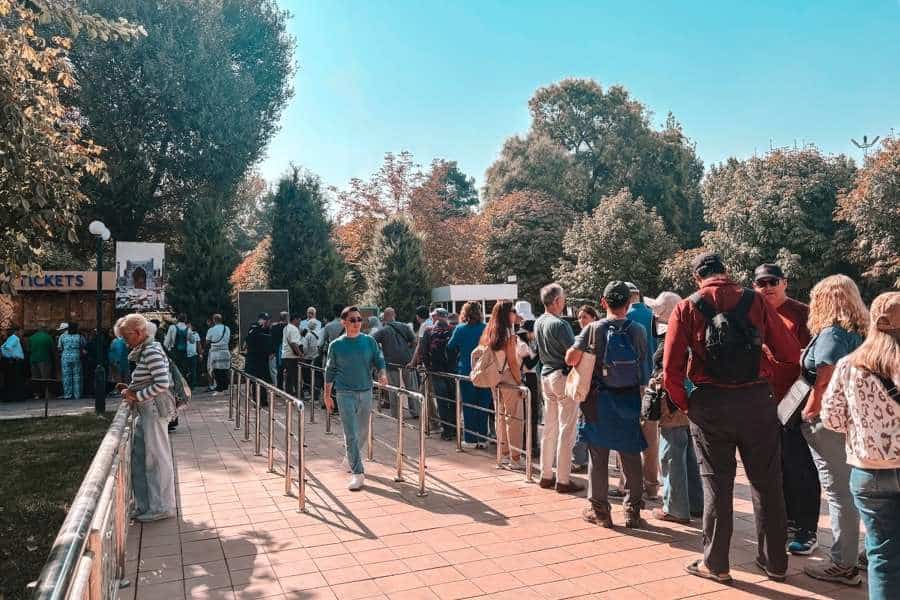
Arrive early (as soon as the gates open) to enjoy the quiet before the tour buses pour in. Opening hours change with the seasons, but it usually begins around 8 am. Tickets cost 100,000 UZS for adults and 50,000 UZS for children (at the time of our visit in October 2025).
If you arrive late, expect queues, and trust me, they move slowly. Since peak season gets crowded fast, buying your ticket online is the smarter option.
Once inside, pause in the center of the square. Don’t rush. Take in the beauty of the trio of madrasas — Ulugh Beg, Tilya-Kori, and Sher-Dor — with their perfect symmetry, the blue-and-gold tiles glowing in the morning light, and the calm that lasts only for the first hour of the day.
Start with Ulugh Beg Madrasa, the oldest. Ulugh Beg, Timur’s grandson, was an astronomer and mathematician rather than a warrior king, and he turned Samarkand into a major center of learning.
Before you step in, admire the main entrance, Iwan covered in star patterns and Kufic calligraphy, a quiet nod to his love for science.
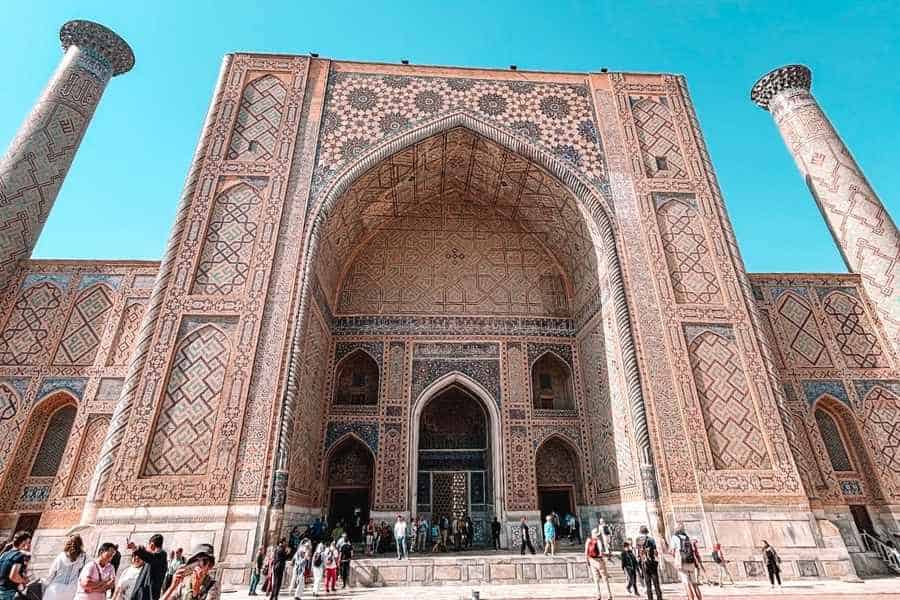
Inside, the decoration is simple, geometric, and more purposeful than ornamental. Look for the star motifs, interlocking patterns, the precise symmetry, and the muqarnas (honeycomb-style designs) ceilings that pull your eyes upward. It feels thoughtful, almost academic.
As you walk around the courtyard, you’ll notice two floors of student rooms lined up in perfect symmetry, one row on the ground floor and another right above it.


The rooms downstairs are open and now used as tiny craft shops run by local artisans. The upper rooms are closed to visitors, but you can still see their doors from below and picture how students once lived and studied here many centuries ago.
Notice the wooden doors, the tucked-away corners, and the calm that still sits in this space. Ulugh Beg’s madrasa feels like the “thinking” part of Registan: quiet, intelligent, and full of purposeful detail.

Next, walk towards Tilya-Kori, the “gilded” madrasa. From the outside, it looks simple, but step into the mosque hall, and it suddenly turns grand, with deep blues, warm golds, and patterns that glow even in dim light. The name makes sense the moment you see the gilded walls.


Inside Tilya-Kori, you’ll also find the small Museum of the History of the Registan Complex. It’s not huge, but it’s a good, quick stop to understand how the square looked in different centuries, how it was restored, and how the three madrasas fit together. If you’re short on time, this is the one place that gives you a neat “Registan in a nutshell” view.
This madrasa was partly used as Samarkand’s central mosque for a while, which is why it feels a bit bigger and richer than the rest. Take your time inside. It’s glowing and beautifully balanced.
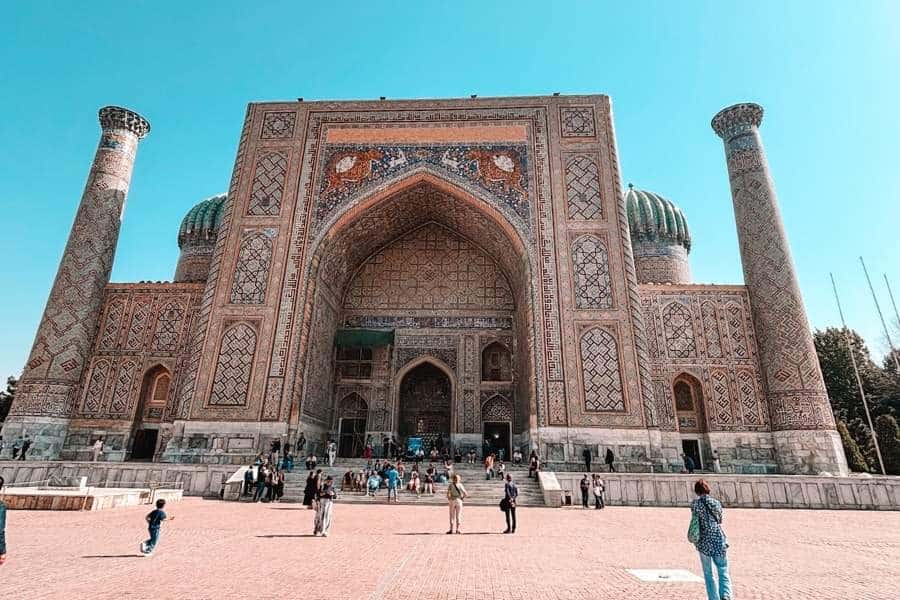
End with Sher-Dor, the one with the famous tigers mosaic on the façade. The giant mosaic tigers, with tiny sun-faced humans on their backs, chasing a white deer, always make people stop and stare.
It’s unusual because Islamic art avoided depicting living beings, yet here they are, boldly sitting on the main entrance. A playful exception that has become Registan’s signature surprise.
Abdullohon shared two stories about the mosaic, and this one stayed with me. The tiger is the student, full of energy and hunger to learn. The deer is knowledge, always a step ahead, the thing you keep running after, no matter how old you get. And that sun with a human face is the teacher, quietly lighting the way so you don’t lose your path.
As per the second pov, the lion-tigers stand for strength, the deer for grace and abundance, and the rising sun for clarity and confidence. Some locals say it even feels like an old Persian and Zoroastrian idea, the victory of light over darkness, or a mind waking up.
Inside Sher-Dor, you’ll find a small room with old photos of Registan showing how it looked before restoration: a quick, quiet peek into its past. Once you hear this, the whole wall starts to feel like a message: keep learning, keep chasing, and keep looking up to those who guide you.
You’ll need about 2 hours to explore Registan Square.
If you only have 24 hours in Samarkand, combine Day 1’s and Day 2’s highlights.
✨ Registan Square during dawn
✨ Gur-e-Amir Mausoleum
✨ Alisher Navoi Central Park
✨ Bibi-Khanym Mosque
✨ Siab Bazaar
✨ Shah-i-Zinda
✨ Hazrat Khizr Mosque
✨ Registan Square during dusk
From Registan, start walking toward Gur-e-Amir. It’s a short, gentle walk, and honestly, the nicest way to take in Samarkand, instead of jumping into a taxi and missing the little moments happening on the streets.
If the weather is warm and your energy is dropping, pause for a quick tea on the way at any small local chaykhana you see along the walk toward Gur-e-Amir. There are always tiny family-run spots pouring green tea and selling samsa.
10 am: Rukhabad Mausoleum & Artisans Center (quick stop on the way to Gur-e-Amir)
Your first quick stop is the Rukhabad Mausoleum, a small, simple brick shrine with a rich history. It’s a peaceful space believed to contain a box with seven strands of the Prophet Muhammad’s hair. One of the oldest buildings in the city, it is the silence that is its charm.
Right next to it is the Samarkand Artisans Center. Step in for five minutes and you’ll see wood-carvers, miniaturists, and ceramic artists working right in front of you. If you have teens, they usually get hooked here because everything feels “hands-on” and not too museum-y.
11 am: Gur-e-Amir Mausoleum


As you walk toward Gur-e-Amir, the first thing you’ll notice is the blue dome ribbed like a giant silk turban rising above the trees. The tiles shift between blues and turquoise, and the star-pattern majolica mosaics shine best during golden hour. It has this calm, steady, emotional, and intimate presence.
This is the mausoleum of Amir Timur, his sons, and grandsons, including Ulugh Beg. It’s not very big from the outside, but once you step inside, the space feels almost sacred.
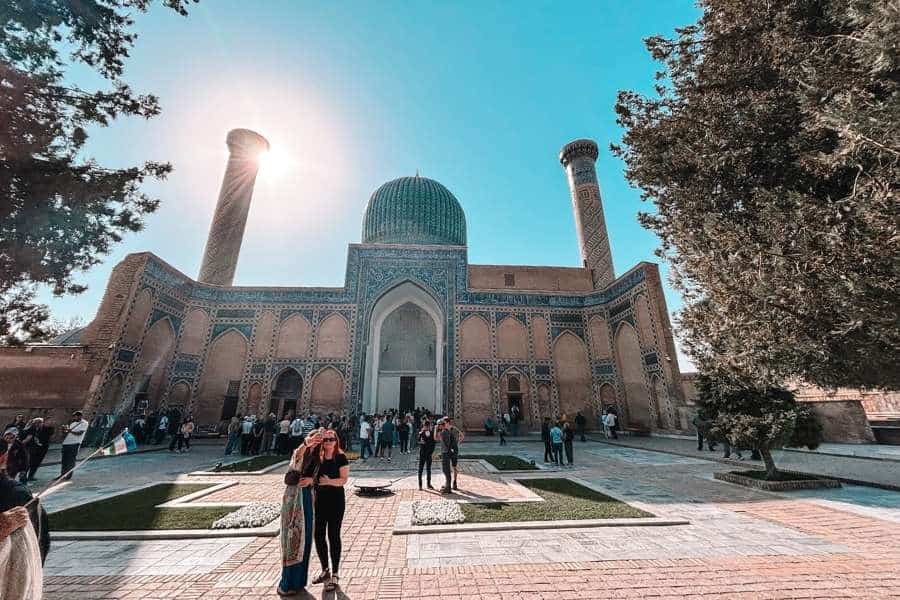
The muqarnas above the doorway, those carved honeycomb layers, look like sculpted spirals frozen in motion.
The hall is cool, dim, and somehow calming, with a high dome painted in gold and lapis lazuli. It glows softly with walls covered in delicate, detailed gilded papier-mâché work, deep blue patterns on the arches, and a gentle light that falls on the tombs in the center.


The honeycomb-style ceiling (muqarnas) creates layers of gold that almost look three-dimensional. It gives the hall a sense of height, but it actually doesn’t have.
In the center, behind a low ornamental fence, are the tombstones of Timur’s family, including his spiritual teacher. Timur’s own marker is the big dark green jade stone. His actual body rests below in a crypt.
Timur’s original mausoleum wasn’t supposed to be here. He had planned to be buried in his hometown of Shahrisabz. But when he died in winter, the mountain passes were blocked with snow, so they brought him to Samarkand instead. That’s how this place became the royal tomb.
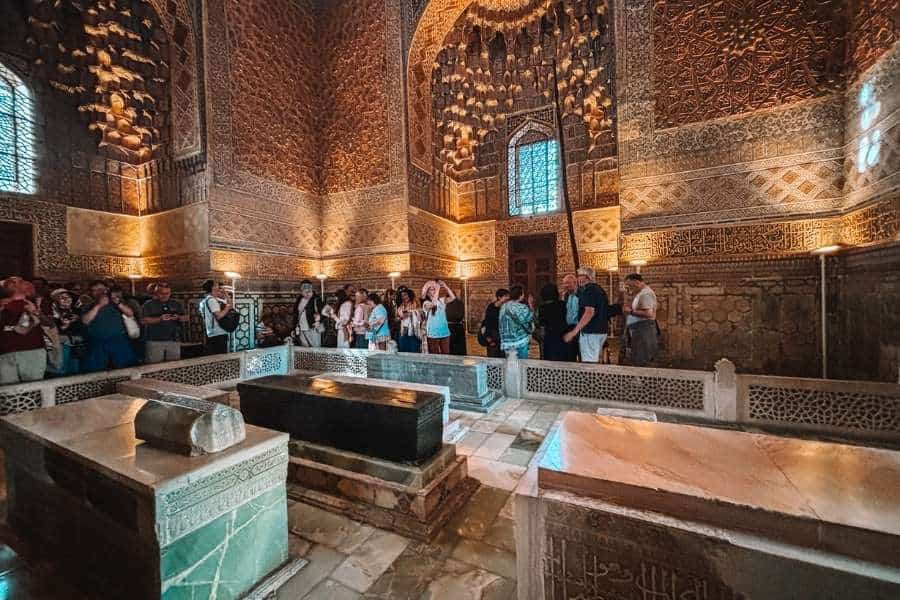
Legend says that Timur ordered a simple stone, but the one you see today (dark green, heavy, polished) became famous later because of a story local guides love to share, the supposed “curse of Timur”.
When Soviet archaeologists opened his tomb in 1941 against local advice, they found an inscription warning: “Whoever opens my tomb shall unleash an invader more terrible than I,” and the invasion of the USSR began the very next day.
When Timur’s remains were reburied with proper rituals in 1942, the tide of the war slowly shifted, and Stalingrad happened. Again, belief or coincidence, but it’s a great conversation starter.
What many visitors don’t realize is just how influential this place was. The Timurid architectural style here: the dome, the geometry, the proportions, the layout, inspired later Mughal masterpieces, including the early ideas that led to the Taj Mahal. You’re basically standing inside the blueprint of India’s most famous monument.
Most people don’t walk to the back courtyard. It’s peaceful and offers a great view of the dome from the back, perfect if you want photos without crowds.
Give yourself 30-40 minutes here. It’s compact, but timeless, powerful, and emotionally rich, one of those places where you automatically slow down without realizing it.
12 am: Aksaray Mausoleum
Just a few steps from Gur-e-Amir is Aksaray Mausoleum: small, peaceful, and usually empty. It looks inconspicuous with plain brick and a quiet dome, but it has a gentle charm that makes the stop worth it.
It was constructed in the early 15th century, most likely for one of Timur’s close relatives, and what makes it special is that it still carries its original Timurid brickwork.
If you look closely at the façade, you’ll see the geometric patterns and glazed tiles in soft blues peeking through the age: the kind of raw, untouched beauty that the heavily restored monuments sometimes lose.
The small cross-shaped hall and side rooms are covered with blue-and-gold paintings on the dome, done in the Timurid kundal style, and glazed mosaic on the walls. A narrow staircase leads down to an octagonal marble crypt with a few tombs.
Spend 15-20 minutes here.
12:30 pm: Walk along University Boulevard → Bul’var → Alisher Navoi Central Recreation Park → Amir Temur Statue + Lunch


Now, slow down a little and enjoy one of my favorite walks in Samarkand.
From Gur-e-Amir, start drifting toward University Boulevard — a long, tree-lined stretch from the old Russian period. It has that gentle, lived-in charm… tall trees, deep shade, tiny book stalls, students rushing to class, office workers on a break — everyday life unfolding right beside you.
This is the part of Samarkand where the city suddenly feels real and human, not just a collection of monuments.
There’s a row of old academic and government buildings on both sides. Many of these buildings, once housing banks and government offices, now belong to Samarkand State University and the city administration, and still show a mix of European-style façades and Central Asian touches.
As you walk, you’ll spot a bright blue building on your left — impossible to miss. That’s the former Russian–Chinese Bank, now a small Museum of Friendship. You can step inside for a quick 20–30 minutes to see simple displays on the old bank and Silk Road trade.
Even if you don’t go inside, pause for a second. Its pastel blue walls, white columns, and old-world curves make it look like someone dropped a pretty European mansion in the middle of Central Asia.


Keep walking and let the city move around you. Grab an ice cream from a street vendor, or pick up dried apricots or nuts from a little pushcart; they’re everywhere on this stretch. If you’re traveling with parents or teens, this walkway is perfect; no rush, no traffic noise, just easy strolling.
The boulevard blends into Bul’var, a local hangout spot with more trees, benches, and families enjoying the day.
Next, you step into Alisher Navoi Central Park, also called the Square of Poetry. It’s leafy and relaxed, with statues and murals celebrating poets, writers, and old legends. You’ll see colorful tile panels tucked between the trees, and little sculptures here and there.
End your walk at the Amir Temur Statue, where he’s seated on a throne: calm, regal, and watching over the whole roundabout along the University Boulevard.
Note: Consider a break at Boulevard Restaurant & Bakery (University Blvd, 1) for lunch; right on the same stretch, easy to reach, and good, simple food. If you want something calmer, Oasis Garden is a lovely leafy spot. For a more local, homestyle meal, Old City Restaurant is a solid choice.
8 pm: Sound & Light Show at Registan Square

From the Amir Temur Statue, start drifting back toward Registan the same way you came.
You can walk the whole stretch in about 15–20 minutes, but if your legs are done for the day, call a quick Yandex. I like walking here; the shift from Soviet blocks to old domes feels like the city slowly changing its outfit as you move closer to the old town.
If you need a little caffeine or sugar boost, there are many small cafés and kiosks near the square. Places like Magistr, tucked between Registan and Gur-e-Amir, are handy for a quick coffee or tea and a snack without wandering too far from the view.
There is also a small coffee and gelato stand near the viewing terrace where people happily sit with paper cups staring at the madrasas as the lights come on.
Reach Registan while there’s still daylight. We got there around 5.30 pm, picked up our coffee, and sat on the steps near the retractable metal fence outside the ticket gate. This whole area is free and open to everyone.
Sit here for a while and let the evening settle in. As the sun drops, the blues turn deeper, the gold begins to glow, and the whole square softens in the prettiest way.

Just behind the steps is the raised viewing terrace, my favorite spot. You get the entire ensemble in one frame, plenty of space to stand, and move around for a better experience. For me, it’s the best place to watch the light show.
If you want to experience the show from inside the square, you can buy an evening ticket at the gate and sit on the chairs arranged facing Tilya-Kori.
Once it gets dark, the real show begins. The sound-and-light show usually starts between 8 and 9 pm, depending on the season, a little earlier in winter and later in summer, and some nights there is an extra 3D laser segment afterward.

That evening, we waited on the terrace till 8, but the show started a little late due to a technical issue. Watching Registan slowly light up while we waited was half the experience.
The show itself was lovely — lights, music, and stories projected onto the three madrasas. The buildings light up one by one, patterns shift, domes glow, and for about twenty minutes, the whole square turns into a live storybook of Samarkand’s past.
The only drawback for us was that the narration was in Uzbek, so we couldn’t fully understand the tale. But the visuals gave us the idea. Since we’re from India, where many forts and palaces run spectacular light-and-sound shows (and offer both English and Hindi versions), this felt familiar.
One important thing. The schedule can shift, and the show does not run every single night in the low season. Some evenings, it depends on tour groups or special events. The easiest way to avoid disappointment is to ask at the Registan ticket office or your hotel in the morning what time the show is planned for that day.
9:30 pm: Dinner
End your day with a local dinner. You can walk a few minutes to a restaurant with a cosy courtyard or a rooftop view of Registan, such as Emirhan Restaurant, which is famous for its traditional food and night views of the domes.
Or end the night the simple way. Sit for a few extra minutes on the steps, hold your tea or ice cream, and let that lit-up square sink in. Day one has done its job.
Day 2: The Soulfuls
Start your second morning with a quick breakfast at the hotel and head out early. Shah-i-Zinda feels its best when the city is still quiet, and the blue tiles catch the first light.
8:00 am: Start Early at Shah-i-Zinda Necropolis

If Samarkand has a place that quietly grabs your heart, it’s Shah-i-Zinda. This remains my favorite monument in Uzbekistan!
Come early. PLEASE.
This place gets crowded, like really crowded.
The gates usually open around 8 am, and those first quiet minutes feel like pure gold. You’ll have some peaceful space to breathe and admire the details. The tour groups arrive fast, and trust me, once they enter, the magic gets diluted.
Selfie sticks, tour guides calling loudly, big groups marching past, all of that starts after 9 am. So please, please go early. 8 to 8:30 AM is perfect.
The mausoleums face east, so the first sunlight hits the tiles gently. The blues glow softly without being too bright. If you come late, the tiles get a bit harsh under direct sunlight, and the whole lane gets noisy. Early morning is where the magic lies.
Shah-i-Zinda is basically a long, narrow corridor of mausoleums climbing uphill, each one covered in blues that look freshly painted by the sky itself. Turquoise, cobalt, ink blue, sea, soft cloudy blue, and a few shades that probably don’t have names yet.


Right at the start, there is a staircase that everyone must climb. BTW, climb slowly; the steps are steep.
Before you start climbing the steps at Shah-i-Zinda, remember one thing. This is an active pilgrimage site. You’ll see locals coming here to pray, touch the tiles, whisper wishes, and walk slowly with great devotion. So keep your voice low, skip the dramatic photo shoot poses, and dress a little modestly out of respect.
Our guide told us a fun Samarkandi belief: If you count the steps while going up and then count again while coming down, and the number matches, you’re a good person. If the numbers don’t match, well… Samarkand has judged you.
Of course, hubby and I took this way too seriously and counted like our whole reputation depended on it. Luckily, our numbers matched, so now we walk around proudly deciding we’re “officially good people certified by Shah-i-Zinda.” If your number doesn’t match, please don’t panic. Just blame the crowds 😉


The complex has more than 20 tombs and mausoleums, built between the 11th and 19th centuries, mainly by the Timurid royal family and elite women of the court. Many of them belong to unnamed aristocrats, ministers, generals, and scholars from the Timurid era.
Some of the notable structures include Shirin Bika Agha Mausoleum (Timur’s sister), Shadi Mulk Aka Mausoleum (Timur’s niece), Tuman Aqa Mausoleum (Timur’s wife), and Kusam ibn Abbas Mosque & Tomb Chamber (important religious shrine).


But the most important and sacred shrine sits right at the beginning of the complex. It’s the tomb of Qutham ibn Abbas, the first cousin of Prophet Muhammad. Locals believe he did not “die” but “went to live eternally,” which is why the complex is called Shah-i-Zinda — The Living King.


When we visited, a few of the most beautiful mausoleums, especially some of the upper ones, were covered in scaffolding. Restoration was underway, so we couldn’t step inside some chambers I really wanted to see.


Honestly, it felt a bit disappointing for two minutes, but when you realise they’re protecting 600-year-old tiles from humidity and the passage of time, it feels justified.
Still, I’d say: check if any sections are closed during your visit.
Give yourself 1.5 hours here. Unless you’re completely smitten with blue tiles like me, add another half an hour.
9:30 am: Visit Hazrat Khizr Mosque

From Shah-i-Zinda, you can either walk downhill for about 10–12 minutes or take a quick Yandex if the sun is intense or your legs need a break. Both ways are easy.
Hazrat Khizr Mosque sits on a small hill, so before you even step inside, you get a wide, pretty view of Samarkand: domes, rooftops, and the city stretching out quietly below.

It’s one of the oldest surviving mosques in Samarkand, dating to the 7th–8th centuries, though it has been rebuilt many times.
The earlier structure was destroyed during Genghis Khan’s invasion in 1220, so the mosque you see today is a later reconstruction. The present version is from the 19th century, restored after independence.


Our guide told us it’s named after Khizr, the legendary wandering saint who protects travelers and shows up when you least expect him. So locals come here for prayers, blessings, and a little hope.
Inside, the mosque feels warm and intimate: red-painted wooden beams, delicate floral patterns, and soft light coming in from the courtyard.
If you go around late morning or just before sunset, the light makes the red interiors glow beautifully.
30 minutes would be enough here.
Note: On the hillside below Shah-i-Zinda, near this mosque, is the upper stretch of the old Bukharan Jewish Mahalla. You can even spot the Jewish Cemetery from the Shah-i-Zinda Observation Deck, a quiet patch of history tucked into the slope. The lower part of this mahalla, with its lived-in lanes, synagogue, and old hammam, sits closer to Siab Bazaar and Bibi-Khanym. You’ll explore that later in the day, but it helps to know how the neighborhood hugs this whole hill.
10 am: Check out the Islam Karimov Mausoleum
Just outside, right next door, in the lower courtyard, is the mausoleum of Islam Karimov, Uzbekistan’s first president.
The building is simple, white, and beautifully maintained, and people stop for a moment as they pass. You can walk in and take a peaceful loop around the memorial garden. You can easily spend 10–15 minutes here.
10:10 am: Walk to Siab Bazaar (Siyob Bozori)

From Hazrat Khizr Mosque and Islam Karimov Memorial, it’s a short 5–6 minute downhill walk to Siab Bazaar. You’ll cross a small pedestrian bridge on the way. Once you step off it, the buzz of the market starts to hit you.
This is Samarkand’s living, breathing market. Everything is here: melons, nuts, pickles, spices, halva, pomegranate juice, freshly baked non-bread, pistachios, mulberries, saffron, dried fruit rolls, local souvenirs, and even small household things.
If you visited Chorsu Bazaar in Tashkent earlier, this one will feel a bit different. Siab is cleaner, prettier, and a little more tourist-polished, the kind of place built to impress visitors as much as it serves locals.

It’s lively, but it doesn’t have that raw everyday chaos Chorsu has. Still, it works. It’s bright, organized, photogenic, and fun to wander through.
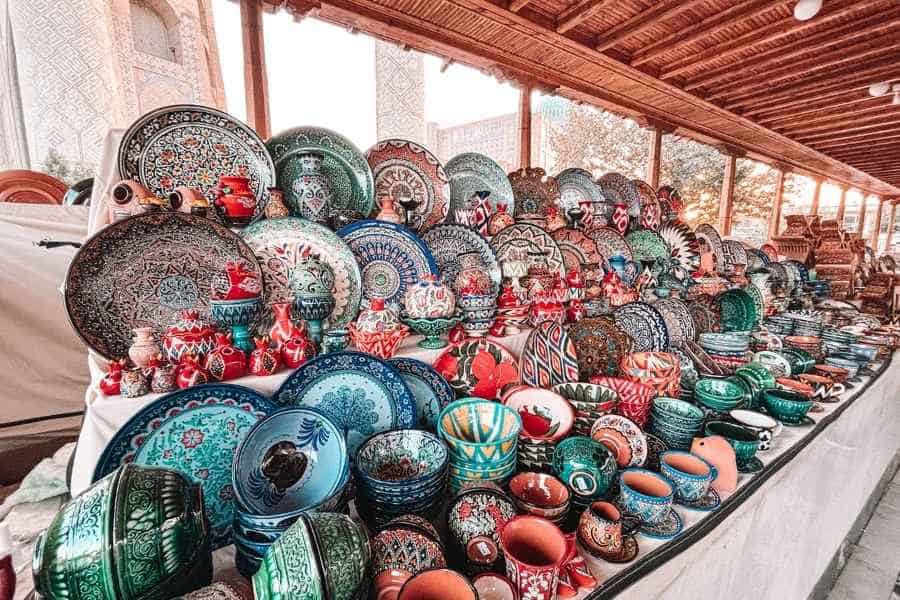
You’ll also see artisans showing their work: painted magnets, ceramics, carved wooden pieces, and embroidered souvenirs. Prices vary a lot.
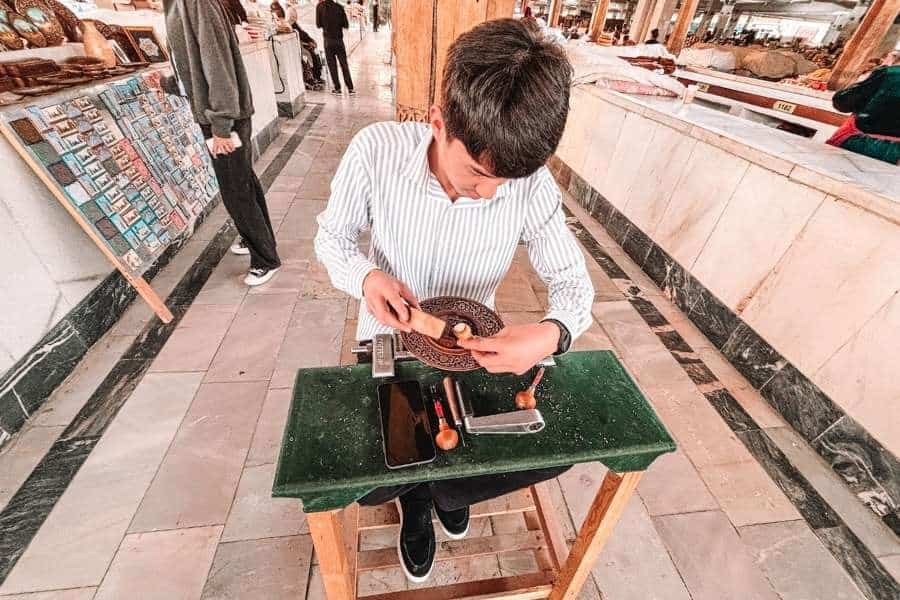
Someone quoted us 2,500–3,500 UZS for a handmade magnet, and just a few steps deeper inside, another seller agreed to 1,500 with a smile. So don’t stress about “getting the best deal.” Buy what you like, enjoy the interaction, and ride the market’s mood.
Wander freely for 45–60 minutes.
11:15 am: Explore Bibi-Khanym Mosque

From Siab Bazaar, reaching Bibi-Khanym Mosque is the easiest part of your day; they’re practically neighbours.
Walk out from the main entrance of Siab Bazaar, turn slightly left, and follow the wide pedestrian-friendly path lined with small stalls and fruit sellers. The blue dome of Bibi-Khanym starts peeking at you almost immediately, so you won’t get lost even if you try.

It’s a straight, gentle 3–4 minute walk. By the time you finish that last bite of non or dried apricot from the bazaar, you’ll be standing right in front of one of Timur’s grandest creations.
You’ll see Bibi-Khanym long before you reach its gate. It’s massive. Like really massive.


In its time (late 1300s to early 1400s), this was one of the largest mosques in the entire Islamic world. Timur wanted something that would make visitors gasp the moment they entered Samarkand, and this was his way of saying, loudly, “Welcome to my empire.”
After returning from his India campaign (1398), Timur was in one of his “I shall build something the world has never seen” moods.
He had brought back wealth, craftsmen, and architects, and he wanted a mosque so grand that even the sky would look small above it.
Construction started around 1399, and thousands of workers and artisans were brought in. Some say the workforce included 95 elephants brought from India to move heavy materials.


The artisans themselves came from everywhere Timur had conquered — Persia, Azerbaijan, Khwarezm, India, even parts of modern-day Iraq and Afghanistan. Each group brought its own style of tilework, calligraphy, and design, which is why the mosque looks like a mix of many traditions instead of just one.
It was built fast, too fast, because Timur kept pushing for bigger domes, higher arches, more decoration, you know how emperors get when they’re inspired.
According to another popular legend, Bibi-Khanym (Timur’s favorite wife) wanted to surprise him by gifting this mosque while he was away. She hired a brilliant, young architect who fell in love with her. He refused to finish the mosque unless Bibi-Khanym allowed him one kiss.
She kept refusing, but he said, “Without the fire of love, no masterpiece can be completed.” Finally, running out of time, she agreed. The kiss left a mark on her cheek.
When Timur returned and saw the mark, the story unraveled. Timur, furious, punished the architect; entombed him inside the mosque walls themselves, and ordered all women of his court to wear veils. Yes, this legend is one of the folk explanations for face veils in the region.
It’s folklore, yes, but once you know it, you can’t help looking at the arches with a little more curiosity.
Timur pushed for an impossible scale. The central dome was so large that the foundations cracked under the weight within a few years. By the 17th century, the mosque was already partly ruined. Earthquakes didn’t help.
A major reconstruction began in the Soviet period and continues to this day. Some parts are restored beautifully. Some still feel fragile. That’s precisely why it feels real — grand yet human, beautiful yet imperfect.

When you stand in the middle of the courtyard, Bibi-Khanym feels like a giant theatre: huge, dramatic, a little broken in places, slightly imperfect, which makes it even more beautiful, and full of stories. Some walls lean, some tiles look newer than others, some arches seem too ambitious for their own good.
BTW, stand slightly off-center when you enter: that’s the best photo angle, where the arch, dome, and courtyard line up perfectly.
The central entrance arch (the pishtaq) is towering, heavily restored, and still feels like it’s trying to outdo the sky. The scale hits you the moment you walk in.
Right in the courtyard sits a massive stone lectern (rehal) built to hold a massive Qur’an. Locals believe sitting under its shadow brings good luck. Some even believe that women who struggle to conceive may be blessed with pregnancy if they pass under its shadow.
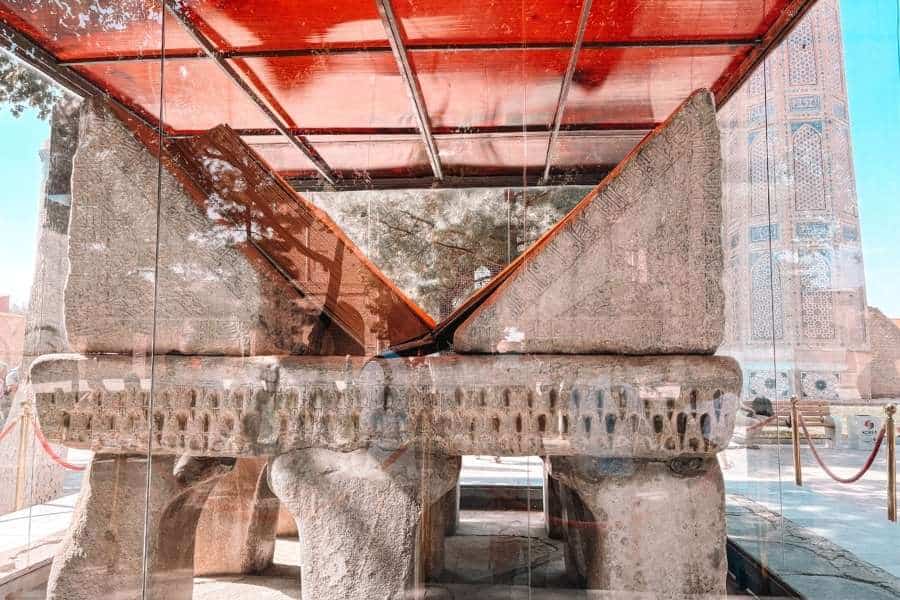
The main mosque hall is closed to visitors. It’s still in ruins, with stones and old brickwork waiting for proper restoration, so you can only admire it from the outside.
The side prayer halls have gorgeous mosaic details, deep blue tiles, and delicate patterns. Stand under the smaller domes and look up; the geometry is stunning.


Even with restoration, the dome of the central mosque still looks powerful. In Timur’s time, they said it was “so large it made the heavens jealous.”
At least spend 45 minutes here.

Directly opposite the mosque stands the Mausoleum of Bibi-Khanym. It’s smaller and more secluded than the central mosque, but beautifully detailed. This is where Bibi-Khanym is believed to be buried. It’s not as grand as the mosque, but it completes the complex’s story and is worth a quick stop.
12 pm: Tea Break or Early Lunch or Both, If you are me 😉

By now, you’ll want a little pause, either a proper tea break or an early lunch, depending on how your morning felt.
Bibikhanum Teahouse, right next to the mosque, is perfect for both.
If you’re in a tea mood, order a pot of spiced black tea with parvarda (Uzbek milk-based soft candy), pestil (grape-fruit sheet), and nuts dipped in grape syrup—simple, sweet, and very Samarkandi.
If hunger kicks in, they also serve simple Uzbek meals that hit the spot without slowing you down.

A few steps away, Zargaron Restaurant is a traveler’s favorite: cozy Uzbek dishes, indoor and outdoor seating, and a nice break from the heat.
If you prefer something quieter, Bibikhanum Hotel Restaurant and Ikat Boutique Café offer a mix of Uzbek and European dishes, plus good coffee for a caffeine boost.
For something more local and less touristy, Sayqali Samarkand Chayhana is just a short walk away.
And if you want a pretty courtyard setting, Old Havuz Restaurant is a tiny detour but a lovely lunch choice.
Give yourself 45 minutes to 1 hour here before you move on.
1 pm: Happy Bird Art Gallery
Just a short 5–7-minute walk from Bibi-Khanym, in the little streets around the mosque, you’ll find Happy Bird Art Gallery. It’s a bright, cheerful space filled with colorful prints, ceramics, postcards, and modern Uzbek art.
Even if you’re not planning to buy anything, it’s worth stopping for 10–15 minutes to enjoy the colors and creativity. The place has that warm, friendly vibe you get in small, local studios — nothing fancy, just genuine art and artists.
If you’re interested in Persian-Timurid-style miniature painting, you’ll see a few artists working in nearby lanes too (they don’t really show up on Google, so it’s best to ask around).
Most still paint with ultra-fine brushes, gold dust, and natural pigments, fascinating to watch even for a few minutes.
Expect to spend 20–25 minutes here before you continue.
1:30 pm: Samarkand’s Traditional Ice-Cream Parlor (Plombir Time!)
Walk to the nearest “Morojniy” stall. Ice Cream Muzqaymoq (Islam Karimov 39) is about 50 meters from the Happy Bird Art Gallery.
Plombir is creamy, old-style Soviet ice cream, simple, milky, and nostalgic. Try the plain vanilla or chocolate swirl. Teens love it, adults love it more. Perfect for a warm afternoon.
2 pm: Quick Stop at the Statue of Islam Karimov

It stands in a small landscaped square just behind Bibi-Khanym Mosque, only a minute or two from Happy Bird Art Gallery.
The statue is tall, polished, and placed against a beautiful tiled backdrop, very Uzbekistan in its style.
Locals come here for photos, schoolkids gather around it on field trips, and it’s usually calm enough to pause for a moment before heading into the older lanes.
2:30 pm: Explore Muborak (Mubarak) Mahalla or Old Jewish Quarter
Next, slip into Mubarak Mahalla, one of Samarkand’s oldest neighborhoods.
The lanes here are narrow and restful, with blue doors, old courtyards, and that lived-in calm you don’t get in the busy tourist areas.
This mahalla is the heart of the old Bukharan Jewish community, which lived here for centuries. They spoke Bukhori (a Judeo-Tajik language), kept their own traditions, ran local shops, and were entirely woven into the daily life of Samarkand.
Even today, a few Jewish families still live here, and the neighborhood carries traces of that past, a synagogue tucked inside the lanes, the doorway of the old hammam, and the path leading up toward the Jewish Cemetery on the hill.
The cemetery itself sits on the upper slope below Shah-i-Zinda. If you noticed a peaceful, walled section from the viewpoint earlier, that was it. Generations of Bukharan Jews are buried there, many with beautifully carved gravestones.
You’ll also pass the little Muborak Mahalla Mosque, a placid neighborhood mosque that blends into the homes around it, the kind where elders sit outside chatting, and life moves at its own slow pace.
4 pm: Hammom Davudi (Traditional Bathhouse)
From the mahalla mosque, it’s a short walk through the narrow lanes to Hammom Davudi, one of Samarkand’s oldest neighborhood bathhouses. This isn’t a polished spa-kind experience. It’s raw, warm, and wonderfully old-school.
Families in this area have been bathing here for generations. It’s rustic, a little steamy, occasionally chaotic, and authentic. Male and female guests have separate timings, and the attendants guide you through the steps with that solemn Uzbek energy.
If you’re in the mood for it, go in for a scrub and steam. If not, even a brief look around the entrance gives you a sense of how deeply rooted these community spaces are.
Spend 45–60 minutes.
5 pm: Samarkand–Bukhara Silk Carpets Factory
Take a 10–12 minute walk to the Samarkand–Bukhara Silk Carpets Factory.
If your 14-day Uzbekistan route doesn’t include the Fergana Valley (the real heartland of Uzbekistan’s silk), visiting a silk factory here is actually a lovely way to experience a slice of that tradition without traveling far.
You see everything from silk threads being dyed to women knotting carpets by hand and patterns forming stitch by stitch. It gives you a whole new respect for the carpets you casually admire in shops.
If you prefer something smaller and more intimate, try one of the family-run silk weaving workshops nearby. These are usually tucked inside homes, warm and welcoming, and the women weaving there often share little stories while they work.
45–60 minutes are good here, depending on how much your heart gets pulled by handmade things.
6:30 pm: Early Dinner at Samarkand Plov Center (Osh Markazi)
Take a 10-minute Yandex ride to Samarqand Osh Markazi.
This is the ultimate spot for Samarkand’s signature plov, made in huge kazan pots. They serve until the pot runs out, so go on time.
Order plov (obviously), Achichuk salad, and Ayran or chay. Even if you’re vegetarian, ask for the “bez miasa” (no meat) version.
Day 3: The Localish
Today is for all the corners people skip while running after the “top 10 places” list. This side of Samarkand feels older, calmer, and a little bit hidden, like the city finally takes a breath and lets you walk with it.
9 am: Ulugh Beg Observatory

Take a quick Yandex from your hotel and head to the quiet hilltop where Samarkand once looked up at the stars rather than its domes: Ulugh Beg Observatory.
This is where Timur’s grandson, Ulugh Beg, studied the stars 600 years ago. He was unusual for a ruler of his time. While most kings were busy expanding borders, he spent his nights studying the sky, teaching astronomy, and writing star tables with his students.
He gathered the best astronomers of his time, taught them himself, and created a center that was far ahead of its time.


The observatory once had a massive, circular above-ground tower, but most of it was destroyed in the 16th century. What survives today and what you’ve come to see is the underground part of his gigantic sextant, the curved brick arc used to map stars with surprising accuracy.

It was a 40-meter-long instrument whose calculations were so precise that later European astronomers admired them centuries later.
The museum is small but interesting, where you’ll see models of how the observatory looked, old manuscripts, diagrams, and a short display on Ulugh Beg’s star catalog, the Zij-i Sultani, which mapped more than a thousand stars and stayed one of the best astronomical works in the world for nearly 200 years.

The surrounding grounds are peaceful, with a few trees, benches, and a sense of space that feels different from the busy city. There’s also a statue of Ulugh Beg nearby, calm and scholarly, holding a book rather than a sword, which tells you everything about the kind of ruler he was.

Give yourself about 45 minutes here. It’s compact, but if you love stories of science and curiosity, this is one of the most meaningful stops in Samarkand.
10:00 am: Afrasiyab Museum & Ancient Settlement Ruins

It’s just a 5-minute taxi ride from the Observatory, and suddenly you’re standing in the oldest chapter of Samarkand.
Afrasiyab is where ancient Samarkand lived long before Timur, long before the blue domes, long before the Silk Road became famous. This was the heart of the old Sogdian city, a place that thrived from the 6th century BC until 1219, when Genghis Khan invaded and burned it to the ground.
After that destruction, people slowly moved south, and the Samarkand we see today grew around the Registan area. The museum sits right at the edge of these ancient ruins.
From outside, the hills look plain and sandy, but once you know the story, you start seeing them differently. These mounds are the “old bones” of Samarkand.
Inside the museum, everything is quiet and straightforward, but the Afrasiyab fresco is the star. This 7th-century mural, discovered by accident in the 1960s, depicts Sogdian kings, foreign ambassadors, riverboats, Chinese princesses, hunting scenes, and everyday moments.
It’s one of the most critical discoveries in Central Asia because it shows how connected Samarkand was even back then. The fresco room is climate-controlled and dim, so the colors stay safe.
A guide here really helps, because every small figure on the mural has a story: who they are, what they’re carrying, where they came from, and why they matter. The fresco becomes ten times more interesting when someone explains the tiny details.
The other galleries display pottery, coins, burial objects, and models that explain how ancient Samarkand looked before the Mongol invasion.
Outside the museum, you can walk a little around the ruins, gentle sandy slopes, broken walls now covered in grass, and a quiet view of the city. It feels peaceful and untouched.
It can take anywhere from 1 to 1.5 hours to explore the ruins.
11:45 am: Khoja Abdi Darun Shrine
It’s just a short 5-minute taxi ride from Afrasiyab.
Khoja Abdi Darun is one of Samarkand’s oldest and most respected shrines. It’s built around the 9th-century grave of Abd-al Mazeddin (also known as Khoja Abdi), a well-known Islamic jurist and scholar. “Darun” means “inside the city,” because the second related shrine (Abdi Birun) stands outside the old city walls.
The complex grew over centuries, so what you see today is a mix of time layers. In the 15th century, a central ziyarat hall was added around the tomb. The 19th century added a small mosque, a minaret, and an aivan, that beautiful raised wooden platform with carved pillars you’ll notice near the pond.
Speaking of the pond, locals say its water comes from a natural spring and once had healing qualities. Today, people sit around it, feed the ducks, or make wishes.
As you walk around, you’ll spot hand-painted ceilings, old brick patterns, and a few small rooms with relics and displays about the saint. It’s still an active spiritual place, so dress modestly and move quietly.
You can easily spend 20–30 minutes here.
12:30 pm: Mausoleum of Khoja Daniyar (Prophet Daniel)
A 6–7 minute taxi ride from Khoja Abdi Darun takes you to one of Samarkand’s most unusual and deeply loved shrines.
The mausoleum has been rebuilt many times, most recently in the 20th century, but it still feels humble and calm.
Here’s the tomb of Khoja Daniyar, known in different traditions as Daniel, Daniyar, or Doniya. That’s what makes this place special. Muslims, Jews, and Christians all believe he was a holy man, so you’ll often see people from different backgrounds beautifully sharing the same space.
The first thing you’ll notice is the tomb itself. It’s long. Very long. Much longer than any human body could be.
Local legend says the saint’s body keeps growing, so the tomb has been extended multiple times across the centuries. Whether you take it literally or see it as a sign of respect, it does add a sense of mystery.
There’s also a little story web around this place, depending on whom you ask. Some people believe Khoja Daniyar is the biblical Prophet Daniel, the same Daniel known for his wisdom and visions, and that he is a descendant of King David and King Solomon. That’s why you see visitors of all three Abrahamic faiths here.
Another version says the tomb belongs to a local saint, also called Khoja Daniyar, who lived much later. He was believed to be a close companion of Kusam ibn Abbas, the cousin of Prophet Muhammad, who brought Islam to this region. In this version, Daniyar was an early Islamic scholar whose burial site became a place of blessings for local people.
There’s another story locals love: Timur supposedly brought back a relic of Daniyar, a part of his remains or his hand bone, after a military campaign, hoping it would bless Samarkand with prosperity.
When they buried it here, a spring appeared at the foot of the hill. That small stream still flows today, and people consider it blessed.
Locals don’t argue over which version is correct. They accept all of them because the place’s feeling matters more than the technicalities.
Outside the shrine stands a vast, ancient pistachio tree: twisted, old, full of character. People tie ribbons to its branches and whisper wishes, believing the saint’s blessings travel through the tree. Our guide told us, very seriously, that “the tree never dries because Daniyar watches over it.”
Spend 20–25 minutes here.
12:45 pm: Ishratkhana Mausoleum
Ishratkhana sits a few minutes away, tucked away in a neighborhood where kids play cricket-style games and grandmothers sit outside their gates.
The mausoleum looks half-broken at first glance, a giant Timurid shell with collapsed domes, exposed brick, and traces of blue tiles hanging on like memories. But that’s precisely what makes it fascinating.
Built in the 1460s, Ishratkhana was commissioned during the reign of Abu Sa’id, the Timurid ruler and a grandson of Miranshah (Timur’s son).
Most historians believe it was meant to be a royal mausoleum for women of the Timurid dynasty, possibly the resting place for princesses or noblewomen, a rare dedication in Central Asian architecture.
Time and earthquakes haven’t been kind to it. A large part of the dome collapsed long ago, and the inner chambers stand open to the sky.
Though if you look closely, you still see the elegance that once defined it: the carved muqarnas inside the arches, the remains of floral frescoes, and the geometric brickwork typical of the late-Timurid period. It feels like walking into something unfinished and intimate.
There’s no crowd here… no queues… just a hauntingly calm space that helps you imagine what Samarkand’s monuments looked like before restoration teams stepped in.
Gorgeously Raw. Wonderfully Historic. Beautifully Imperfect. Places like Ishratkhana are slowly disappearing in Uzbekistan, especially with the fast-paced restoration and tourism push.
Give it around 20 minutes.
1:15 pm: Lunch Break
Stop at Oshqand for lunch. It sits right on the way from the Ishratkhana Mausoleum to Meros.
The place is clean, modern, and known for good Uzbek staples such as soups, salads, kebabs, and their namesake “osh” (plov-style rice dishes).
Portions are decent, prices are reasonable, and it’s perfect for sitting for a bit, cooling down, and resetting before continuing your day.
You’ll reach in 7–8 minutes by Yandex from Ishratkhana, and from Oshqand, the ride to Konigil Village is another quick 10–12 minutes. Perfect midpoint.
3:00 pm: Meros Paper Mill (Konigil Village)
At Meros Paper Mill, they make traditional Samarkand paper using mulberry bark, precisely the way it was done centuries ago, without machines, with water wheels, wooden tools, and a lot of patience.
Someone will usually walk you through the whole process, from stripping the mulberry bark to boiling it, pounding it into pulp, lifting those delicate sheets out of the water, and drying them in the sun. The polishing process is surprisingly fun to watch. They use smooth stones and even shells to give the paper the soft sheen for which Samarkand was once famous.
With shady trees, flowing water, small bridges, and little corners where you can sit with a pot of tea and breathe, the garden around the mill is lovely. The river wheel turning beside you adds its own calming soundtrack.
There’s a small shop where you can pick up notebooks, bookmarks, journals, and postcards made right here. The prices are fair, and buying something supports the artisans, so you don’t feel bad about indulging.
Give yourself around 1–1.5 hours.
4:45 pm: El Merosi Theater of Historical Costumes
Reaching El Merosi is easy, about 10 minutes from the city center or roughly 20 minutes if you’re coming straight from Konigil after the Paper Mill.
El Merosi is one of Samarkand’s most unique experiences. Not your regular theater; their entire focus is on bringing Uzbekistan’s history to life through costumes, music, and movement.
You’ll see everything from Sogdian nobility and Silk Road traders to Timurid royals and traditional village outfits, all presented as a timeline of how people here dressed across centuries.
The performances feel more like a visual story than a play. There are no dialogues or complicated plot, only music, dance, and beautifully recreated costumes that show how rich and diverse Samarkand’s past really was. If you’re into culture and history, like us, it hits all the right notes.
Shows usually happen late afternoon or early evening, and the times often change, so confirm beforehand.
If you happen to visit on a non-show day, there’s still a small exhibition area where you can see many of the costumes up close: fabrics, embroidery, headgear, jewelry. It’s not as immersive as a live show, but it’s still worth walking through.
If you manage to catch the performance, set aside about an hour. If you’re only exploring the exhibition, 20–30 minutes is enough.
El Merosi wraps up the day beautifully: very “Samarkand”.
6:15 pm: Early Dinner
By this time, you’ll be ready to sit down and eat something comforting. Luckily, this part of Samarkand has some great spots nearby.
Samarkand Restaurant is the easy pick if you want classic Uzbek food in generous portions.
If you want something a little more polished, Platan is a lovely choice. Cozy lighting, nice ambiance, and a menu that balances Uzbek and European dishes really well. We liked this one for a calmer, slower dinner.
Suzani Café is another option: warm, colorful, and homey, with simple dishes and good tea.
Day 4: The Beyond and the Modern Side
Today is your bonus day, the one that fixes regrets, repeats favorites, or adds something completely different. Samarkand has enough around it to fill a fourth day, but it also has enough inside it to make re-visits feel just as special.
Morning: Half-Day Trip to Shahrisabz
We set off for Shahrisabz around 8 in the morning with our guide, Abdullohon, who had already promised us “mountains, stories, and a little drama.”
The drive is worth waking up early for. Samarkand slowly fades behind you, and the road begins curling through the Zerafshan mountains, with villages tucked into the slopes and shepherds appearing out of nowhere like moving dots on the hills.
Somewhere on this route sits Teshik-Tosh, a rocky, cinematic-looking gorge that locals are very proud of. A part of the old Hollywood movie “Apachen (The Apaches)” was shot here, and once you see the cliffs, you won’t doubt it. It looks nothing like Uzbekistan for a second, more like a cowboy set where someone might suddenly ride out on a horse.
Abdullohon stopped here for us to stretch our legs, breathe in the cold mountain air, and, of course, get a photo that looks like you’ve traveled much farther than you actually did.
The drive continues toward the Takhtakaracha Pass, which honestly feels like someone kept upgrading the scenery every few minutes. At one of the bends, there’s a tiny local market, just a row of stalls with dried fruits, nuts, and snacks that locals swear by.
This is where our guide insisted we try qurut, those little white, salty cheese balls that Uzbeks snack on like we snack on chips and popcorn. They’re basically dried yogurt mixed with salt, rolled into marbles, and left to harden under the sun. Super traditional. Super local.
He popped one into his mouth like it was a chocolate truffle. We tried, and let’s say our taste buds were not ready.
It’s very salty, so salty that we quietly reached for water while our guide happily ate a second one and said, “This is my favorite snack.”
I guess Uzbeks have lovingly built their taste for it over generations. We tried, we nodded politely, and then quietly opened our packet of peanuts, because nothing else on that table suited our very Indian taste buds.
Closer to Shahrisabz, you pass Kitob, a quiet mountain village with a viewpoint. The mountains here naturally form a shape locals say resembles an open book, which is probably why the town is called Kitob (book).
You might need a little imagination, but once you see it, you can’t unsee it. It’s a cute stop and gives you that small thrill of discovering something most tourists zoom past.
The drive to Shahrisabz felt like slipping out of Samarkand’s polish and stepping into the raw, old heart of Uzbekistan. Abdullohon, told us this was the land where Timur was born, raised, and shaped, so naturally, everything here feels heavier with history.
The moment we entered the city, I understood why people say Shahrisabz still has “soul.” It’s less restored, less shiny, less “Instagram-made,” and somehow more alive.
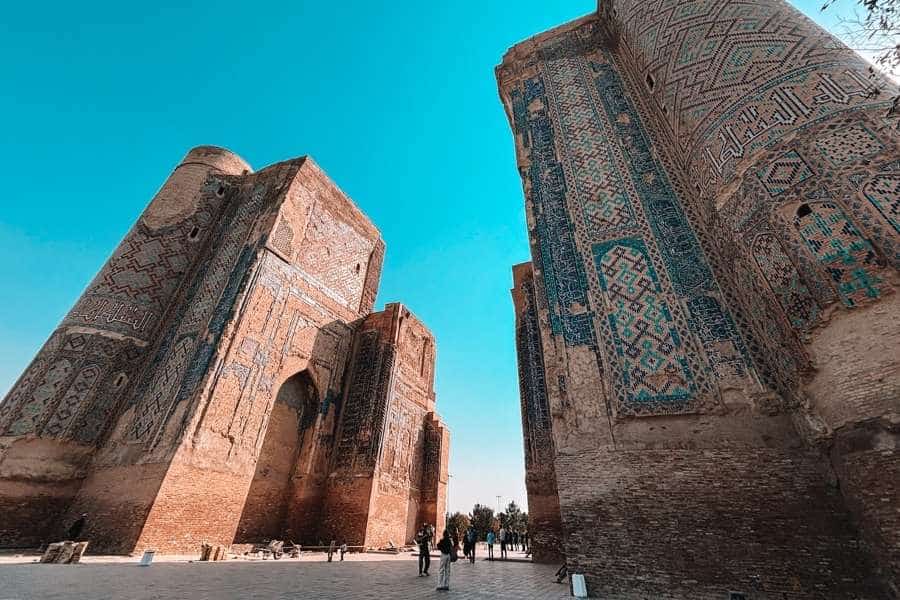
The first thing that hits you is the size of the Ak-Saray Palace ruins — two giant arches so tall you feel like a tiny pixel standing under them. Even though most of the palace is long gone, the leftover pieces are enough to tell you how massive and ambitious the original structure was. Timur didn’t think small, ever.
UNESCO loves Shahrisabz for its Timurid relics, but a large section of the old town was demolished in 2015 to make way for a park and tourist zone.
Many historians weren’t happy. You can see why… some areas look “too open” now, but the remaining structures still hold enough depth and power to pull you in.
The moment you walk through the main gates, there he is — Timur himself, standing tall in the front courtyard, watching everyone stroll in. You’ll probably pause here just like we did, because the whole setting feels grand without trying too hard.

Expansive green lawns, long pathways, and those dramatic tower fragments of the Ak-Saray Palace rising like broken giants in the distance.
From here, most travelers walk straight to the palace, and yes, you should, but save some time for the Dorut Tilovat ensemble, which sits just a little ahead before you reach Kok Gumbaz. This is one of those places that quietly carries the emotional weight of the Timurid family.
Dorut Tilovat was the center for religious learning in the 14th century, built to honor Timur’s spiritual mentors and his family. The complex includes the blue-domed Gumbazi Seyidon Mausoleum, the tomb of Shamsiddin Kulol (Timur’s revered Sufi teacher), and the elegant Gumbazi Chobi, where members of Ulugh Beg’s family were later buried.
The place feels calm, dignified, and deeply connected to the spiritual side of the Timurid dynasty. The blue dome here is softer, the courtyards quieter, and somehow it balances the grandeur of Ak-Saray with a gentler mood.
After Dorut Tilovat, the path leads naturally to the Kok Gumbaz Mosque, Ulugh Beg’s Friday Mosque, built in 1437 for his father, Shah Rukh. The name literally means “Blue Dome,” and when you see it, you understand why.
There’s also the “House of Meditation” behind the mosque, built by Ulugh Beg, but strangely never used as a burial space.
Just across from here sits the Hazrat-i Imam complex, part of what locals call Dorus-Saodat, or Dor-Us-Siyadat, the “Seat of Power and Might.” This is where you’ll find the Tomb of Jahangir, Timur’s eldest and most beloved son, who died heartbreakingly young in battle. History says Jahangir’s death changed Timur forever.
Near Hazrat-i Imam is a simple bunker-like door that leads you down into the so-called Tomb of Timur. Soviet archaeologists opened it in 1943 and found a stone casket inscribed with Timur’s name, but instead of Timur, there were two unidentified bodies. Our guide said nobody fully knows for sure who they were. Timur himself, as we know, lies in Samarkand. Shahrisabz keeps its secrets close.
There are more minor touches that make the city even more interesting — old hammams, the remains of an 18th-century bazaar, and the Shahrisabz Museum of History and Material Culture, which gives a nice timeline of the region.

One thing you can’t miss is the big open theatre at the end of the complex, an outdoor stage where concerts and celebrations like Navruz take place today. It sits where parts of the medieval town once stood, and while that change is controversial among historians, it does create a beautiful open space.
Shahrisabz may not feel as polished as Samarkand, but it has something more profound — a lived-in, unfiltered connection to the Timurid world. I liked that. You can still see the original brickwork, the cracks, the colors softened by time.
You can still sense how the city once stood long before cameras and tourism boards got involved. And maybe that’s why it stayed with me, not because it was perfect, but because it wasn’t.
If you have a good guide, the stories flow nonstop — Timur’s childhood, Ulugh Beg’s science-driven mind, family dramas, wars, losses, victories. Abdullohon made the whole trip feel like we were walking through a family album, not a museum.
Note: If you’re heading to Samarkand and want a guide who genuinely knows the city, reach out to Abdullohon Asatilloev at +998 (90) 477 – 94 – 57 or nobodydouble12@gmail.com.
Alternatives to Shahrisabz
If Shahrisabz doesn’t fit your plan (or you’re tired of long drives), Samarkand still has a few lovely half-day alternatives that don’t demand too much energy.
One of the nicest detours is Urgut, about an hour away. The big draw here is Chor Chinor, a sacred grove of ancient plane trees, some over a thousand years old, with hollow trunks and little shrines tucked inside them. It feels peaceful, calm, and a little mystical. Pair it with a stop at Urgut Bazaar if you’re visiting on a Sunday, piles of suzanis, antiques, old coins, and that classic “market chaos with charm” vibe.
Another easy option is Nurata, a popular short trip from Samarkand. It’s known for its ancient fortress linked to Alexander the Great and the sacred spring beside the mosque. If you want something more immersive, you can continue to the Aydarkul yurt camps for a desert lunch, camel rides, or just that quiet “big sky” feeling. Many travelers do this on the way from Samarkand to Bukhara, turning the journey into a relaxed desert day instead of a straight drive.
If mountains make you happier than monuments, consider a day around the Seven Lakes (Haft Kul). Though the lakes are in Tajikistan, many local tour operators now run day trips from Samarkand. It’s a long, full day: turquoise lakes, tiny villages, mountain roads, but absolutely worth it if you love nature more than crowds.
And if none of this calls out to you, you can always have a “what we missed” day in Samarkand itself. Yes, why not revisit what felt rushed? Maybe you didn’t get the morning quiet at Shah-i-Zinda. Maybe Registan at night looked different in your photos. Maybe Siab Bazaar stole your heart, and you want another visit. Your “redo” list will tell you where to go.
Or spend an afternoon sitting in a chaikhana with tea, parvarda, and no timetable at all.
Evening: Wander Through Samarkand’s “Official Side”
If you’ve spent the day in mosques, bazaars, and old neighborhoods, this little detour feels like flipping the city to its modern, serious face for a bit.
Samarkand has a small belt where most government offices, banks, and administrative buildings sit together: clean roads, wide pavements, tidy lawns, and that “everything is in order” vibe.
The easiest way to experience this area is to take a relaxed walk along Mirzo Ulug‘bek Street and the connecting stretch of Shokhruh Mirzo Street or Shohruh Mirzo Street. This is where you’ll see the Central Bank’s regional office (beautiful, clean façade), the big NBU building, insurance offices, and a row of official-looking structures with their flags and neat guards.
It’s not a tourist hotspot, and that’s precisely why it feels interesting. You get a small glimpse of the modern Uzbekistan that locals interact with every day.
What I liked about walking here was how different it felt from the tourist zone: no souvenir shops, no tour groups, no hustle. Just office workers stepping out, couples strolling, kids on scooters, and the kind of everyday atmosphere that makes you understand a city a little better.
If you enjoy photography, the light around sunset hits the pale buildings nicely, and the streets look surprisingly elegant. Spend around 20–25 minutes strolling. It’s not meant to “wow” you, more like a soft reset after a day full of heavy history.
End the stroll by grabbing a quick drink at a nearby café, or head back toward the Registan area for dinner. It’s a calm little pocket of Samarkand where the city feels organized, safe, and quietly proud of its present.
That’s our four-day blueprint for soaking in Samarkand. I’d love to know how this plan feels to you. Are you visiting for the first time, going back for a second round, or already carrying your own favorite corners of the city in your memory? Tell me. I always enjoy hearing how others meet a place.
More travel resources to plan your Uzbekistan trip
Save this Itinerary for Samarkand to Pinterest
