
The most practical and no-nonsense Uzbekistan travel guide packed with everything you need to plan smart, travel easily, and make every moment count. If you’re planning your first visit, this guide is your travel ally: a blend of tips I lived through, learned from other seasoned travelers, and wished I’d known before setting foot in this jewel of Central Asia.

Uzbekistan is having its moment and how. What used to be a far-off, “maybe someday” kind of place is now showing up on every travel list, Instagram feed, and tea break chat. And rightly so. It’s packed with history, soul, colors that don’t quit, and stories etched into every mosaic and madrasa.
The best part is how naturally Uzbekistan fits family travel at every age. Wide walkways, open courtyards, compact sights, and a pace that doesn’t demand rushing from one attraction to the next. Every age finds something to latch onto: colors, stories, space, or simply the freedom to explore. Traveling in Uzbekistan as a family felt easier than expected and far more enjoyable.
Sure, this country wasn’t designed with prams or strollers in mind, but neither was parenting. You adapt… You laugh… With comfy carriers, easy visas, super fast trains, and enough warmth and kindness to fill every heart (and patience meter), Uzbekistan’s pretty hard not to fall for.
This guide is your everything-in-one-place kind of thing. From where to go, what to skip, what to eat, how to plan with kids, how to pack (or not overpack), and all those little things that only show up after you land, we’ve got it covered. Look, I’m not saying this is the most comprehensive Uzbekistan travel guide on the internet… but I also wouldn’t be surprised if it is.
Once you’ve got the practical bits sorted (visa, money, when to go, how to get around), the next question is usually “okay, but where do I actually go?” That’s where our 2-week Uzbekistan itinerary picks up, a realistic 14-day route through the Silk Road cities, the Aral Sea, and the Fergana Valley.
Heads up: some links here are affiliate links. That means if you click and buy something, I may earn a teeny-weeny commission (think chai money, not a private jet) at no extra cost to you. It’s a small way to keep this blog running, the words flowing, and the pages free for you to enjoy. I only recommend things I truly love, use, or secretly wish I invented, because trust matters, and so do good recs. Thanks for supporting the little cozy corner of the internet I call my virtual home.
Quick Facts About Uzbekistan
Capital: Tashkent, a big, busy city with over 2 million people. You’ll see a mix of Soviet-era blocks, leafy streets, and shiny new buildings popping up everywhere.
Other Major Cities: Samarkand, Bukhara, Khiva, Nukus, and Fergana.
Languages: Uzbek is the official language. Russian is widely spoken, especially by older folks and in bigger cities. You’ll also hear Tajik in parts of Samarkand and Bukhara. English is rare outside touristy spots. A few words like salom (hello) or rahmat (thank you) go a long way, and locals genuinely appreciate the effort.
Money & Currency: Uzbek Som (UZS). The notes come in large numbers. Don’t be surprised if you’re carrying a million Som in your wallet. $1 USD is roughly 12,070 UZS (but exchange rates do change). Cash is still preferred, especially in smaller towns. That said, most hotels, malls, and restaurants in bigger cities now accept cards. ATMs are around in towns and shopping areas, but it’s smart to carry some USD or EUR as backup, especially when heading off-grid.
Religion: Majority Muslim (mostly Sunni), but Uzbekistan is a secular and fairly relaxed country. Women don’t have to cover their heads, except inside mosques; carrying a scarf is a good idea out of respect. Dressing modestly is appreciated, especially outside Tashkent, though you’ll see all kinds of styles.
Time Zone: UTC +5 (Uzbekistan Standard Time).
Power plugs and sockets: Type C and Type F. The standard voltage is 220 V at 50 Hz.
Why Visit Uzbekistan?

There are so many reasons. First off, Uzbekistan is home to some of the most legendary Silk Road cities—Samarkand, Bukhara, and Khiva.
Walking through these old towns, you’re literally following the paths of ancient traders. Every corner of these cities feels like a history lesson brought to life, captivating travelers.
It beautifully blends old-world traditions with lingering hints of the Soviet era, creating a culture that feels both unique and layered.
Beyond the cities, there’s a whole other side of Uzbekistan that’s just as interesting. The disappearing Aral Sea takes you to Moynaq, where rusted ships sit in the sand, a little eerie, but worth seeing once.
In the Kyzylkum Desert, you can sleep in a yurt, ride a camel, and sit by a campfire under a massive sky.
If you’re up for mountains, Chimgan is excellent for walks, fresh air, and even a bit of skiing in winter.
And the Fergana Valley is calm and green, with silk workshops and lush orchards scattered between the hills.
But what you’ll remember most is the warmth of the people. Locals are friendly, helpful, and kind. They effortlessly make you feel safe, seen, and welcome.
For family travelers like me, Uzbekistan offers clean cities, spacious parks, car-free zones, and well-managed public transport, and a strong sense of safety, making it surprisingly easy to travel with kids of all ages.
Budget-wise, it’s a relief. From hotels and food to transportation, everything is reasonably priced. Even stylish boutique stays and 4-star hotels often cost much less than mid-range options elsewhere.
So yeah. Go for the blue domes, the stories, the space. Go for the small moments you didn’t plan for. Go because it’s different in the right way. Just go.
Visa for Uzbekistan: Uzbekistan Entry Requirements

Uzbekistan has made it incredibly easy for travelers from around the world to visit. Citizens of around 90 countries can now enter visa-free for up to 30 days. This includes most European nations, the UK, South Korea, Japan, Malaysia, Singapore, Australia, New Zealand, and several countries in South America and the Middle East, such as the UAE, Qatar, Turkey, and others.
If you’re from the U.S., you’ll need to apply for an e-visa for now, but there’s a small exception. U.S. citizens aged 55 and above can currently enter visa-free for up to 30 days for tourism. If you’re under 55, you’ll need an e-visa or apply through the Uzbekistan embassy, depending on your travel plans. As of January 2026, all American passport holders are now eligible for 30 days of visa-free entry, regardless of age.
For those who do need a visa, Uzbekistan’s e-visa system is smooth and straightforward. It’s available to travelers from over 70 countries, including the U.S., Canada, India, Bangladesh, South Africa, Indonesia, the Philippines, Vietnam, and more. You can apply for an e-Visa online, single-, double-, or multiple-entry visa, each valid for 30 days per entry, and usable for 90 days from the date of issue.
Processing usually takes 2–3 working days, and costs from $20 for single-entry, $35 for double-entry, and $50 for multiple-entry visas. Just make sure your passport is valid for at least 3 months beyond your intended departure date, has at least one blank page, and that you upload a passport-sized photo (35x40mm) and a scan of your passport information page during the application. Once approved, download and print the e-visa; border officers might still ask for a hard copy even if it’s digital.
If you’re traveling with kids, the rules are simple: every child needs their own visa, even infants. However, children under 16 years old traveling with parents or legal guardians are exempt from needing a visa for up to 90 days, as long as the parent or guardian holds a valid visa or visa-free status. It’s a good idea to carry a birth certificate if you’re the only parent accompanying your child, just to be safe.
If your country isn’t mentioned on any list, you’ll need to apply for a visa through the nearest Uzbekistan embassy or consulate. The requirements can vary depending on the country, but generally include a visa application form, a valid passport, passport-sized photos, confirmed hotel bookings, and sometimes a visa support letter (LOI – Letter of Invitation), which can be arranged by a registered tour operator or hotel in Uzbekistan. Processing times can take longer than the e-visa route, so it’s best to apply well in advance.
Some additional good-to-know bits: you don’t need any vaccine certificates, and while travel insurance isn’t required like it is for Schengen countries, it’s still strongly recommended. Immigration officers might ask to see your hotel booking, onward/return flight, or travel insurance, but not always. Best to keep copies handy anyway.
Customs is divided into a double corridor system: green and red. The choice is simple. The green channel is for travelers who have nothing to declare, meaning personal belongings, standard electronics, and cash within the allowed limit, and most visitors walk straight through this lane without stopping.
The red channel is for anyone carrying large amounts of cash, professional equipment, medicines that require declaration, or items intended for resale, where officers may ask a few routine questions and conduct a brief check.
Signboards are easy to follow, staff usually guide you if you look unsure, and the entire channeling process feels orderly and unhurried, arriving far less stressful than expected.
If you’re carrying prescription medicine, especially anything containing codeine or strong painkillers, bring your prescriptions and declare them at customs. Some medications are restricted, and it’s better to be safe than sorry.
You’ll fill out a customs declaration form, especially if you’re carrying more than $2,000 USD in cash. Make sure to declare it, as that’s required by law. Immigration officers are usually polite and efficient, especially if you have a visa-free passport or a valid e-visa printed and ready.
Most travelers arrive at Tashkent International Airport, but you can also enter via land borders with Kazakhstan, Kyrgyzstan, and Tajikistan. All e-visas are valid at airports and official land crossings, and land borders are usually open and straightforward. That said, things can move slowly, so bring printed copies of your documents and a bit of patience.
There’s also a transit option: travelers flying with Uzbekistan Airways from many countries (including India, South Africa, the USA, etc.) can stay visa-free for up to 5 days, provided they’re in transit and not leaving the airport area. A 72-hour transit visa is also available if you’re connecting onward via land or air and want to step out and explore.
Tourist Registration in Uzbekistan: What You Need to Know
Uzbekistan has a registration system in place, a legacy from Soviet times, and while it sounds intimidating on paper, it’s far simpler in practice today.
If you’re staying in hotels, guesthouses, or registered apartments, registration is usually handled automatically at check-in. Still, it’s always worth asking your host or hotel directly, just to be sure. We stayed in an apartment in Tashkent and confirmed with our host that they would handle the registration for us, which they did.
So, if you stay in a private, unregistered apartment or with friends, the host is responsible for registering you, and it’s worth confirming this in advance.
Most of the process is now digital, especially in hotels, and paper slips are rarely checked. In our case, our registration slips were never asked for at any point during travel or at departure. That said, it’s still a good idea to save any registration slips or confirmations you receive from hotels when you check out, just in case.
One thing we learned the practical way: the system tracks where you’re staying. When we stayed at Arda Tarun in Khiva, the hotel forgot to check us out in the system. When we reached Tashkent and tried to check into our next hotel, we were told they couldn’t check us in because we were still showing as “checked in” in Khiva. A quick phone call between the hotels fixed it, but it did mean waiting around until the Khiva hotel updated the system.
It’s a reminder that while the process is mostly seamless, it’s still worth keeping any slips or confirmations until you exit the country, confirming your accommodation handles registration, and checking out properly when you leave.
Some travelers mention registration checks at overland border crossings or when traveling to neighboring countries like Kazakhstan. We didn’t experience this ourselves, but if you’re planning cross-border travel, it’s best to double-check current requirements closer to your trip.
In short, registration in Uzbekistan is more of an administrative formality than a travel hurdle. Be aware of it, ask once at check-in, keep your paperwork just in case, and then move on with your trip.
Money and Currency in Uzbekistan

Uzbekistan uses the Uzbek som (UZS) — coins exist, but you’ll mostly handle banknotes in everyday life. Common notes are 2000, 5000, 10 000, 50 000, 100 000, and 200 000. Smaller bills (like 100, 500, 1000 som) are helpful for tiny purchases, water bottles, bus rides, chai, etc.
While the country has moved forward with digital payments, cash still runs the show. Markets, taxis, small cafés, craft workshops, guesthouses, and bazaars all prefer cash.
Keep small denominations separate from larger notes. Bazaar sellers and craft stalls struggle to break big bills, and you’ll waste time trying to find change when you’re rushing between sights.
Cards work best in international hotels, large chain restaurants, and some craft stores, but don’t bank on it everywhere. Visa is the most widely accepted card type in Uzbekistan. Mastercard works in some places but less reliably. American Express is rare.
ATMs are common in bigger cities (Tashkent, Samarkand, Bukhara) and usually dispense som. Even where cards are accepted, ATMs are still more dependable because machines sometimes go down or networks lag.
About money exchange, banks and official exchange offices give the best and most consistent rates in Tashkent, Samarkand, and Bukhara. Exchange counters at Tashkent International Airport are convenient on arrival, but rates aren’t as reasonable as those at city banks.
Avoid unofficial street exchangers; rates may look attractive, but they’re risky and often illegal. Hotels sometimes exchange money, but rates are usually less favorable. Keep your exchange receipts if you’re changing larger amounts.
When exchanging money, give crisp, clean notes because exchanges and banks will inspect them. Old, folded, stained, or crumpled notes often get a lower rate or may even be refused. My husband experienced this firsthand; he exchanged older USD notes and was shown a noticeably lower exchange rate than for fresh bills. It’s normal, and most exchange counters will tell you upfront if a note is unacceptable.
Use a reliable tool (e.g., XE.com, Google “USD or EURO to UZS,” or the XE app) to check live rates before you exchange. Rates at banks tend to be very close to these live mid-market rates, whereas rates at airport counters and hotels are slightly lower.
The current exchange rates are (April 2026):
💵 1 USD ≈ 12,070 UZS
🇪🇺 1 EUR ≈ 14,067 UZS
When it comes to tipping and bills, most places will show you a UZS total on the receipt. Don’t panic if it looks large; Uzbekistan’s som has a high number count. Tipping is not mandatory but is appreciated in restaurants (5–10% if the service was good).
For guides and drivers, a small cash tip at the end of the day or tour is customary, especially if they’ve been attentive, patient, or helpful beyond the basics. Often, a simple round-up or a discreet cash tip feels more natural than adding it to a card payment.
Language in Uzbekistan
Language is one of those things that surprises you in Uzbekistan, and not in a frustrating way, just in a very real, human way. Uzbek is the primary language you’ll hear everywhere, from markets to taxis to small cafés, and outside hotels and tourist-heavy spots, English is not widely spoken.
At first, it feels like a hurdle, especially if you’re used to destinations where English does most of the heavy lifting. But very quickly, it turns into one of the most memorable parts of the journey.
What fills the gap beautifully is effort. Even when we didn’t understand a word of Uzbek, and they didn’t understand our English, people tried. Conversations turned into a mix of hand gestures, smiles, half-remembered English words, numbers typed into phones, and a lot of laughing. It was chaotic, slightly hilarious, and oddly heartwarming. You could feel that genuine desire to connect, to help, to explain, even when language failed both sides.
Google Translate became our quiet hero. Downloading Uzbek offline translations made a massive difference for menus, directions, and small daily interactions. Locals were patient while we typed things out, and many leaned in with curiosity, amused and eager to make sense of what we were trying to say. It never felt transactional or rushed. It felt shared.
What stood out even more was the younger generation. You see English-learning schools everywhere, especially in cities like Tashkent and Samarkand, and there’s a growing demand for English teachers in the country.
Many young people are learning English with big dreams, to study abroad, work internationally, or open more doors for themselves. We lost count of the times students approached us, sometimes shyly, sometimes with excitement, asking if they could practice their English.
One asked us, very proudly, “Hindustan?” before following it up with carefully chosen sentences they’d clearly rehearsed. Another stopped us while we were sitting in a restaurant, to try speaking for a few minutes.
Once, while crossing the road, a young man waved us over and asked if he could talk in English to improve his confidence. Moments later, he became our unofficial translator when we failed spectacularly at explaining our location to a Yandex driver. He took the phone, spoke perfect Uzbek, got the cab for us, and returned it with a smile. We helped with his English. He saved our evening.
These moments didn’t feel intrusive. They felt earnest. You could sense how much it mattered to them, and how seriously they took the chance to speak, even if the sentences were broken or mixed with Uzbek and Russian. It added a layer of warmth to everyday travel moments that guidebooks never talk about.
Yes, language in Uzbekistan requires a little patience and flexibility. But what you get in return is something far richer than smooth communication. You get connection, curiosity, kindness, and stories you’ll remember long after the words themselves are forgotten.
Best Time to Visit Uzbekistan

Uzbekistan, like India, changes its mood with the seasons, and each one paints a different picture.
Spring (April to June) is hands-down the most popular time to visit, and rightly so. The weather is just right, warm but not melting hot. Apricot blossoms pop up everywhere, cities feel fresh and lively, and Navruz (Persian New Year) brings a festive buzz in March. It’s that sweet spot where you can walk for hours, sip tea outdoors, and not feel like you’re roasting.
Summer (July and August) is not for the faint-hearted. The heat is real, I mean, 40°C and up in some places. But the upside is fewer tourists, great hotel deals, and long daylight hours. If you’re sticking to air-conditioned museums, early mornings, and shady courtyards, it’s doable.
Autumn (September to October) is another gem. The heat drops, but the sunlight stays golden. Markets overflow with ripe melons, pomegranates, and all sorts of harvest goodies. Cities feel calm, kids are back in school, and travel is smooth. It’s a relaxed, golden-window kind of season.
Winter (November to February) can be freezing, especially at night. But if you like a slower pace, empty streets, snowy rooftops, and cozying up with hot green tea, winter’s not a bad shout. The Chimgan mountains near Tashkent even offer skiing if you’re into that kind of thing.
In short, if you’re after color, comfort, and festivals, or rather perfection, spring and autumn win. But every season brings its own mood, and Uzbekistan wears them all well.
What to Pack for Uzbekistan

Packing for Uzbekistan is more about comfort and practicality than dressing up. You’ll walk a lot, deal with changing weather, and move between modern cities and ancient streets, sometimes on the same day.
I’d suggest dressing modestly: it isn’t about restricting your style, it’s about being respectful, harmonizing with local customs, and feeling more at ease in every setting.
Clothes (By Season)
If you are visiting during spring (March to May) or autumn (September and October), Pack for layers. Light cotton tops, full-length trousers, long skirts, or dresses work well. Add a light jacket, cardigan, or shawl you can easily put on and take off.
For a summer trip (June to August), pack loose, breathable clothing: cotton or linen tops, wide trousers, flowy dresses. Covering up actually feels cooler than being in the sun with exposed skin. Avoid heavy fabrics altogether. A light shawl or jacket is functional even in warmer months, as trains and restaurants are often air-conditioned and evenings cool down. Bring sandals for evenings.
For winter travel (November to February), pack proper warm layers: thermal innerwear, sweaters, a heavy jacket or coat, a scarf, gloves, and closed shoes. Cities like Tashkent and Samarkand can get cold, especially at night. Snow isn’t constant, but temperatures drop sharply. Hotels and trains are heated, sometimes very well, so layering helps. If you’re visiting mountain areas like Chimgan, pack winter boots and extra warmth.
Must Carry (No Matter the Season)
- Comfortable walking shoes
- Scarf (useful for religious sites, sun protection, and unexpected dust)
- Day bag with a zipper (small backpack or crossbody bag)
- Sunscreen, sunglasses, and a hat or cap
- basic medications and a first aid box
- Reusable water bottle
- Wipes
- Personal medicines and ORS
- Copies of documents
- Power bank and universal adapter
- digital and physical copies of required documents such as passports, visas, hotel bookings, train tickets, travel insurance, flight confirmations, registration slips from hotels, emergency contact details, and a note of your accommodation addresses in each city.

Free Download
Get the All-Inclusive Travel Packing Checklist
Pack smart, travel lighter, forget nothing. This isn’t just a list — it’s your travel sanity-saver. From the must-haves to the ‘why didn’t I think of that’ items, this one-pager keeps overpackers in check and underpackers prepared. Print it, check it, and get going. Your smoothest trip yet starts right here.
How Many Days in Uzbekistan

Uzbekistan isn’t huge, but it isn’t a quick hop either. Distances matter, trains take time, and most places deserve more than a rushed half-day. How many days you need really depends on how deep you want to go.
Seven days is the bare minimum for a first visit. It works for the classic route — Tashkent, Samarkand, and Bukhara, with Khiva only if you’re okay moving fast. High-speed trains make it doable, but days will be packed, travel-heavy, and a little rushed. You’ll see the highlights, but with little breathing room.
Ten days is the sweet spot for most travelers. This gives you time to add Khiva and slow down just enough to enjoy evenings, markets, and unplanned walks. You won’t feel like you’re constantly packing and unpacking.
12 to 14 days is ideal if you want to go beyond the usual circuit. This is when you can include the Fergana Valley, a yurt stay, or even Nukus and the Aral Sea, without burning out. It also allows rest days, which matter more here than people expect.
Culture and Etiquettes in Uzbekistan

Uzbekistan carries its culture lightly but proudly, and as a visitor, you feel it almost immediately. People are warm, curious, and genuinely happy to see travelers.
A smile goes a long way here, and a slight nod or greeting often turns into a short conversation, a recommendation, or an offer of help. Hospitality is deeply rooted in everyday life, and it shows in small gestures rather than grand displays.
Modesty is appreciated, especially in mosques, madrasas, and older neighborhoods. Covering shoulders and knees keeps things respectful and helps you blend in without effort.
Shoes may need to come off in some religious or traditional spaces, so footwear that slips on and off easily is practical.
Public behavior is calm and unhurried, and loud displays or rushing through places tend to feel out of place. Uzbekistan moves at its own pace, and leaning into that rhythm makes travel smoother and more enjoyable.
Food culture is generous and social. Sharing dishes is common, tea is often offered, and repeatedly refusing can feel awkward, so a polite taste is usually the best response.
Using your right hand while eating or receiving something is considered respectful.
Tipping is not deeply ingrained but is appreciated in restaurants, cafes, and with guides who go out of their way to help.
Photography is welcome, especially in public squares and historic sites, but it is courteous to ask before photographing people, shopkeepers, or inside religious spaces. Uzbek culture values dignity and privacy, and a quick gesture asking permission is always well received.
Overall, traveling through Uzbekistan feels easy because the etiquette is guided by kindness, patience, and mutual respect, and when you follow that tone, the country opens up beautifully.
Health & Safety in Uzbekistan

No special vaccines are required to visit Uzbekistan; the usual travel immunizations, such as tetanus, hepatitis A, and others, are needed. You won’t be asked for vaccine certificates at immigration.
That said, pack your own basics, because while pharmacies (called Dorixona in Uzbekistan) are easy to find (you’ll spot a sign every other kilometer, especially in cities), they’re a bit unpredictable.
Don’t expect every medication to be available, and some common ones (especially anything with codeine) are restricted. If you absolutely need to bring something more substantial, carry a prescription and declare it at customs. Saves you the stress.
Tap water is not a great idea. Stick to bottled or boiled water; it’s available everywhere, so it’s not a hassle. If you can, carry a reusable bottle with a filter.
Public toilets in Uzbekistan are worth noting, especially outside airports, major train stations, and newer malls. In big cities like Tashkent and Samarkand, you will find clean, well-maintained restrooms in airports, metro stations, museums, and modern cafes, often staffed and equipped with basic supplies.
However, along highways, at smaller attractions, or in older areas, facilities can be basic or squat-style, and toilet paper or soap may not always be available. Carrying tissues, wet wipes, and hand sanitizer makes a noticeable difference and keeps things stress-free, especially when traveling with family.
Many public restrooms also charge a small cash fee, so having loose change on hand makes quick stops much easier.
Uzbekistan is one of the safest countries to travel in Central Asia. Violent crime is infrequent. Most travelers, including families, report feeling completely safe walking around, even after dark in most cities.
Still, like anywhere, be mindful in busy bazaars or markets where pickpockets might try their luck. And since you’ll often be carrying a chunky wad of cash (thanks to Uzbek Som’s large denominations), don’t flash it around.
In major tourist areas, you’ll often see Tourist Police, especially near monuments, metro stations, and busy squares in cities like Tashkent, Samarkand, Bukhara, and Khiva.
Honestly, I loved this concept. Not because Uzbekistan is full of scams or aggressive touts, it really isn’t, but because the presence itself changes the atmosphere. You walk a little lighter, vendors behave better, and no one dares to push, pressure, or overstep because there’s always someone official nearby who actually exists to help travelers.
The Tourist Police are approachable, used to visitors, and perfectly happy to give directions or step in if needed. It adds a quiet layer of reassurance without feeling intimidating.
Walking around Uzbekistan, I rarely felt the need for them, which says a lot, but seeing them around made me think how badly destinations like India could benefit from this kind of visible, tourist-focused support. Fewer scams, fewer uncomfortable moments, and a lot more trust. Sometimes, good tourism infrastructure is simply about making people feel protected without making a fuss.
Coming back on tangent, while the country is peaceful, it shares borders with regions that occasionally see tension, so it’s worth keeping an eye on local news if you plan to cross by land.
Also, you must buy travel insurance; no two ways about it. Choose a solid plan (I recommend Heymondo) that covers medical needs and emergency evacuation. Healthcare in Tashkent is decent, but in smaller cities, it is basic.
Connectivity in Uzbekistan

WiFi is widely available in hotels, cafes, and restaurants in big cities like Tashkent, Samarkand, and Bukhara. It may not always be lightning-fast, but it usually does the job for basic browsing and calls. Once you head into remote or rural areas, though, don’t expect much, so download your maps and translations in advance.
Buying a local SIM is pretty straightforward. You’ll find mobile counters at the airport and phone shops in every city. Ucell and Beeline are two major operators, and both offer good coverage across the country. Just bring your passport, they’ll need it to register the SIM.
Or, if you’re into the hassle-free life, get an eSIM before you arrive. Providers like Airalo now offer Uzbekistan eSIMs, which means you can land and be online before you even clear customs.
Overall, mobile networks work well in urban areas, but don’t expect a strong signal in the desert, mountains, or yurt camps. Perfect excuse to unplug, unless you really need Google Maps to find that secret lagman spot.
How to get to Uzbekistan

By Air
Most travelers fly into Tashkent International Airport (TAS), the country’s central hub and the easiest way in. There are now direct flights from a growing number of cities across Europe, Asia, and the Middle East, including Istanbul, Dubai, Moscow, Delhi, Frankfurt, Seoul, and India.
Uzbek carriers such as Uzbekistan Airways and Qanot Sharq, as well as international airlines, operate these routes. With tourism on the rise, the options keep expanding.
You can also fly directly into Samarkand (SKD) and Urgench (UGC), ideal if you want to skip a domestic transfer and head straight to those regions.
Bukhara Airport (BHK) currently handles mainly domestic flights, but a new, modern international terminal is under construction and is expected to open by late 2026. Once it opens, international arrivals to Bukhara should become much easier.
For now, Samarkand and Urgench remain the more practical options for direct international flights, especially from nearby hubs like Istanbul or Moscow.
Overland
If you are arriving by land, Uzbekistan shares borders with Kazakhstan, Kyrgyzstan, Tajikistan, Turkmenistan, and Afghanistan. Overland travel is possible at several official crossings, for instance, from Kazakhstan into Tashkent or the Fergana Valley, or from Tajikistan into the Samarkand region.
That said, some land borders (especially with Turkmenistan and Afghanistan) may have unpredictable hours or closures, so always double-check current conditions and visa requirements.
If you’re doing a broader Central Asia trip, you can absolutely include Uzbekistan in your overland route, but be patient at the border posts, and carry printouts of visas and bookings.
For most family travelers (or anyone who values comfort), flying into Tashkent and using the country’s reliable trains is the most convenient option.
How to Get Around Uzbekistan

Uzbekistan is refreshingly straightforward to get around. Trains do most of the heavy lifting, taxis are affordable, apps work, and cities are manageable.
Trains are the real hero here. Uzbekistan’s high-speed rail system pleasantly surprised me. It’s safe, clean, and super efficient.
The Afrosiyob high-speed train is easily the best way to travel between the main cities. It connects Tashkent, Samarkand, and Bukhara, and does so quickly and comfortably. Tashkent to Samarkand takes around 2 hours, and Samarkand to Bukhara takes about 1.5 hours.
The trains are modern, clean, air-conditioned, and have assigned seating, luggage space, and even a café car. If you’re traveling with kids, this is a blessing, no long road journeys, no motion sickness drama, no endless “are we there yet”.
By now, train connectivity has improved even further. You can reach Khiva by train, though part of the journey may still be slower or overnight, depending on schedules. Plans are underway for a fully high-speed Tashkent–Khiva route, but for now, trains are still the easiest and most comfortable way to cover the classic Uzbekistan circuit.
Tickets do sell out in peak seasons, so booking ahead is a good idea. You can buy tickets online on the Uzbekistan Railways website (English version available), via apps, or from local agents.
Quick Note: I’ve explained how Afrosiyob ticket booking actually works, further down.

Domestic flights exist, but you may or may not need them.
Uzbekistan Airways operates domestic flights from Tashkent to destinations such as Urgench (for Khiva), Nukus, Termez, and other far-flung cities. Flights are short and reasonably priced.
That said, for the main tourist route—Tashkent, Samarkand, Bukhara—trains are usually faster and far more convenient. Flying also means airport waits, security checks, and transfers, which can feel like extra work if you’re traveling with young kids.
Flights make more sense if you’re tight on time or heading far west, including Khiva, or into the Fergana Valley.

Road travel fills in the gaps.
For places not connected by train, such as yurt camps and mountainous areas, road travel is the way to go. You can hire a private driver, take a shared taxi, or use ride-hailing apps. Intercity shared taxis are common and affordable, but if you’re traveling as a family, booking a private car is usually more comfortable. Always agree on the fare beforehand if you’re not using an app.
Within cities like Tashkent and Samarkand, apps like Yandex Go (formerly Yandex Taxi) and Yango work really well. Prices are upfront, cars are easy to find, and you avoid language barriers and haggling; honestly, it’s a lifesaver. Public buses and marshrutkas (minibusses) also run everywhere and are incredibly cheap, but they can be crowded and tricky to navigate if you don’t speak Uzbek or Russian.

Then there’s the Tashkent Metro: efficient, inexpensive, and unexpectedly beautiful. The stations are a throwback to Soviet-era design, each with its own theme, chandeliers, mosaics, and drama. Photography is allowed now, so yes, it doubles as transport and sightseeing.
Driving yourself is possible, but not ideal.
You can rent a car in Uzbekistan, but most travelers don’t. Roads between major cities are decent, but signage isn’t always in English, driving styles can be unpredictable, and fuel stations are sparse in rural areas. Unless you’re very confident and love road trips, trains, and hired transport are far less stressful, especially with kids.
We asked a local driver-guide about self-driving, and he laughed when he told us one of the biggest surprises for foreign drivers wasn’t potholes or road signs, but speed cameras and fines.
Cameras are all over the place, even where the speed limits aren’t obvious, and as soon as you go above the limit, you can automatically get a fine.
Some rental companies even require a big deposit at pickup because they know tourists often get snapped and end up paying the fine after they’ve already left the country.
In fact, fines for even minor speed violations aren’t tiny: exceeding the limit by a bit can cost the equivalent of $30–$150 or more, depending on how fast you were going and how many violations you rack up.
That means sometimes people end up paying more in fines than they planned to on the rental itself, a situation no one wants on holiday.
Another wrinkle is that road signs and speed limits can be hard to read if you’re not used to local markers, and cameras are often placed where you least expect them.
Also, starting April 2026, Uzbekistan has linked traffic camera violations to a points system, meaning repeated offenses could eventually hurt your license status.
All that said, the roads between major cities are generally in decent shape, and the driving experience isn’t dangerous if you stick to the rules.
It’s really just the combination of automatic cameras, unclear limits, unfamiliar signs, and how rentals handle fines that make self-driving more trouble than it’s worth for most visitors. That’s why trains and hired drivers tend to be the less stressful choice for most travelers.
Note: If you do rent a car, ask the company how they handle fines, check your speedometer carefully in towns vs. the countryside, and maybe use a navigation app that warns about cameras. Be sure it’s legal to use it where you’re driving.
Walking and strollers in old towns.
Historic areas like Bukhara’s Old Town and Khiva’s Ichan Kala are best explored on foot. Many of these zones are pedestrian-only or have very little traffic, which makes wandering around much easier. Streets are generally safe, and people are happy to help if you look lost.
That said, expect uneven surfaces, cobblestones, steps, and narrow lanes. A sturdy stroller works, but a baby carrier will make life simpler in tighter spots. The upside is that kids can roam more freely here without you constantly worrying about traffic.
Booking Afrosiyob Train Tickets: What You Should Actually Expect
If you’re planning to travel between cities in Uzbekistan, chances are Afrosiyob will be at the top of your list. It’s fast, comfortable, and makes routes like Tashkent–Samarkand or Samarkand–Bukhara feel effortless. On paper, booking it sounds straightforward, too. Tickets are said to open about 30 days in advance on the Uzbekistan Railways website.
In reality, this is where many travelers, including us, hit a wall.
I checked the official site exactly when tickets were supposed to open, and not just for one date, but across several. Everything was sold out. Fully. Cleanly. As if the trains had been booked months ago. At first, I assumed I was doing something wrong. I refreshed, rechecked dates, tried different routes, and even questioned my calendar skills. Same result every time.
What I later learned, and what many travelers mention online, is that Afrosiyob tickets can show as “sold out” even when you check right around the official booking window. It happens for a few very unromantic reasons.
First, Afrosiyob has limited seats, limited departures, and extremely high demand, and in peak months, it genuinely sells out fast. Travelers on forums describe seats disappearing within minutes of release, especially on the popular Tashkent–Samarkand–Bukhara routes.
Second, a big chunk of seats gets hoovered up by tour operators and agencies. Multiple traveler communities openly say agents buy blocks of tickets and then resell them for two to three times the price, or hold inventory and release leftovers later. That is why you see “no places” on the official site, and then magically the same train appears as a “guaranteed” ticket on aggregator sites at a much higher rate.
Third, the “tickets open X days before” rule is fundamental, but it is not always as clean in practice. People report different release windows, sometimes 45 days, sometimes 60, and sometimes seats appearing in batches rather than all at once, which makes it feel like the calendar is lying to you.
Fourth, even when seats exist, the official booking flow can be its own obstacle course. Quite a few travelers report payment issues with foreign cards on the Uzrailways site or app, which means seats can vanish while you are stuck refreshing a loading screen.
So how is it possible that everything looks sold out 30 days ahead? Usually, it is a mix of real demand, agencies buying early inventory, and the occasional batch release and payment drama that keep regular travelers out. The result is exactly what you saw: the official site shows sold out, third-party sites show availability at inflated prices.
This is precisely what happened with us. Our tour guide arranged Afrosiyob tickets at a higher price, which made sense once I understood how limited availability, agency bookings, and reselling play out in real life. It wasn’t ideal, but it kept our plans intact, and knowing how common this is helped take the sting out.
At that point, it really comes down to choice. You can decide if paying extra feels worth it to keep your itinerary intact, or if you’d rather switch to slower options like Sharq or overnight trains, which are comfortable, reliable, and much easier to book.
My biggest takeaway is this: if Afrosiyob tickets don’t appear on the official site when you expect them to, don’t panic or assume your trip is falling apart. This happens often, it’s not personal, and it’s not a glitch you’re causing. Build a little flexibility into your plans, know your alternatives, and you’ll be just fine.
Uzbekistan travel is smooth and rewarding in most ways, but Afrosiyob bookings are one area where flexibility, patience, or a Plan B really helps.
Where to Stay in Uzbekistan
Tashkent

Tashkent is a big, spread-out city, so choosing a central area makes life much easier. The City Centre around Amir Timur Square is generally the best base, putting you within walking distance of sights, cafés, restaurants, metro stations, and shops.
Here you’ll find a good range of accommodations to suit different budgets: comfortable mid-range options like International Hotel Tashkent, Wyndham Tashkent, Mir Luxe Plaza, AZIMUT Grand Hotel Tashkent, or Lotte City Hotel Tashkent Palace offer spacious rooms and reliable service with breakfast included.
For something a bit more boutique and stylish, Art Hotel Tashkent, Shodlik Palace Hotel, and Baden-Baden Hotel Tashkent are well-reviewed and centrally located.
Ichan Qal’a Premium Class Hotel is a popular upscale option with a traditional touch and good facilities. At the same time, international chains like Courtyard by Marriott Tashkent and Holiday Inn Tashkent City by IHG offer modern rooms, consistent service, and central locations.
If you’re on a tighter budget but still want convenience, places like Bek Hotel or Old Town Boutik Hotel provide clean, simple rooms with easy access to the metro and attractions.
We chose to stay in an apartment in the Mirobod area, and it turned out to be one of the nicest surprises of our trip. The neighborhood felt posh, calm, and well-kept, with wide roads, greenery, cafés, and easy access to the airport and city center. Staying in an apartment gave us more space, a quieter base after sightseeing, and a very local feel without sacrificing comfort. If you like a slower, more residential atmosphere, Mirobod is an excellent choice.
Samarkand

Again, stay close to the action, where most of the city’s main sights are clustered around the historic center. The Registan and Old Town area is the most convenient base, allowing you to walk to places like Registan Square, Bibi-Khanym Mosque, Siyob Bazaar, and even Shah-i-Zinda without constantly relying on taxis.
Staying near Registan not only saves time but also lets you experience Samarkand early in the morning and late in the evening, when the crowds thin and the city feels calmer.
There’s a wide choice of hotels around this area. Comfortable and reliable options include L’Argamak, Hotel Minor, Hotel Silk Road Empire, Registan Plaza Hotel, Bibikhanum Hotel, EmirHan Hotel, and East Star Hotel, all of which offer a good balance of location, comfort, and character.
For those who prefer international standards or larger properties, Mövenpick Samarkand is a solid choice with modern facilities and a more upscale feel.
If you prefer something more atmospheric, Kosh Havuz Boutique Hotel, Kohinur Plaza, Sangzor Boutique Hotel, Antica Hotel Samarkand, Gur Emir Palace Boutique Hotel, and Platan Hotel are popular boutique options that blend traditional design with modern comfort.
We stayed at Hilton Garden Inn Samarkand, which is a bit farther from the historic center, but comfortable, quiet, and well-run. It works well if you don’t mind being outside the walkable sightseeing zone, are up for short taxi rides, and prefer a more contemporary hotel setup.
There’s also a growing cluster of newer hotels slightly outside the old town, including Savitsky Plaza, Lia! by Minyoun Stars of Ulugbek, Silk Road by Minyoun, Hilton Samarkand Regency, and Wellness Park Hotel Bactria.
Budget travelers can look at smaller guesthouses near the old town, many of which, such as Old Street Guest House, Guest House Registan Center, Bahodir B&B, Amirshox Guest House, and Shaxboz Guest House, are simple but clean and well-located.
Bukhara

The best place to stay is inside or right next to the Old Town, especially around Lyabi-Hauz and the historic trade domes. This area keeps you within walking distance of almost everything — Poi Kalyan, Chor Minor, the Ark, bazaars, cafés, and quiet evening strolls through old lanes.
Staying in or near the Old Town means you can step out early in the morning or late at night, when Bukhara feels most atmospheric and calm, without worrying about transport or schedules.
There’s an excellent range of characterful hotels here. Some of the best-loved options in the historic core include Amulet, Omar Khayyam, DUSTON Boutique XIX Century Rooms, Kukeldosh, AIST Boutique in the Historical Caravan Sarai, Khurjin Old Karavansaray, Hotel Malika, Boutique Hotel Minzifa, Hotel Fatima Boutique, Shahristan Plaza, Hotel Old Bukhara Boutique, Shohnishin Boutique, Kavsar Boutique Hotel, Silver Terrace Boutique, and Komil Boutique Hotel. These places are known for traditional architecture, inner courtyards, and a relaxed pace that suits families and slow travelers.
If you want something slightly more modern but still central, Hotel Asia Bukhara, Lyabi House Hotel, and Sahid Zarafshon provide larger rooms, pools, and easy access to the old town.
We stayed at the Bakhmir Palace Hotel, and it turned out to be a very comfortable base. The rooms were spacious, the atmosphere calm, and it was close enough to the Old Town to walk or take a short, hassle-free taxi ride.
Budget travelers will find plenty of small guesthouses tucked into the lanes — simple, clean, and often run by local families who are happy to help with directions and tea.
Khiva

The best option by far is to stay inside Itchan Kala, the walled old city, where nearly all of Khiva’s sights are located. Staying inside the walls means everything is a short walk away: minarets, mosques, palaces, shops, and evening strolls when the crowds disappear.
For atmospheric and character-filled stays inside Itchan Kala, Orient Star Khiva (set inside a former madrasa), Zukhro Boutique Hotel, Khiva Tosh Darvoza Hotel, Arkanchi Hotel, Arslanbob Boutique Hotel, Meros B&B, Asia Khiva Hotel, Bek Khiva Hotel, and Hotel Euro-Asia are all well-located and popular for their traditional courtyards and old-town feel.
Families often prefer guesthouses with courtyards, such as Islam Khodja Guest House or Anor Qal’a Hotel, where rooms are spacious and mornings are relaxed.
If you prefer more modern comforts or slightly quieter nights, staying just outside the walls near the main gates is also practical. Hotels like Farovon Khiva Hotel and Erkin Palace Hotel offer larger rooms, pools, and easy access to Itchan Kala on foot.
That said, Itchan Kala accommodations are limited and often sell out early. We couldn’t find availability inside the walls by the time we booked, so we stayed at Arda Tarun instead. While it sits outside Itchan Kala, it worked well for us, with comfortable rooms, a short ride to the old city, and quieter nights after long days of sightseeing.
Fergana Valley

For the Fergana Valley, staying in Fergana City is the most practical option if you want to comfortably cover the region. It sits centrally, has better roads, easier transport, and more reliable hotels, making day trips to Margilan, Rishtan, Kokand, Namangan, and Andijan manageable without constantly changing accommodation.
In Fergana City, hotels like Asia Fergana Hotel, Grand Fergana Hotel, Saroy Gardens Hotel, and Club Hotel 777 offer spacious rooms, predictable amenities, and breakfast included.
For a more local and immersive experience, consider adding a night in Margilan or Rishtan. Margilan is ideal if silk is your primary interest, with small guesthouses and hotels near the Yodgorlik Silk Factory that let you explore workshops and markets early in the day. Adras House Hotel and Ikat House are the famous ones here.
Rishtan is quieter and known for ceramics; staying here means easy access to pottery studios and village life, though accommodation is simpler and best suited for travelers who don’t mind basic comforts.
What to Eat in Uzbekistan

Uzbek food leans heavily on meat. Lamb, beef, and chicken show up everywhere, often front and centre. If you’re a vegetarian, like me, it helps to know this upfront so expectations are set early.
You won’t starve, but you will need to choose carefully, ask questions, and sometimes repeat the same safe options (boring, I know). Bread, rice, soups, salads, and pastries are easy to find, and in bigger cities, cafés make life much simpler.
The dish you’ll see everywhere is plov—rice cooked with carrots, onions, oil, and meat, usually lamb or beef. Every region swears that theirs is the best. It’s rich, oily, and very filling, which makes it great for lunch. Locals mostly eat it midday for a reason.
Non or Lepeshka, the round Uzbek bread, shows up at every meal. It’s thick, slightly chewy, and often stamped with patterns. Even if you don’t love the main dish, the bread usually saves the meal.
You’ll also see a lot of shashlik, grilled meat skewers. These are usually safe bets if you want something familiar and not too heavy. Chicken versions are easier for kids and lighter eaters.

Samsa, baked pastry pockets filled with meat, potatoes, or pumpkin, is another everyday food you’ll encounter. They’re sold at bakeries, markets, and roadside stalls. Hot, filling, and easy to eat on the go.
Then there are lagman and manti. Lagman is a noodle dish, sometimes soupy, sometimes stir-fried, with vegetables and meat. It varies wildly by place. Manti are large steamed dumplings, usually stuffed with beef and onions.
Dairy shows up often. Yogurt-based drinks like ayran help cut through the heaviness of meals, especially in summer. You’ll also find fermented dairy products that locals love but visitors may not warm to right away. Try, but don’t feel obliged.
Vegetables are present, but they don’t lead the plate. Salads (Achichuk) are usually simple: tomatoes, cucumbers, onions, lightly seasoned. Fresh fruit is excellent, especially in season, and markets are the best place to enjoy it rather than restaurants.

Desserts, like in India, aren’t a big deal here. Meals tend to end with fruit, tea, or something lightly sweet rather than elaborate sweets. Tea, especially green tea, is constant. You’ll be offered it everywhere, and it’s more about hospitality than craving or thirst.
If you’re traveling with kids or picky eaters, it helps to know this: Uzbek food is predictable. That’s a good thing. Nothing is fiery or heavily spiced. But it is repetitive. After a few days, many people start craving variety, which is why cafés, bakeries, and international food spots in big cities come in handy.
Where to Eat in Uzbekistan
Tashkent

Samarkand

Bukhara

Khiva


PS: You’ll notice Safia Cafe & Bakery mentioned in almost every city, and that’s intentional. When you’re tired, hungry, or traveling with people who all want different things, Safia saves the day, with good coffee, a full range of refreshing drinks, fresh bread, salads, soups, pastries, and enough vegetarian and vegan options to keep everyone happy. At some point, you will get tired of plov and lagman, trust me, it happens. For the days you don’t want Uzbek classics, but just decent coffee and a slice of cake, Safia becomes that pause button!
What and Where to Shop in Uzbekistan

If you love handicrafts, you’ll love shopping in Uzbekistan as much as I did. There’s a real thrill in seeing how things are made, not just picking something off a shelf.
Shopping in Uzbekistan can feel both easy and strangely confusing at the same time. While certain cities are known for specific crafts, the reality is that you’ll see almost the same things in markets across the country.
Silk scarves, ceramics, suzani-style embroidery, carved boxes; they show up everywhere, from big city bazaars to small tourist lanes. That makes it hard to tell what’s truly local, what’s authentic, and what’s just passing through.
Prices add another layer of confusion. Two stalls sitting next to each other can quote wildly different numbers for the same-looking item. One seller might ask 2,000 som, another 3,000, and a third something entirely different, all with complete confidence.
There’s very little price consistency, and yes, haggling plays a role here. Haggling is part of the experience, not a confrontation, so approach it with a smile. Start lower than where you expect to land, and enjoy the dance of negotiation.
Sometimes it works, sometimes it’s exhausting, and sometimes you walk away unsure if you got a good deal or just survived the interaction.
This is why buying directly from the source makes a noticeable difference. In places like Margilan for silk or Rishtan for ceramics, prices may not be the cheapest, but they’re usually fixed, explained, and tied to the actual making of the product.
You’re paying for craftsmanship rather than negotiation skills, and you walk away knowing what you bought and where it came from. It’s less draining, especially if you’re shopping with family or have limited time.
As for payment, cash is still the safest option in smaller markets, bazaars, and artisan stalls. That said, Uzbekistan is not as cash-only as it used to be. Cards are accepted at larger shops and official craft stores, with Visa being the most widely accepted.
MasterCard works in fewer places, and American Express is rare. Still, machines go down, networks fail, and small vendors often prefer cash, so carrying a mix of both is practical.
What many travelers mention and what I felt too is that shopping here rewards patience more than impulse. If something feels rushed, overpriced, or confusing, it usually is. Take a walk, check another stall, ask questions, and don’t feel pressured to buy immediately.
Uzbekistan doesn’t run out of scarves or ceramics, but energy does. Choosing where and how you shop can make the experience enjoyable instead of tiring.
Once you accept that slower, more thoughtful shopping works better here, it becomes easier to focus on the few things Uzbekistan truly does well, and silk is the obvious place to start.
Uzbekistan sits right on the old Silk Road and still takes it seriously. Ikat fabrics, locally called atlas and adras, are hand-dyed using resist techniques that create those slightly imperfect, flowing patterns. You’ll see them as scarves, shawls, cushion covers, table runners, carpets, and sometimes full bolts of fabric. They last, they travel well, and they feel special without being fragile.
Margilan, in the Fergana Valley, is the real deal if you’re serious about silk. It’s the silk capital of Uzbekistan and the heart of its traditional silk weaving culture. Workshops and factories here show the dyeing and weaving process, and prices make more sense when you see the labor involved.
Well-known places include the Margilan Crafts Development Center, Gold Silk (Margilan Crafts Center), and the Yodgorlik Silk Factory. Kumtepa Bazaar, a local market in Margilan (Sundays and Thursdays) is also known for textiles, especially khanatlas and adras silk.
But if Margilan isn’t on your route, look for government-certified shops, workshops attached to madrasas, or stores that openly disclose the source of their fabric for authentic, high-quality ikat in cities like Samarkand, Bukhara, and Khiva. The key is to look for natural silk, slightly uneven patterns, and sellers who aren’t rushing you.
For silk carpets, Sabina Burhanova’s Silk Carpets and the Samarkand Bukhara Silk Carpets Factory are reliable names that take quality and provenance seriously.
Ceramics are everywhere, and every region has its own style. Blue-and-white plates from Rishtan are the most recognizable, but you’ll also see bowls, teapots, and serving dishes in earthy greens and deep turquoise.
If you want them straight from the source, of course, Rishtan is the place to go — it’s the pottery heartland of Uzbekistan, where these pieces are still made using local clay and traditional firing methods. Well-known workshops here include Alisher Nazirov, Said Akhmedov, and Rustam Usmanov, all of whom continue family traditions and clearly explain how their ceramics are made. Buying here removes most of the guesswork around authenticity.
Gijduvan is another important ceramics center and has a very distinct look — bolder patterns, warmer colors, and a slightly heavier feel. The Alisher Nazrullaev Workshop is one of the most respected names here, and visiting it gives you a much better understanding of how regional styles differ from Rishtan’s cooler palette.
In the Fergana Valley, workshops like Vakhobjon’s in Gurumsaray continue local ceramic traditions and are worth stopping at if you’re passing through.
If you’re not traveling to pottery towns, you can still buy good ceramics elsewhere, but choosing the right shop matters. In Tashkent, Rakhimov Ceramics Studio is a reliable option.
Suzani embroidery is one of the most meaningful things you can buy. These large hand-embroidered textiles were traditionally made for weddings and special occasions. Even the smaller pieces—cushion covers, wall hangings, table mats, bags, jackets —carry symbolism in their patterns. Yes, they cost more than mass-produced items, but they also take weeks or months to make. If you want one statement piece, this is it.
Strongest in Bukhara, this is where you’ll find the most authentic Suzani selection, from large wall hangings to cushion covers and table mats. Prices vary wildly depending on age and handwork, so take your time, ask questions, and don’t rush into the first piece that catches your eye.
Rakhimjon Toshev’s Suzani Workshop is one of the most trusted names in the city, known for its traditional hand-embroidery by local women.
Another standout is Zaynab Murodova Suzani, a respected atelier that focuses on classic Bukhara embroidery styles with rich color palettes and symbolic motifs. Both places work directly with artisans, offer clear explanations about technique and origin, and make it easier to walk away knowing exactly what you’re buying.
Artisan shops inside Abdulaziz Khan Madrasa also sell suzani. Quality varies from stall to stall, but sellers here are usually transparent about age, handwork, and origin if you ask.
In Samarkand, Happy Bird Gallery is a reliable place to find well-finished suzani alongside other thoughtfully curated crafts. In Tashkent, Suzani by Kasymbaeva is another trustworthy stop, known for authentic hand embroidery and transparent sourcing. Samarkand is also home to the Valentina Romanenko Art Workshop and Studio, which stands out for its finely detailed silk work and a more artistic, contemporary approach rooted in traditional techniques.
Urgut Bazaar, near Samarkand, is one of the oldest and most traditional markets in the region and a good place to browse suzani textiles.
In Bukhara, Feruza’s and Minzifa are reliable places to look for ikat textiles, suzani-style embroidery, and other traditional fabrics. Both shops are known for good-quality pieces.
For traditional zardozi gold embroidery, Nodir Rasulov’s workshop in Bukhara is a respected name, known for precision, heritage techniques, and ceremonial designs.
Woodwork is underrated and surprisingly beautiful. Hand-carved boxes, doors, trays, and small stools show incredible detail, especially in Khiva and Bukhara. These make great gifts because they’re sturdy and intensely local. A small carved box easily becomes a jewelry keeper or keepsake holder back home.
In Khiva’s Itchan Kala old town, many small craft shops and family workshops near the main gates sell hand-carved trays, boxes, stools, and decorative panels that showcase local patterns. In Bukhara, the areas around Lyab-i Hauz and the lanes near Abdulaziz Khan Madrasa are reliable spots for quality carved wood souvenirs, and several artisans will show you their workshops if you ask.
Uzbek miniature painting is another distinctive craft, best seen and purchased in Bukhara at the Ustoz–Shogird Miniature Workshop, where artists continue the traditional master–apprentice style and create finely detailed paintings inspired by varied themes.
You can also look for handmade leatherwork such as bags, belts, slippers, and journals. These pieces are practical, well-made, and reasonably priced. In Samarkand, the Alibi Leather Workshop at the Craftsmen’s Center is a reliable stop, where you can see the work up close, buy ready-made items, or place custom orders with personalized engraving.
Metal embossing and engraving is another under-the-radar craft, especially in Bukhara and Khiva. Look for hand-engraved trays, bowls, teapots, and decorative plates in copper or brass, where fine detailing matters more than shine. In Bukhara, the Jurabek Sidikov Workshop is a reliable stop for well-crafted, traditionally engraved metalwork.
Traditional artistic knives (known as pichak or pichhoq) are among Uzbekistan’s most distinctive crafts. While Chust in the Namangan region is the most famous center, traditional knife-making is also practiced in Shakhrikhan in the Andijan region. These hand-forged knives are valued for their strength, balance, and practical design, often made by family workshops carrying the craft forward. They’re best bought in Chust or Shakhrikhan, preferably directly from a smith or a trusted workshop.
If you love beautiful stationery or handmade paper, Samarkand has something special. Traditional mulberry paper, often called Samarkand paper, has a thick, textured, slightly uneven feel that’s perfect for writing, sketching, or collecting. The best place to see and buy it is the Konigil Meros Paper Factory, where the paper is still made using traditional methods and sold as loose sheets, notebooks, and small albums.
Spices, nuts, and dried fruits are the most practical buys. Uzbek markets are stacked with raisins, apricots, figs, nuts, and spice blends. They’re inexpensive, lightweight, and actually useful. They’re inexpensive, lightweight, and genuinely helpful once you’re back home. Ask for vacuum packing if you’re carrying them long-distance. It’s completely normal, and sellers are used to travelers asking.
You can pick them up at local bazaars across the country — Chorsu Bazaar in Tashkent is the most famous, but you’ll find equally good selections in Samarkand, Bukhara, and Khiva.
For something small and personal, look at handmade jewelry. Silver rings, earrings, and pendants often feature traditional patterns or stones such as turquoise and carnelian. These make thoughtful gifts without taking up much luggage space.
And about pashmina and cashmere in Uzbekistan. You’ll see colorful pashmina scarves stacked high in Samarkand, Bukhara, and pretty much every tourist market in between. At first, they look tempting, especially if you’re in the mood for something soft and easy to carry home.
But here’s the part that made me pause. I started asking questions because I already have a wardrobe full of pashminas from my trips to Kashmir. Almost every seller told me the same thing without hesitation — these pashminas are imported, mainly from India, and cashmere is imported from China. And then came the prices. Steep. Surprisingly steep.
That’s when the irony hit me. As an Indian, buying a Kashmir-origin product from another country that imported it from my own felt odd. Especially when I know what these pieces cost when purchased directly from the source, in the Kashmir Valley, where you’re paying for the craft, not import duties, transport, and tourist markups. The quality back home is often better priced, better explained, and far more personal.
So my personal take is simple. It makes more sense to buy things from where they originate. Pashmina belongs to Kashmir and Ladakh. Skip it here and save your energy for what Uzbekistan genuinely does best — silk, ikat, suzani, ceramics, woodwork.
In a country overflowing with its own beautiful crafts, pashmina is one place where restraint actually makes the shopping experience better.
There’s also the bigger picture. The word “pashmina” is used very loosely in markets around the world. Sometimes it means pure, sometimes a blend, sometimes just a soft scarf wearing a fancy label. In Uzbekistan, the lack of clarity adds to the price confusion, and unless you really know what you’re looking at, it’s easy to overpay.
One thing worth clearing up here is the difference between pashmina and cashmere, because the two are often used interchangeably in markets, even though they’re not the same thing.
Authentic pashmina comes from the Changthangi goat found in the Kashmir and Ladakh region, and it’s the finest grade of cashmere: lighter, softer, and far more labor-intensive to produce. That’s why genuine pashmina is expensive at the source itself, and why quality varies so dramatically once it starts traveling through multiple markets.
General cashmere, on the other hand, is produced in much larger quantities, mainly in China and parts of Central Asia, and doesn’t have the same fineness or softness as Kashmir pashmina. This is why you might see “cashmere” scarves in Uzbekistan that feel decent and are priced lower; they’re usually mass-produced cashmere or blends, not genuine pashmina.
Best Things to do & Places to Visit in Uzbekistan
Each place in Uzbekistan feels distinct, and the pace changes as you move through the country. Some cities are wide, modern, and easy to settle into. Others are compact, historic, and meant for slow walking. Instead of trying to see everything at once, it helps to understand what each city offers and plan accordingly.
Tashkent

Most trips begin in Tashkent, not because it’s the highlight, but because it’s the easiest place to land, adjust, and get oriented before moving on. Here are the best things to do in Tashkent:
Samarkand
Bukhara

- Start at Lyabi-Hauz: A calm square with a water pond, old madrasas, cafés, and people just sitting around.
- Wander the old town streets: You’ll pass mud-brick houses, wooden doors, tiny courtyards, and mosques tucked into everyday neighborhoods.
- Visit Chor Minor: A small, quirky structure with four towers, hidden inside a residential area.
- Explore the trade domes: These old covered markets sell everything from jewelry to hats to carpets and textiles. Even if you don’t buy anything, browsing here gives a good sense of Bukhara’s trading past.
- Spend time at the Poi Kalyan complex: The Kalyan Minaret dominates the skyline. Walk around the square, sit for a bit, and go inside the mosque if it’s open. Sunset light makes the brick glow, and the space feels calm rather than crowded.
- Step inside the Ark of Bukhara: A massive fortress that once housed the emirs. Thick walls, open courtyards, and viewpoints from the ramparts.
- See the Ismail Samani Mausoleum: Small, simple, and beautifully built from brick. It sits inside a park, which is handy if someone needs a break or space to move around.
- Explore the old Zindon prison and Bug Pit: They tell a harsher side of Bukhara’s past.
- Shop for handicrafts: Bukhara is great for suzani textiles, carpets, puppets, ceramics, and hand-carved wood.
Khiva

Shakhrisabz
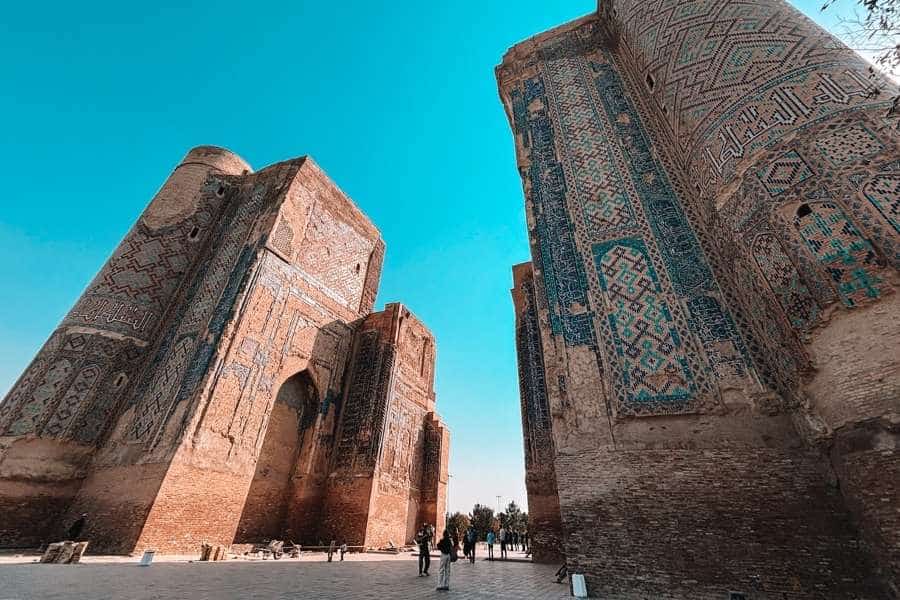
Fergana Valley

Nukus, the Aral Sea, & Yurt Stays

Termez

Itinerary Suggestions for Uzbekistan
7-Day Uzbekistan Itinerary
Day 1: Arrival in Tashkent | Explore Tashkent
Day 2: Tashkent → Samarkand (Afrosiyob Train) | Explore Samarkand
Day 3: Explore Samarkand
Day 4: Samarkand → Bukhara (Afrosiyob Train) | Explore Bukhara
Day 5: Explore Bukhara
Day 6: Bukhara → Khiva
Day 7: Khiva → Tashkent (Flight) → Depart Tashkent
10-Day Uzbekistan Itinerary
Day 1: Arrival in Tashkent | Explore Tashkent
Day 2: Explore Tashkent
Day 3: Tashkent → Samarkand (Afrosiyob Train) | Explore Samarkand
Day 4: Explore Samarkand
Day 5: Samarkand → Shakhrisabz → Samarkand
Day 6: Samarkand → Bukhara (Afrosiyob Train) | Explore Bukhara
Day 7: Explore Bukhara
Day 8: Bukhara → Khiva (Flight or Overnight Train)
Day 9: Explore Khiva
Day 10: Khiva → Tashkent (Flight) → Depart Tashkent
12–Day Uzbekistan Itinerary
Day 1: Arrival in Tashkent | Explore Tashkent
Day 2: Explore Tashkent
Day 3: Tashkent → Fergana Valley | Explore Rishtan & Kokand on the way
Day 4: Fergana Valley → Tashkent | Explore Margilan & Namangan on the way
Day 5: Tashkent → Samarkand (Afrosiyob Train) | Explore Samarkand
Day 6: Explore Samarkand
Day 7: Samarkand → Shakhrisabz → Samarkand
Day 8: Samarkand → Bukhara (Afrosiyob Train) | Explore Bukhara
Day 9: Explore Bukhara
Day 10: Bukhara → Khiva (Flight or Overnight Train)
Day 11: Explore Khiva
Day 12: Khiva → Tashkent (Flight) → Depart Tashkent
14–Day Uzbekistan Itinerary
Day 1: Arrival in Tashkent | Explore Tashkent
Day 2: Explore Tashkent
Day 3: Tashkent → Fergana Valley | Explore Rishtan & Kokand on the way
Day 4: Fergana Valley → Tashkent | Explore Margilan & Namangan on the way
Day 5: Tashkent → Samarkand (Afrosiyob Train) | Explore Samarkand
Day 6: Explore Samarkand
Day 7: Samarkand → Shakhrisabz → Samarkand
Day 8: Samarkand → Bukhara (Afrosiyob Train) | Explore Bukhara
Day 9: Explore Bukhara
Day 10: Bukhara → Khiva (Flight or Overnight Train)
Day 11: Explore Khiva
Day 12: Khiva → Nukus → Aral Sea → Yurt stay near Aydarkul
Day 13: Yurt stay near Aydarkul → Nukus
Day 14: Nukus → Khiva → Tashkent (Flight) → Depart Tashkent
More travel resources to plan your Uzbekistan trip
Save This Travel Guide to Visiting Uzbekistan on Pinterest
