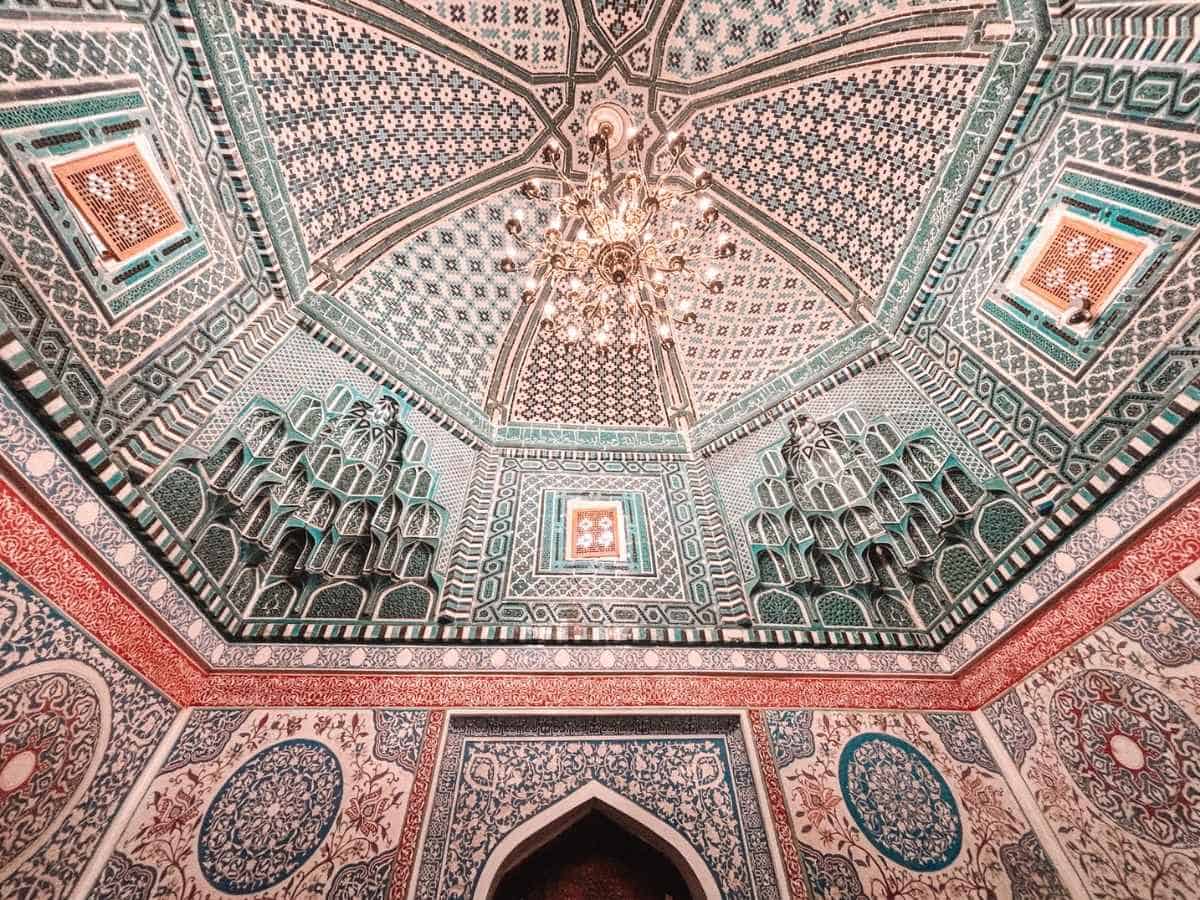
This is a real, recently-traveled 2-week Uzbekistan itinerary: Tashkent, the Fergana Valley, Samarkand with a half-day to Shahrisabz, Bukhara, Khiva, the Aral Sea via Karakalpakstan, and back to Tashkent for the flight home. We did it as a family of three last autumn (October–November 2025), and what follows is the route exactly as it worked, with the train timings I wish I’d known sooner, the hotels I’d actually book again, and the pieces I’d cut if I had to do it in 12 days instead of 14.
Most 2-week Uzbekistan guides skip the Fergana Valley to keep the route neat. We didn’t, and I wouldn’t change it. Fergana is where the country stops performing for tourists and just lives. It’s where the looms still clack inside Yodgorlik silk factory, potters still spin in courtyards in Rishton, and the plov tastes a little different at every bazaar. If you want the classic Silk Road, you’ll get it in full (Samarkand, Bukhara, and Khiva are all here at proper depth). If you want the layer underneath, that’s here too.
The route is built for travelers who want to feel the place. We took trains where it made sense and drove where it didn’t. Evenings were slow on purpose. Two weeks of non-stop sightseeing would have finished us off by day five. Wherever the planning got tricky, Afrosiyob tickets selling out, the long drive from Khiva to Moynaq, which city to start in, I’ve written down exactly what we did, and what I’d do differently next time.
Heads up: some links here are affiliate links. That means if you click and buy something, I may earn a teeny-weeny commission (think chai money, not a private jet) at no extra cost to you. It’s a small way to keep this blog running, the words flowing, and the pages free for you to enjoy. I only recommend things I truly love, use, or secretly wish I invented, because trust matters, and so do good recs. Thanks for supporting the little cozy corner of the internet I call my virtual home.
Why Uzbekistan, and Why Now
This autumn, we canceled our trip to Georgia and picked Uzbekistan instead. The name sounded mysterious, a country between worlds, packed with history and stories we barely knew.
All we had seen were a few pictures of blue domes and Silk Road cities on Instagram, and that was enough to spark curiosity. Sometimes, the best trips begin when you don’t know what to expect.
Uzbekistan is one of the five Central Asian republics, along with Kazakhstan, Kyrgyzstan, Tajikistan, and Turkmenistan.
Once part of the Soviet Union, these nations share a common past but have grown in very different ways. Uzbekistan stands out as the most developed and tourist-friendly among them. Its cities are easy to travel through, public transport works well, and you’ll find a good balance of modern comfort and old-world charm.
Tashkent was our first stop: clean, calm, and full of friendly faces. We met people who could sing old Bollywood songs word-for-word. From there, we continued to the Fergana Valley, alive with color, craft, and culture, then to Samarkand, known for its stunning blue domes; next to Bukhara, where every lane feels soaked in history; and finally to Khiva, glowing gold under the desert sun.
Every city had a story to tell, from Persian poets to Mongol kings to Russian rule, each leaving a piece of their past behind.
Uzbekistan today feels like a history book that’s still alive. You see the past here; you walk through it, touch it, and taste it, with endless cups of green tea and plates of plov.
We spent two weeks exploring this beautiful country and returned with hearts full and suitcases infused with the aroma of spices and bread.
If you love places that blend old charm with simple warmth, this two-week itinerary for Uzbekistan will help you explore the best of Uzbekistan, one city, one story, one frame, one plate of plov at a time.
When to Visit Uzbekistan
The sweet spot is late September to early November, or April to mid-May. Outside those windows, you’re dealing with either summer heat (Khiva and Karakalpakstan touch 40°C in July) or steppe winter, when some monuments close for restoration, and the Aral Sea trip becomes hard to pull off.
We went in October, and the timing was almost perfect. Tashkent and Samarkand were warm in the day, light jackets at night. Khiva was crisp and golden; that late-autumn light made the mud walls glow at any hour. Karakalpakstan was already biting; our Aral Sea morning needed real layering.
Crowds were manageable rather than thin: short ticket queues, no restaurant waits, minimal jostling, and Yandex showed up in minutes. Shah-i-Zinda was the one place the crowds did get to me, and I still regret not going back early the next morning before the tour buses arrived.
Hotels were the real bottleneck: we’d booked last minute, and most of the places we wanted in Samarkand, Bukhara, and Khiva were already gone, taken by travelers who’d planned weeks ahead. We also overlapped with the Bukhara International Biennale of Contemporary Art, which turned out to be one of the trip’s highlights.
For travelers from India, the timing is genuinely tricky. Our main school holidays: summer in June–July and winter in December, don’t line up with the best Uzbekistan months. June and July are brutally hot; December works for the Silk Road cities, but the Aral Sea trip becomes a real stretch. Most families I know plan around the Diwali break in October–November, or pull the kids out for a week in late March or early April when the weather opens up again.
One date to plan around carefully: Navruz, around March 21. It’s a major celebration across Central Asia, and the markets are at their most colorful, but transport books out, hotel rates climb, and rooms inside the Itchan Kala disappear weeks ahead. Either plan around it deliberately or skip that exact week.
How to Divide Your Two Weeks
There’s no single right answer to this, and anyone who gives you one is probably trying to sell you a tour. But here’s how we actually split our 14 days, and what I’d trim if you have 12, 10, or 7 instead.
Our breakdown was 2 nights in Tashkent (book-ended on either side of the trip), 2 nights in the Fergana Valley, 3 nights in Samarkand with a half-day to Shahrisabz, 2 nights in Bukhara, 2 nights in Khiva, 2 nights in Karakalpakstan covering Nukus and the Aral Sea, and a final day back in Tashkent before the flight.
Samarkand earned the third night because there’s a lot to absorb there, and Shahrisabz is a half-day round trip that doesn’t fit comfortably into two days.
Bukhara and Khiva felt right at two nights each, though Bukhara could easily take three if you’re the kind of traveler who likes lingering in courtyards and revisiting the same square at three different lights. I am, but the calendar disagreed.
Khiva is small but deserves at least two nights because the real magic happens after sunset, once the day-trippers leave and the Itchan Kala finally exhales.
If you have 12 days, drop the Fergana Valley extension. It’s a real loss. Fergana is the most human, lived-in part of the country, but it’s also the most logistically demanding stretch. You’ll save two days on the road and arrive in Samarkand fresher.
If you have 10 days, drop both Fergana and Karakalpakstan and stay on the classic Silk Road quartet: Tashkent, Samarkand, Bukhara, Khiva. You won’t see Uzbekistan’s emotional core; the Aral Sea is unforgettable in a way the cities are not, but you’ll see the postcards properly, with time to actually sit with them.
If you have 7 days, do Tashkent, Samarkand, and Bukhara. All three are connected by the Afrosiyob high-speed train, so you spend your time in the cities, not on the road. Khiva is worth saving for a future trip. Until the new high-speed line opens in 2026, getting there still costs you a 6-hour drive or a 14-hour overnight train each way, which eats up most of a 7-day window.
What I wouldn’t recommend at any length is trying to squeeze Karakalpakstan into a single day from Khiva. The drive alone eats most of it, and you’ll resent the Aral Sea while you’re there because you’ll be exhausted by the time you arrive. Give it two days properly, or save it for next time.
Should you start in Tashkent or Khiva?
While researching, I came across all sorts of mixed suggestions: some recommended starting in Tashkent and moving west, others advised beginning in Khiva and going the opposite way. Everyone had their own logic.
I first planned to start in Tashkent too, but since this was a last-minute, spontaneous trip, the Afrosiyob train tickets for our preferred dates and timings were all sold out. When I flipped the plan and started in Khiva instead, the tickets magically matched our schedule. Problem solved, or so I thought.
Then our local guide smiled and said, “Turn it around, it’ll make life easier.” He had a point, and you’ll see why.
So we went back to our original idea, starting in Tashkent, and he somehow managed to get Afrosiyob tickets for us, though at a slightly higher rate. That’s another story for later and one worth noting in my upcoming post about things to know before visiting Uzbekistan.
Update: That “upcoming post” is now very much here. I’ve since added this explanation to the guide itself, breaking down how Afrosiyob tickets work and why availability looks the way it does.
The main reason our local guide suggested starting in Tashkent instead of Khiva was simple: we had plans to visit the Fergana Valley. He said, “Don’t leave it for the end; you’ll have no energy left.” And he was right.
The Fergana Valley is long, rich, and full of cultural depth, colorful markets, traditional crafts, and the kind of warmth that needs your full attention (and patience). It’s a long, tiring drive from Tashkent, and doing it at the end of a packed two-week trip, more so, after the haunting beauty and emotional weight of the Aral Sea, would’ve been pure exhaustion.
Starting in Tashkent meant we could explore Fergana while we were fresh and excited, not half-asleep, counting the hours until we were back home.
Tashkent, Samarkand, and Bukhara are connected by the Afrosiyob high-speed trains, which run smoothly as butter, but Khiva sits at the far end of the Silk Road route and still waits for its bullet-train days. It’s a seven-hour ride via classic Soviet-era sleeper train or a six-hour road journey from Bukhara to Khiva.
There aren’t many international flights to Urgench. Most of them go through Istanbul, usually with Turkish Airlines, and direct flights are rare.
So, unless you’re flying from Istanbul, you’ll likely have to reach Tashkent first and then get there by a 14-hour overnight train from Tashkent, but that’s a long haul after a packed trip, so flying is the smartest choice. There are regular flights from Tashkent to Urgench Airport, which is about 30 minutes from Khiva’s old town.
The good news is that Uzbekistan is already upgrading this route. The government has announced that by 2026, modern high-speed electric trains will run on the Tashkent–Urgench–Khiva corridor via Bukhara, cutting the journey time to about 7 hours and 40 minutes, nearly half of what it is now. Once that launches, traveling across the entire Silk Road stretch will be even smoother and faster.
Whichever way you plan, starting in Tashkent or Khiva, you’ll have to backtrack a little unless your trip starts or ends in Istanbul. If not, it’s best to pick the route that fits your schedule and comfort, because in the end, both ways let you see the same magic from different directions.
Quick Tip: Getting from Stations & Airports
Yandex taxis are the best option for most transfers across Uzbekistan. They are safe, easy to book, and significantly cheaper than local taxis. If the app doesn’t work late at night, negotiate a fare with the drivers waiting outside (start around half their first quote).
2-Week Uzbekistan Itinerary at a Glance
A clean overview of the route, the time we gave each stop, and where I’d actually book if I were planning this trip again, with a few weeks of lead time instead of a few days.
Day 0–1 | Tashkent (2 nights) Where to stay: Hotel Uzbekistan, if you can get a room. It’s iconic, walkable, and the metro is at the doorstep. We didn’t, and ended up at a last-minute apartment in Mirabad, which turned out to be a well-located backup 10 minutes from Amir Timur Square.
Day 2–3 | Fergana Valley (2 nights, Fergana city as your base) Where to stay: Saroy Gardens Hotel. It’s newly built, clean, and easy to run to Kokand, Margilan, and Rishton. Homestays in Rishton or Margilan for a more local feel.
Day 4–6 | Samarkand + half-day Shahrisabz (3 nights) Where to stay: Kosh Havuz Boutique, Sangzor Boutique, or Gur Emir Palace, all close to Registan and worth booking weeks ahead. We stayed at Hilton Garden Inn Samarkand Afrosiyob (comfortable but slightly out of the center) because everything closer was full.
Day 7–8 | Bukhara (2 nights) Where to stay: AIST Boutique in Historical Caravan Sarai, Amulet, Omar Khayyam, or Duston, pick whichever has rooms; all carry that old-city heritage feel. Book early; September through January fills up fast. We stayed at the Bakhmir Palace Hotel, slightly out of the old town.
Day 9–10 | Khiva (2 nights) Where to stay: Arslan Boutique Hotel or Orient Star Khiva (Madrasah Muhammad Aminkhan 1855), both inside the Itchan Kala walls. At least one night inside the old city is non-negotiable. We stayed at Arda Turan in the newer part and went into Itchan Kala four times in two days.
Day 11–12 | Karakalpakstan: Moynaq, Aral Sea & Nukus (1–2 nights) Where to stay: Jipek Joli Inn in Nukus, right beside the Savitsky Museum. If you have the appetite for it, add a night at Besqala Yurt Camp near the Aral shore, basic but unforgettable.
Day 13 | Back to Tashkent Save this for the metro stations you didn’t ride, Chorsu shopping you skipped on day one, and either a slow city day or a half-day trip to Chimgan & Charvak Lake or the Sun Solar Furnace & Heliocomplex. Same hotel as Day 0–1.
Day 14 | Fly home
Detailed 2 Weeks in Uzbekistan Itinerary
This 2-week itinerary (equal parts practical and soul-stirring) is our honest attempt to help you see the best of the country without feeling rushed or missing what truly matters.
Day 0: Arrive in Tashkent

Fly into Islam Karimov Tashkent International Airport, and ease into the rhythm of Tashkent, the capital of Uzbekistan.
Depending on when you arrive, check into your hotel, freshen up, and enjoy your first Uzbek meal. Perhaps start with a comforting bowl of plov, which never disappoints, and give yourself time to settle in.
If you arrive during daylight, stretch your legs with a stroll around Amir Timur Square or relax in one of the city’s leafy parks to get your first taste of Uzbek calm before the adventures ahead.
Where to stay in Tashkent
We booked an apartment in Mirabad, a modern part of Tashkent that turned out to be a great choice for a last-minute plan. The area has a good mix of cafés, shops, and hushed residential streets, is safe and lively, and is close enough to the center to save time on travel. It’s about 10–15 minutes from Amir Timur Square, so you’re never too far from the main sights.
We actually wanted to stay at Hotel Uzbekistan, that big, iconic Soviet-style building overlooking the square, but it was fully booked by the time we finalized our trip. If you can grab a room there, it’s perfect for first-timers, everything is walkable, the views are lovely, and the metro’s right next door.
Mirabad, though, had its own charm, calm evenings, local bakeries, and more space to stretch after long travel days. So, no regrets there.
Day 1: Explore Tashkent


Tashkent was our first real impression of Uzbekistan: clean, calm, and more modern than we expected, still rooted in the history of the Silk Road. With its order, tree-lined avenues, and easygoing people, it wins you over with humility.
Once the fourth-largest city in the Soviet Union, after Moscow, Leningrad, and Kyiv, Tashkent was the USSR’s “window to the East,” built to impress visiting diplomats from Asia and the Middle East. That’s why even today, its streets feel unusually grand for a Central Asian city, a mix of Soviet ambition and Uzbek warmth.
Since our trip came together at the last minute, we found our local guide through a Facebook group for Uzbekistan travel. He turned out to be a gem, friendly, funny, and one of those people who genuinely love their city. He planned our entire day in Tashkent beautifully, covering all the highlights from morning to evening, and even provided us with insider tips that you won’t find in guidebooks.
Tashkent felt like a city made for balance. We loved the Hazrati Imam Complex, where history feels alive, and the Chorsu Bazaar, which smells like spices and freshly baked bread. The Tashkent Metro blew us away; each station felt like stepping into an underground art gallery.
But yes, the traffic around evening hours did test our patience, and some parts of the city felt too polished, a bit too “Soviet neat.” Still, that’s what makes it unique.
We ended our first day with a long dinner over steaming plates of plov and endless cups of tea: black (kora-choy), green (kuk-choy), and fruit (meva choy). The fruit tea was a surprise favorite, warm, slightly sweet, and slightly tangy, the kind of drink that somehow feels like a hug after a full day out.
Top Experiences in Tashkent
➳ Strolling through Amir Timur Square, the city’s heart, framed by fountains and grand Soviet-era buildings.
➳ Visiting the Hazrati Imam Complex, home to the world’s oldest Qur’an and Tashkent’s spiritual core.
➳ Browsing the colorful chaos of Chorsu Bazaar, piled high with bread, spices, and dried fruits.
➳ Admiring the elegant Minor Mosque and the impressive State Museum of the Temurids.
➳ Riding the Tashkent Metro, where each station feels like a piece of art carved in marble and mosaic.
➳ Wandering Independence Square and catching a performance or photo stop at the Alisher Navoi Theatre.
➳ Relaxing in the green spaces around Mirabad or Magic City for a slower evening vibe.
➳ Grab a plate of plov at Plov Center (Besh Qozon), rich, aromatic, and cooked in giant cauldrons.
➳ Sip black (kora-choy) or green tea (kuk-choy) at a cozy choykhana like Choykof or Giotto.
➳ Try fruit or lemon tea, sweet, tangy, and served almost everywhere in Tashkent.
Getting to the Fergana Valley from Tashkent
You can fly, drive, or take the train; each has its own charm depending on how much time (and patience) you have. Uzbekistan Airways flies to Fergana twice a week, with a flight time of 40 minutes. The Sharq train winds through the 19 km Qamchiq Tunnel, linking the valley to the rest of Uzbekistan in about 5 to 6 hours. We chose to drive, crossing the scenic Qamchiq Pass with our local guide, stopping for tea, fruit stalls, and views along the way.
Day 2-3: Fergana Valley

If Uzbekistan had a soul, you’d find it in the Fergana Valley. It’s where the country feels most human: slower, warmer, and deeply personal. It’s the creative heart of Uzbekistan, where tradition is remembered and lived. After the tidy streets of Tashkent, the valley felt like stepping into a storybook filled with color, kindness, and craft.
We traveled here with the same local guide who’d shown us around Tashkent, a man with endless stories, the patience to stop wherever and whenever we wanted, and who somehow always knew when we needed a tea break and where to stop for the best somsa. The drive itself was unhurried, winding through mountains, orchards, and small towns where life still runs on old rhythms.
Fergana has always been a vital part of Uzbekistan. Once a major Silk Road stop linking China with Central Asia, it traded silk, ceramics, and ideas long before roads had names.
Framed by the Tian Shan mountains and bordered by Kyrgyzstan and Tajikistan, the valley sits along the Syr Darya River, blessed with rich soil that sustains endless orchards and cotton fields. It’s Central Asia’s most fertile and densely populated region, and you can see why: strawberries, cherries, grapes, apricots, pomegranates, melons, and mulberries seem to grow effortlessly here.
During the Soviet era, Fergana became an industrial hub; yet somehow, the people never let go of their roots. The region’s towns each tell a different story. Kokand, once a royal capital, still carries traces of its khanate past; Rishton is the land of blue-glazed pottery; Margilan keeps silk weaving alive in its buzzing workshops; Namangan is known for its gardens and calm spirit; and Andijan, the birthplace of Babur, holds great historical pride.

The valley feels like a meeting point of worlds. Uzbek, Tajik, and Kyrgyz cultures intertwine here through language, food, and family ties. You’ll hear different dialects, see varied dress styles, and taste subtle regional differences in the same dish of plov. That mix gives the Fergana Valley a special warmth; it’s Uzbek at heart but shaped by many hands.
I expected the Fergana Valley to feel raw and rustic: small workshops tucked inside mud houses, artisans working in peaceful courtyards, that earthy charm of untouched craftsmanship. But the reality was more polished.
The new Ceramics Center in Rishton, though impressive, felt modern and a bit too curated. The authenticity I imagined seemed replaced by something tidier, designed for visitors. It wasn’t bad, just different.
The Yodgorlik Silk Factory in Margilan came closest to what I’d hoped for: the sound of looms, the rhythm of hands, the smell of dye. It still felt real.
Fergana is evolving fast, and while its cultural spirit is strong, I sometimes worry that in the race to modernize, it might lose a little of its old heartbeat. You can feel this shift across Uzbekistan, a push for tourism that risks turning stories into souvenirs.
Top experiences in the Fergana Valley
➳ Visit Rishton to watch master potters handcraft the famous blue-glazed ceramics.
➳ See the silk-making process from cocoon to loom at Yodgorlik Silk Factory in Margilan.
➳ Explore Kokand’s Khudayar Khan Palace, an architectural beauty with a royal past.
➳ Walk through Namangan’s bazaars and gardens, where locals chat over tea and fresh fruit.
➳ Stop by Chust, known for its master craftsmen who handmake the traditional Uzbek knives (pichoq) and colorful skullcaps.
➳ Visit Andijan, the birthplace of Babur, founder of the Mughal Empire in India. The city takes great pride in its history, with a small memorial to Babur and lively markets that still carry traces of Silk Road life.
➳ Try plov cooked Fergana-style, richer, heavier, and full of flavor (our guide swore by the one near Fergana Bazaar).
➳ Drink tea anywhere you’re invited; it’s always more about conversation than the tea itself.
Where to Stay in Fergana Valley
We stayed at Saroy Gardens Hotel in Fergana city, a new, neatly managed place that worked perfectly as our base. It’s clean, calm, and close enough to everything, with a small garden where evenings felt easy after long drives.
Accommodation options in the Fergana Valley are still quite limited compared to Samarkand or Bukhara, but that’s part of its charm; it hasn’t been overrun by tourism yet. Fergana city works best if you want comfort and easy access to all the main towns: Kokand, Margilan, and Rishton are all within an hour or two by car.
If you’d like a more local touch, you can also stay in guesthouses or family-run homestays in places like Rishton or Margilan.
They’re simple but welcoming, often run by families of artisans who’ll happily show you their craft workshops or share tea in their courtyard. Staying local here means more than saving money; it’s a chance to experience real Uzbek hospitality, the kind that starts with a smile and ends with “you must eat more.”
Getting to Samarkand from Tashkent
The easiest way to travel from Tashkent to Samarkand is by train. It’s quick, comfortable, and far more convenient than driving. The high-speed Afrosiyob train gets you there in over 2 hours. In this itinerary, we imagine you’ll spend a night in Tashkent after the Fergana Valley and then take an early Afrosiyob to Samarkand. When we traveled, Afrosiyob wasn’t available the next morning, so we booked an earlier evening train instead. We caught the 20:20 Sharq train and reached Samarkand by midnight. Sharq, Nasaf, and the classic Soviet-era passenger trains are good backups; if the high-speed Afrosiyob is full, they still take less time than driving, at most around 3.5 to 4 hours.
Quick Tip: Book Your Flights & Trains the Easy Way
Booking transport in Uzbekistan can be tricky. Official airline and railway sites often reject international cards or crash mid-payment, plus the language issue. We switched to 12Go and booked our train tickets in minutes. Real-time schedules, instant confirmation, and smooth payments, no translation errors or blocked payments. It’s the easiest way to book flights, trains, and transfers across Uzbekistan hassle-free.
Day 4-6: Samarkand & Shahrisabz


Samarkand has a way of humbling you. It’s grand, storied, and proud, the city that knows exactly how magnificent it looks. Once the capital of Amir Timur’s empire, it sat at the heart of the Silk Road, where merchants, scholars, and empires crossed paths.
Today, it’s still dazzling, blue domes shining under the sun, madrasas lined in perfect symmetry, and history so well preserved that it almost feels rehearsed.
It’s a polished version of that glory, rebuilt, restored, and ready for admiration, though at times it feels a bit too ready, like a well-curated museum city.
The crowds can be overwhelming, especially around the main attractions, but if you slow down, step into side streets, or talk to locals over tea, you’ll still catch glimpses of the real Samarkand, the one that existed beyond the postcards.
We had two and a half days in Samarkand, enough to see everything at our own pace. Our wonderful guide, Abdullaxon, showed us around the city by day, and later we revisited most of the spots at night on our own.
Seeing Registan Square twice was like seeing two different cities: grand and sunlit in the morning, golden and magical at night. The light and laser show at Registan Square easily topped my list of highlights; it brings history alive in the most cinematic way.
The Shah-i-Zinda necropolis, though breathtaking, was a bit of a letdown for me. When we visited with our guide, it was packed with tourists, and sections were closed for restoration.
It felt rushed, like beauty fighting for space. We had planned to return early the next morning before leaving for our half-day trip to Shahrisabz, but time slipped away, a regret I still carry. Take it from me: go as soon as it opens, it’s worth every early minute.
Shahrisabz, the birthplace of Amir Timur, sits about 90 km south of Samarkand. The drive, lined with mountains and small villages, felt soothing after the city’s grandeur. You’ll find the remains of Timur’s once-mighty Ak-Saray Palace here, crumbling yet proud, like a fragment of an empire that refuses to fade.
Top experiences in Samarkand
➳ Standing in awe at Registan Square by day and night.
➳ Visiting the Shah-i-Zinda necropolis, go early for peace and photographs.
➳ Exploring Gur-e-Amir, the resting place of Amir Timur.
➳ Wandering through Bibi-Khanym Mosque and Siab Bazaar.
➳ Watching the evening light and laser show at Registan is truly unmissable.
➳ Taking a scenic half-day trip to Shahrisabz, across the Takhtakaracha Pass.
➳ Ending the day with lemon or fruit tea at a café, the city glows best after dark.
Where to Stay in Samarkand
We stayed at the Hilton Garden Inn Samarkand Afrosiyob, one of the few hotels still available. Though slightly away from the center, it turned out to be a peaceful, modern, and comfortable base for exploring the city.
If we’d found rooms in time, we would’ve loved staying closer to the old town, Kosh Havuz Boutique Hotel, Sangzor Boutique Hotel, or Gur Emir Palace were right at the top of our list. All three are near Registan Square, have that lovely old-city charm, and would’ve made evening strolls even easier.
Getting to Bukhara from Samarkand
Several trains run daily between Samarkand and Bukhara. The Afrosiyob high-speed train takes 1 hour 40 minutes, so I’ve kept it as a morning ride in this itinerary to give you a full day in Bukhara. When we did the trip, we boarded the 22:15 Afrosiyob, a last-minute ticket arranged by our local guide. We reached before midnight, rested and ready for the next morning. If Afrosiyob tickets are unavailable, Sharq and passenger trains take around 2.5–3.5 hours, while driving takes about 4 hours.
Day 7-8: Bukhara

Bukhara felt different the moment we arrived. The pace slowed, the noise softened, and everything felt a little more human. After Samarkand’s sparkle, this city was like a deep breath, softer, lived-in, and full of small surprises waiting around every corner.
We didn’t hire a guide this time and wandered on our own. Bukhara is the kind of place that rewards slow walks. We explored Bukhara’s old lanes thrice during our time: once in daylight when the domes glowed gold, once by night when the city felt softer under yellow lights, and once in a rickshaw ride that showed us corners we might’ve missed on foot.
The Poi Kalyan Complex was the heart of it all, standing tall and peaceful as it has for centuries. Some madrasas like Mir-i-Arab and Kukeldash were undergoing renovation, and I couldn’t help thinking that Bukhara, too, is slowly turning into another polished museum city like Samarkand.
Still, the real Bukhara lives in the details: the narrow alleys, the scent of fresh bread, the wooden pillars of Bolo Hauz Mosque reflected perfectly in the pond, and the hidden Chor Minor tucked away in an easy-going neighborhood. The old Toki domes still buzz with life; you’ll find carpets, copper lamps, spices, and souvenirs, all sold with a smile and a story.
Between madrasas and markets, we peeked into Hammam Bozori Kord, one of the oldest working bathhouses in Central Asia. The air smelled faintly of herbs and steam, and for a moment, it felt like time had forgotten this corner of the city.
We were lucky to visit during the Bukhara International Biennale of Contemporary Art. Imagine modern art installations inside centuries-old madrasas and caravanserais, that’s exactly what it was. Seeing bold colors and creative energy set against ancient walls felt like watching Bukhara blend its history with its future. It was past and present staring right at each other, and you felt it.
What made it even cooler was the Indian connection. Names like Subodh Gupta shared space with Uzbek artists, turning the Biennale into a kind of cultural meeting ground between South and Central Asia. Textile-based works, craft legacies, communal stories, these are shared threads for both regions, and seeing them in one courtyard under Samarkand’s glow felt… unforgettable.
Between walks, we stopped at the Silk Road Tea House, one of the coziest spots in the city. Their saffron and spiced teas are worth the hype, served with dried fruits and sweets, it’s like drinking comfort.
For dinner, we tried local favorites like Joy Chaikhana, Ayvon, Zolotaya Bukhara, and Zytoon, each with its own charm, all equally good.
Top Experiences in Bukhara
➳ Watch the golden light wash over the Poi Kalyan Complex from a rooftop at sunset.
➳ Take a slow walk around Lyabi Hauz, the city’s lively heart.
➳ Step inside the Ark Fortress and the wooden-pillared Bolo Hauz Mosque.
➳ Wander through the Toki trading domes packed with carpets, brass lamps, and handmade crafts.
➳ Find the hidden charm of Chor Minor tucked away in the backstreets.
➳ If you’re lucky, catch the Bukhara Biennale, where ancient walls meet modern art.
➳ Sip saffron tea at the cozy Silk Road Tea House.
➳ Roam the old city after dark when the domes and courtyards glow under warm lantern light.
Where to Stay in Bukhara
We stayed at the Bakhmir Palace Hotel, a little away from the center, because it was a last-minute trip and everything else was fully booked. It was clean, cool, and comfortable. We had our eyes on Amulet, Omar Khayyam, Duston, Kukeldosh, and AIST Boutique in Historical Caravan Sarai, but those were long gone. So, a small tip: book early if you’re visiting between September and January; the city fills up fast.
Getting to Khiva from Bukhara
There’s no Afrosiyob high-speed train yet on the Bukhara–Khiva route; only passenger trains take about 6 hours. Tickets go fast in peak season, so it’s smarter to book early. We chose the road instead, leaving at 8 AM and reaching Khiva before 2 PM. The drive cuts through the Kyzylkum Desert, long, sandy, and scenic in parts, though the road could use a little more love. Our driver from Khiva made it easy with regular breaks (These breaks aren’t optional either; police officers, called YPX, often wave cars down with a flag for document checks or to make sure drivers rest on the long, flat stretch) and stories from his hometown. It’s not a smooth ride, but watching the desert slowly give way to Khiva’s ancient walls is a feeling worth the bumps.
Day 9-10: Khiva

Once the capital of the Khiva Khanate and a major stop along the Silk Road, Khiva has seen everything: caravan traders, scholars, and even slave markets.
From the 16th century, Khiva grew into a thriving oasis on the Silk Road, a busy stop for traders and travelers crossing the desert. But its history has a dark side too. In the 18th and 19th centuries, Khiva was also home to one of Central Asia’s largest slave markets, where fortunes were made on tales of pain. The city’s beauty and brutality somehow existed side by side, shaping the Khiva we see today, a small, slow-paced city where everything you want to see sits neatly inside the Itchan Kala.
The Itchan Kala, Khiva’s walled old town and UNESCO World Heritage Site, was everything I had imagined and more. It felt different with every visit, soft and calm in the mornings, golden and magical by sunset, and beautifully lit at night. Our favorite ritual was sitting at Terrassa Café, sipping tea while watching the Kuhna Ark glow in the evening light. The place is always packed, so booking ahead is a good idea. We missed a table the first time and made sure to reserve it for the next day.
We had our breakfast, afternoon breaks, and dinners all within the walls, refusing to leave the charm of the old city even for a few hours. Khiva, though beautifully preserved, is changing fast. Much of it has been restored and polished, and the cracked charm of old stones is smoothing out. While that keeps the heritage alive, it’s slowly losing that raw, ancient soul that once made it feel truly untouched.
The Juma Mosque, known for its forest of 213 carved wooden pillars, was closed for renovation during our visit, another reminder of how rapidly Uzbekistan is upgrading its historic sites. I mean, everywhere we went in the country, scaffolding seemed to follow. I couldn’t help but think that while the shine grows, some of the soul fades a little.
Ticket prices, too, have soared. The Itchan Kala entrance alone now costs around 250,000 UZS (about USD 20) per person and doesn’t include all monuments. The Islam Khoja Minaret (100,000 UZS), the Pahlavan Mahmud Mausoleum (30,000 UZS), and the Ak Sheik Bobo Tower, located on the city’s eastern edge, along with the city walls, also require separate passes.
While you can walk around without a ticket, you’ll need one for almost every major monument, and each ticket is valid for one entry per guest.
Still, none of that took away from Khiva’s charm. Today, it’s a museum-city, yes, but one still alive with tea houses, crafts, and kids playing in the alleys. It’s finding a new balance between preservation and modern tourism, though I hope it never loses that calm, lived-in feeling that makes it special.
If you’re traveling with family or picky teens like us, Safiya Restaurant and FeedUp Café are perfect options, both across the road from Itchan Kala. Safiya serves traditional Uzbek food with a cozy, local touch, while FeedUp has a more modern menu, good coffee, and a relaxed vibe, ideal for when everyone needs a little break from sightseeing and plov.
Top Experiences in Khiva
➳ Climb the watchtower of the Kuhna Ark for sunset views over the old city.
➳ Watch the sky turn gold from Terrassa Café’s rooftop, the best view in Khiva, with a cup of tea in hand.
➳ Visit the Juma Mosque and count its ancient wooden pillars.
➳ Walk the Itchan Kala walls at sunrise before the crowds.
➳ Climb the Islam Khoja Minaret, the tallest in Khiva, for panoramic views of the walled city.
➳ Explore the Pahlavan Mahmoud Mausoleum, beautifully tiled and serene.
➳ Wander through the Toshhovli Palace, once home to Khiva’s khans, filled with ornate tilework and hushed courtyards.
➳ Watch local artisans work in open courtyards, from woodcarvers to weavers, keeping old crafts alive.
➳ End your day with green tea under a mulberry tree as the city slips into stillness.
Where to Stay in Khiva
We stayed at Arda Turan Hotel, a fairly new place in the newer part of Khiva, Arda district, about 10 minutes from the old town. Designed to blend in with the old city’s sand-colored aesthetic, it’s clean, comfortable, and modern, but a little too modern for Khiva’s ancient soul. Since it’s away from Itchan Kala, we had to book Yandex taxis whenever we wanted to visit the old city. Didn’t stop us, though. We went four times in two days: morning, noon, evening, and night, because Khiva pulls you in like that.
If we had found availability, we would’ve stayed in the old town at the Arslan Boutique Hotel or the Orient Star Khiva Hotel – Madrasah Muhammad Aminkhan 1855. Staying within the Itchan Kala makes all the difference. Everything: teahouses, museums, madrasas, is right at your doorstep. At least one night inside those walls is a must if you truly want to feel Khiva’s rhythm.
Getting to Moynaq from Khiva
Getting to Moynaq from Khiva isn’t quick and takes a bit of planning, but it’s one of those trips that stays with you. The distance is long, nearly 400 km, and the drive through Karakalpakstan’s dusty, wide-open landscape takes about 7 to 8 hours. The best way to do it is by private car with a driver-guide, like we did. Our local guide arranged everything, so all we had to do was sit back, watch the desert roll by, and stop whenever we wanted for tea or photos. The road is rough and remote in parts, so having someone experienced behind the wheel makes all the difference. While day trips from Khiva to Moynaq are available, they can be exhausting; it’s better to plan an overnight tour. Most include a stay in a yurt camp near the Aral Sea and stops at Nukus and the Mizdakhan Necropolis along the way. The drive feels endless at times, but when you finally stand before the rusting ships on the dried seabed, it all makes sense.
Day 11-12: Karakalpakstan (Nukus, Mizdakhan Necropolis & Moynaq )

Karakalpakstan hits differently. It’s not pretty in the usual sense, and that’s exactly what makes it unforgettable. After the turquoise domes of Samarkand and Khiva’s postcard-perfect lanes, this land feels raw and real, stripped of everything but truth.
Karakalpakstan is officially an autonomous republic within Uzbekistan, home to the Karakalpak people who have their own language and traditions. Life here moves slowly, shaped by the desert and survival. Most travelers skip this part of Uzbekistan: it’s far, it’s tiring, and it demands patience. But if you make it here, you’ll see a side of the country that no museum can show you.
This trip is not for comfort-seekers. The distances are huge, the roads rough, and the fatigue real, but so is the experience. It’s a place that humbles you, reminds you how fragile the world is, and how much we’ve taken from it. My only tip is to keep your expectations realistic. Karakalpakstan is brutally and eye-openingly raw and a grounding experience.
The Aral is shrinking fast, and this might be your chance to stand where a sea once lived. It’s not about luxury; it’s about perspective, a lesson in what human ambition can take away, and how nature always remembers. That’s exactly why we planned this trip with our teen daughter, a real-life lesson in environmental responsibility that no textbook could teach.
We left Khiva at sunrise with our driver-guide, in a sturdy SUV that thankfully could handle the desert roads. The journey was long (nearly eight hours) through vast emptiness where the horizon barely changes. The land here is flat, dry, and endless. By afternoon, we reached Moynaq, a town that once stood on the shores of the Aral Sea, now 150 kilometers away.
The story of the Aral Sea is one of the world’s biggest fabricated environmental disasters. In the 1960s, Soviet irrigation projects diverted the rivers that fed it, the Amu Darya and Syr Darya, to grow cotton in the desert. The sea began to shrink, fish disappeared, and Moynaq’s proud fishing fleet was left stranded on sand. Walking across the dried seabed, surrounded by rusting ships and silence at Ship Cemetery, aka Ship Graveyard, felt like standing in the aftermath of a forgotten tragedy.
The Aral Sea Museum in Moynaq tells this story with painful honesty, black-and-white photographs of fishermen, Soviet posters promising progress, and paintings of a sea that no longer exists. It’s small, but it leaves a lasting impression long after you’ve gone.
From Moynaq, some tours continue deeper into the Ustyurt Plateau, a vast, desolate landscape that feels almost lunar. Getting there needs a 4×4 and a strong back as the terrain is rough and the wind harsh, but the views are otherworldly. If you’re staying overnight, you can book a yurt camp near the Aral Sea: simple, whist, and miles from everything. Nights here are pitch-black and full of stars, the kind of silence that feels almost sacred.
On our way back to Nukus, we stopped at the Mizdakhan Necropolis, an ancient cemetery and archaeological site spread over a series of low hills. Locals still visit to pray, light candles, and tie ribbons for wishes. From the top, you can see the landscape stretch endlessly, soft and golden in the evening light.
We spent the night in Nukus, the low-key capital of Karakalpakstan. The next morning, we visited the Savitsky Museum, which houses one of the world’s most remarkable art collections, works of banned Soviet avant-garde artists saved by Igor Savitsky during the USSR era. It’s surreal to find this much art in such a remote place.
By the way, while planning our Aral Sea trip from Khiva, I came across the time-forgotten ghost town of Aralsk-7 (also called Kantubek) on Vozrozhdeniya Island, once a secret Soviet biological weapons site hidden deep in the desert. Abandoned in the early ’90s, it’s completely off-limits now, and as I read, the ruins were bulldozed a couple of years ago, erasing what was left. Yet locals still talk about it in hushed tones, a mix of awe and unease, proof that even in the emptiest places, history never really disappears.
Top experiences in Karakalpakstan
➳ Stand among the rusting ships at Moynaq and imagine the sea that once was.
➳ Visit the Aral Sea Museum, small, powerful, and deeply human.
➳ Drive across the Ustyurt Plateau and spend a night in a yurt under a million stars.
➳ Explore Mizdakhan Necropolis and watch the desert turn gold at sunset.
➳ Visit the Savitsky Museum in Nukus, the “Louver of the Steppe.”
Where to Stay in Karakalpakstan
We spent a night in Nukus, the capital of Karakalpakstan. It turned out to be the perfect base for this rugged stretch of the trip. If you’re heading towards Moynaq or the Ustyurt Plateau, this is where you regroup, the only place with reliable hotels, ATMs, and a few decent restaurants.
We stayed at Jipek Joli Inn, a small, family-run spot right beside the Savitsky Museum. Clean rooms, friendly faces, and staff who go out of their way to arrange local drivers and guides, exactly what you need when you’re this far off the tourist trail. If you prefer a touch more comfort, the newer Hotel Jipek Joli Qaraqalpaqstan nearby has modern rooms, a small café, and airport pickups, still simple but solid value.
If you can, try spending a night at a traditional Karakalpak yurt camp near the Aral shore. Besqala Yurt Camp is one of the best-known ones, set near Sudochie Lake and the edge of the Ustyurt Plateau. It’s basic but unforgettable: cold, starry nights, warm tea under a vast sky, and mornings that smell of salt and silence. You’ll need a 4×4 and a local operator (like Indy Guide) to get there; camps usually include dinner, breakfast, and transfers from Nukus or Moynaq.
We skipped the yurt experience because our teen vetoed it, but if you can, you must do it. It’s one of those once-in-a-lifetime experiences you’ll always remember.
Getting to Tashkent from Khiva
The fastest way is to fly, Uzbekistan Airways runs daily flights from Urgench International Airport (about 40 km from Khiva) that take 1.5 hours. It’s the most convenient option, especially after long days on the road. Budget carriers like Silk Avia and Centrum Air also fly this route; they’re cheaper and a good pick if you’re traveling light. If you prefer the train, overnight services connect Khiva and Tashkent, taking around 14 hours. It’s comfortable enough, but after a packed itinerary, flying saves time (and sanity). After exploring Nukus on the 12th day, we drove back to Urgench with our driver-guide, who dropped us off at the airport around 5 PM for our late-evening flight. It was delayed by about half an hour, and we finally landed in Tashkent close to midnight, tired, dusty, but grateful to be back where the journey had begun.

Quick Tip: Fly Home via Istanbul
If you haven’t explored Istanbul yet, here’s a practical yet fun option: you can fly straight from Urgench to Istanbul without looping back to Tashkent. Uzbekistan Airways and Turkish Airlines both run direct flights, and from Istanbul Airport, you’ll find easy connections to almost anywhere in the world. It’s a smarter way to end your trip, skipping the backtrack and adding a new country to your journey.
Day 13: Explore Tashkent City or Day Trip to Chimgan & Charvak Lake or the Sun Solar Furnace & Heliocomplex

At this point, you’ve got two choices: fly home and wrap up your trip or, like us, give yourself one more day in Tashkent.
Most travelers say the city feels underwhelming or only worth a day, but I think that’s unfair. For me, this extra day was a breather after the long, tiring journey through Karakalpakstan, and honestly, Tashkent deserved a slower look.
There were things I’d left unfinished on day one, a proper metro ride, for instance. Tashkent’s metro stations are an experience in themselves, each one uniquely designed with mosaics, chandeliers, and stories from the Soviet era.
I wanted to stroll through the modern downtown with its glass towers, fountains, and cafes. I also wanted to walk along Broadway Street in the evening, soak in the city’s local rhythm, and finally return to Chorsu Bazaar, not to browse this time, but to shop. I had skipped it earlier because carrying extra weight for two weeks didn’t make sense. This time, I filled my bag with the things I’d wanted from the start: dried fruits, local sweets, and spices.
This last day in Tashkent felt like a pause button, a way to catch my breath, slow down, and close the trip not in a rush, but with a smile.
If you still have some energy left (or curiosity that refuses to rest), there are a couple of day trips totally worth the extra push. Head to the Chimgan Mountains and Charvak Lake, about two hours away, for a rendezvous with Uzbek nature. I’ve heard this drive to the mountains feels like therapy (I’m sure it must after days of desert dust), green slopes, cool wind, and turquoise water waiting at the end. You can book a private car or a local tour.
If mountains are not your thing, you can visit the Sun Solar Furnace and Heliocomplex in Parkent, one of the world’s largest solar furnaces. It’s a relic of Soviet science and still looks like something out of a sci-fi film. Even if you’re not into technology, it’s one of those places that makes you pause and think about how wild human ambition can be.
Day 14: Fly Back Home

Islam Karimov Tashkent International Airport is around 15–20 minutes from central Tashkent, depending on traffic. You can easily book a Yandex taxi or ask your hotel to arrange one. Our hotel arranged a complimentary transfer since we had to leave quite early, at 5 a.m., for our 8:30 flight. It was smooth, quick, and by 11:30 a.m., we were back in Delhi with memories (and luggage) full of Uzbekistan.
If your journey doesn’t end here, Tashkent connects beautifully with its Central Asian neighbors. Many travelers extend their trip to Kazakhstan, Kyrgyzstan, Tajikistan, or Turkmenistan for a full Central Asia loop. Flights from Tashkent to Almaty, Bishkek, Dushanbe, and Ashgabat are regular and short, and there are overland border crossings too if you’re in for some road adventure.
As for me, leaving Uzbekistan felt like closing a chapter I already wanted to reread, full of color, kindness, and stories that refused to fade. The country sent me off exactly the way it had welcomed me: warm, well-fed, and a little more curious than before. As the plane lifted off, I realized I wasn’t really leaving Uzbekistan behind; I was carrying it home with me.
More travel resources to plan your Uzbekistan trip
Save this 2-Week Itinerary for Uzbekistan to Pinterest
