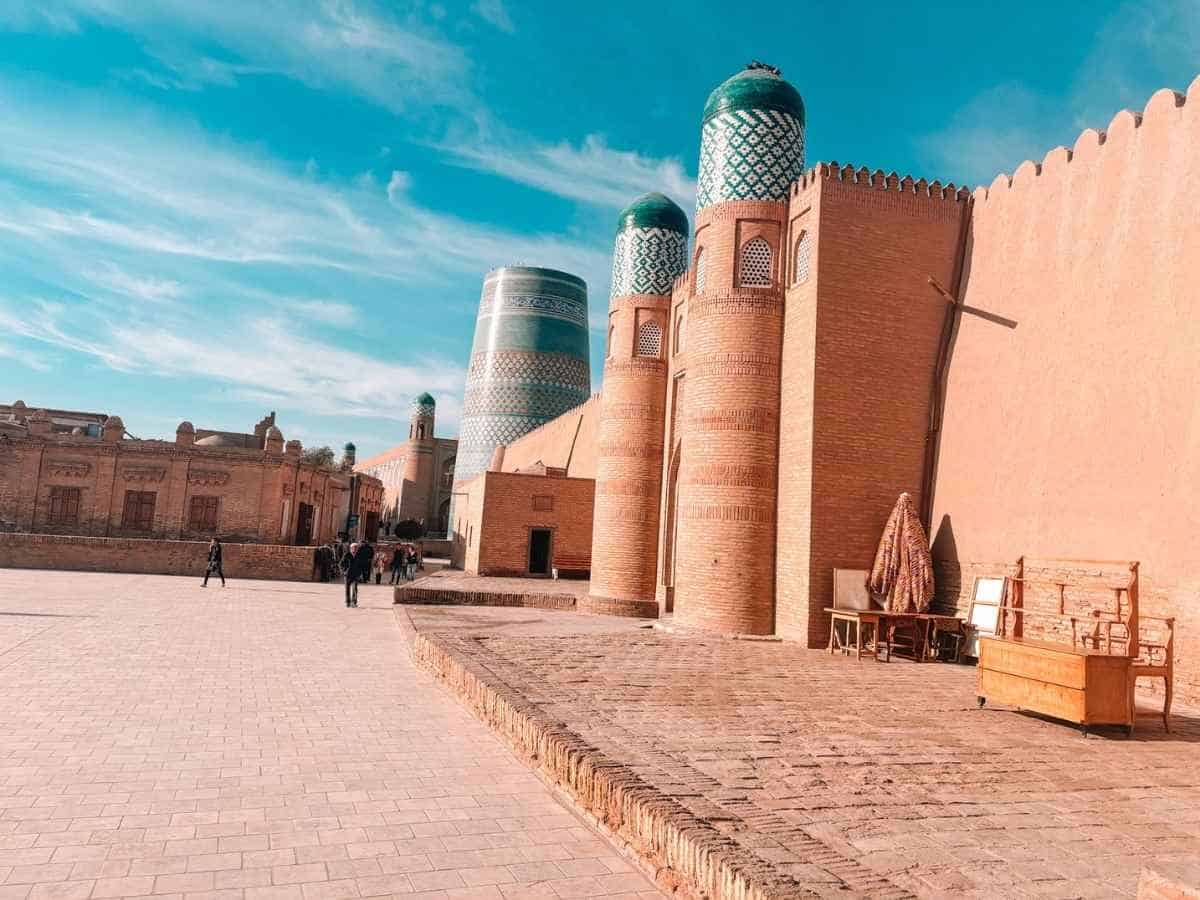
Plan the perfect Khiva itinerary with our ultimate guide to the best things to do in Khiva. From climbing ancient minarets to tasting dill-infused noodles, explore top sights, hidden gems, and unforgettable experiences in Uzbekistan’s desert gem.
Khiva is small in size but big in atmosphere. It’s also the farthest west you’ll go on the Silk Road route, so timing it right matters. If you’re planning the whole trip, see our 2-week Uzbekistan itinerary to know how Khiva fits with Tashkent, Samarkand, Bukhara, the Fergana Valley, and the Aral Sea.
Heads up: some links here are affiliate links. That means if you click and buy something, I may earn a teeny-weeny commission (think chai money, not a private jet) at no extra cost to you. It’s a small way to keep this blog running, the words flowing, and the pages free for you to enjoy. I only recommend things I truly love, use, or secretly wish I invented, because trust matters, and so do good recs. Thanks for supporting the little cozy corner of the internet I call my virtual home.
Khiva: First Impressions

We didn’t mean to fall for Khiva. It just happened. One moment, we were chasing legends and lagman across Uzbekistan. Next, we were standing under a massive mudbrick arch, blinking at a minaret that looked like someone had hit pause halfway through building it. Mini-me leaned in and whispered to me, “Did they just… get bored?” Welcome to Khiva, kid.
South of the Amu Darya River (yes, that’s the ancient Oxus, for all you history geeks), this little desert city looks small on the map.
Still, inside those mud-brick walls, you have centuries of power games, poetry, slave markets, tsarist intrigue, and some very patient woodcarvers all layered together.
It has patiently outlived empires, khanates, invasions, and bad travel planning, and has been around for over 2,500 years. Though no one at the gates checks your knowledge of medieval Silk Road plot twists before letting you in.
Legend says Shem, Noah’s son, had a dream here, something about 300 burning torches and a well. He dug one, tasted the water, and apparently said: “Khi-wa!” (“How tasty!” basically). That well still stands.
So does the city, its 10-meter-high walls, and inside them a maze of minarets, mosques, madrasas, and more stories than you can cram into two days (we tried).
Khiva was once the Silk Road’s final stop before the Persian sands began. It became the capital of the Khiva Khanate in the 1500s, ruled by khans. They built palaces and prisons with equal flair.
By the 17th century, Khiva’s charm came with a shadow. It ran one of Central Asia’s most prominent and notorious slave markets, trading Persian and later Russian captives in these same romantic-looking streets. Heavy? Yes. But it’s history you feel under your feet as you walk these story-stacked alleys.
Today, Khiva is a UNESCO World Heritage “open-air museum” that miraculously still hums with local life. Yes, it’s not a sterile relic; locals still live inside these walls, preserving traditional ways. Families here pass property down through generations, keeping outsiders out to preserve authenticity.
Kids still play hide-and-seek between 200-year-old wooden columns. Artisans still carve magic from tree trunks in sun-dappled courtyards. Families sip tea under ancient arches. You’ll hear laughter, smell baking bread, and probably spot a few camels chilling like it’s no big deal. It’s real… raw… refreshingly unpolished.
If you are thinking that Khiva is the only city where history and daily life go hand in hand. The answer is no.
I’ve seen this before, inside Jaisalmer Fort, where homes, shops, temples, and toddlers all squeeze into golden sandstone lanes. And I’ve read about similar vibes in places like Fes, Morocco, and the old quarters of Jerusalem.
If you’re a family like ours, traveling with a teen who half-lives in the past (history nerd) and half on Instagram (like all teens), Khiva is gold.
Itchan Kala is traffic-free, chaos-free, safe to wander, and full of surprises. In short, a giant open-air museum where kids and teens can freely explore.
From open courtyards and climbable minarets to spooky little jails, there’s enough architectural eye-candy to keep everyone hooked without a single dull moment.
Did you know? This well-preserved “living museum” was even named the 2024 Tourism Capital of the Islamic World.
One tiny rant, okay, not tiny, more like “kind of hard to ignore.” If you’ve been reading any of my Uzbekistan posts lately, you already know what’s coming. Yes, the renovation obsession. And no, they didn’t spare Khiva either.
Before I sound like a grump, tourism is wonderful. I like that more people want to come, see, and fall in love with Uzbekistan’s culture, history, and all that architectural goodness.
We also wouldn’t mind our own tourism department throwing some love (and budget) toward restoring our monuments. And, well, maybe finally fixing that one broken sign that’s been pointing the wrong way for years. We’re all for preservation, fair ticket prices, and seeing our heritage celebrated globally.
This is where I pause. There’s restoration, and then there’s renovation that somehow turns into re-creation. Somewhere in the middle, Khiva’s ancient soul starts to look suspiciously fresh. Like “Did they just iron that madrasa?” fresh.
It felt like military-grade makeover season, domes wrapped in scaffolding, courtyards echoing with the sound of drills instead of prayers, and centuries-old walls suddenly looking like they just had Botox.
It was heartbreaking. Not just because I couldn’t explore half of what I came for (though yeah, that too, I mean, when you fly across countries, you kinda expect to actually see the place… who knows if you’ll get a second shot). But because the pieces I did see looked less like aged beauty and more like a movie set, too clean, too staged, too ready for Instagram.
I get it. Countries want to impress. Tourism is a lifeline. But let’s not polish things so hard that we lose what made them magical in the first place. A little dust never hurt a story. Sometimes, a slightly crumbling wall holds more truth than a newly tiled one with all the history scrubbed off.
Which means you will see scaffolding. You’ll encounter the “closed for renovation” board more than once. You will definitely hear me sighing about it in every blog post from this trip.
While I like that more folks are finally discovering Uzbekistan, I just hope they meet the version with dusty corners and soul, not the overly buffed-up one that looks like it just posed for a travel brochure and forgot it once had stories to tell.
End rant. For now. Let’s get to the part that still gives goosebumps, even behind the scaffolding.
All entry fees listed in this post are exactly what we paid in October 2025. Uzbekistan’s tourism glow-up means prices (and scaffolding) change fast. If you spot a fee hike or a monument under wraps, drop a comment; my future self and baffled travelers will owe you big time.
Khiva Itinerary: How to Spend 1-2 Days in Khiva
Designed for 1–2 days in Khiva, this itinerary balances the classic sights with hidden gems. I’ve tailored it for families and teens, with engaging history and a bit of adventure to keep everyone intrigued.
It also packs in practical tips plus some hard-earned, been-there advice we wish we’d known before setting off.
Day 1: Exploring the Walled City of Itchan Kala

Your first day focuses on Khiva’s Itchan Kala, the walled inner town, ridiculously packed with historic sites.
To get your bearings: four main gates mark the rectangle of Itchan Kala, one on each side, helping you figure out where you are and where you’re heading next.
- Ota Darvoza (West Gate): The grandest, most photogenic, and the usual tourist entry point.
- Palvan Darvoza (East Gate): Historically, the trade gate near the bazaar and caravanserai.
- Tosh Darvoza (South Gate): Less used but equally impressive, with calm entry vibes.
- Bagcha Darvoza (North Gate): The least busy, often used by locals.
Each gate tells part of Khiva’s story. Once you’re inside, it’s like stepping into a living museum, just with a lot more life.
You can actually wander the streets of Itchan Kala freely without a ticket, but you’ll need one to enter the sites.
Purchase the Itchan Kala ticket at the West Gate (Ota Darvoza). It’s valid for one entry per guest and covers entry to most monuments and museums, barring a few. I’ve explained that below in the tickets and guides section.
Morning
Kalta Minor Minaret

Enter through Ota Darvoza, the massive twin-turreted West Gate. Let your first view be those curving mud walls with the blue barrel of Kalta Minor Minaret, Khiva’s most iconic landmark, popping up like a giant glazed lantern. The walls you see today mostly took shape in the 17th–18th centuries and rise to about 8–10 meters high.
Muhammad Amin Khan dreamed of turning this stumpy, turquoise-tiled tower into the tallest minaret in the Islamic world, aiming to outdo Delhi’s Qutub Minar.
But when he died in 1855, construction stopped. The minaret now stands at just 26–29 meters. However, he had planned for it to soar to 70 or even 80. It’s unfinished, but its gleaming turquoise mosaics in the morning sun are stunning nonetheless.
Listening to the minaret’s story of ambition interrupted, mini-me looked up, tilted her head, and said, “Hmmm…. someone gave up halfway… kind of like me and my homework.” I couldn’t argue.
Muhammad Amin Khan Madrassah

Step inside the Muhammad Amin Khan Madrassah just beside Kalta Minor. This 19th-century madrasa, once the largest in Central Asia, now hosts the Orient Star Hotel. Even if you’re not staying here, you can peek into its courtyard to admire the ornate facade and get a feel for how students lived.
Above the entrance, a poetic inscription reads: “This perfect city will stand for eternity, enlightening our descendants.” Bold words and standing here, you believe them.
From here, wander deeper along Khiva’s central stone-paved road, and you’ll feel like you’ve entered a movie set. The city is that well-preserved, some say almost too perfect, almost like someone hit “restore” a few times too many.
While wandering through Itchan Kala, don’t miss the unique bronze sculptures tucked around the lanes and courtyards. A woman weaving silk, a scholar lost in thought, kids playing age-old games: each one feels like a story waiting to be noticed.
Oh, you must have seen or photographed the one right at the West Gate, a charming figure of a traditional water carrier, known locally as a saqqa, standing with his buckets.
Mini-me posed with almost every single one and insisted on ranking her favorites. They might not be ancient, but they add a playful, human touch to Khiva’s history lesson.
Juma Mosque and Minaret

Walk down Khiva’s main street (from the West to the East gate), and you’ll find the 18th-century Juma Mosque tucked unassumingly behind its walls. Khiva’s historic Friday mosque looks very different from mosques in Samarkand or Bukhara.
The exterior looks humble, but step inside, over 200 ancient wooden columns—cedar and elm—rise like a forest in the prayer hall. Some say there are 213; others, 218, but each one carries its own hand-carved personality.
A few columns even have Arabic inscriptions or ancient geometric patterns, essentially woodworking art on display. Some pillars date back to the 10th century, taken from earlier structures, creating an almost mystical atmosphere under the dim light filtering through roof openings. It’s a photographer’s delight of light and shadow.
Centuries ago, mulberry trees grew in the mosque’s courtyards beneath the skylights to naturally purify the air, a clever bit of old-school “air conditioning”.
Juma Mosque was under renovation when we visited (because, of course, it was). If it’s closed when you arrive, admire the exterior for now and circle back later if the doors open. The pillars, when visible, are truly mesmerizing in their simplicity and antiquity.
Next to the mosque stands the Juma Minaret, slender and straightforward compared to its flashier neighbors. While it’s no longer climbable due to preservation restrictions, it remains an iconic part of the skyline, especially striking when framed against the mosque’s modest dome.
Wandering Beyond the Main Monuments in Itchan Kala

As you stroll between sights, take time to explore the winding lanes of Itchan Kala. Every corner reveals something: a slice of local life or a hidden architectural gem.
You might stumble upon the Mohammed Rakhim Khan Madrasa, named after one of Khiva’s last rulers, who tried to modernize the khanate while negotiating with the advancing Russian Empire. It’s a beautiful stop, rich with stories.
Adjacent to the Exhibition of Akmechet Mennonites, the Exhibition of Akmechet Mennonites tells the story of a community of German Mennonites who lived in the region in the 1800s. It’s small, but genuinely fascinating if you enjoy offbeat historical footnotes.
Nearby, smaller mosques like the Ak Mosque, a 17th-century domed mosque near the East Gate known as the “White Mosque,” and the Bagbanli Mosque offer a more peaceful, more intimate look at neighborhood religious life.
Their plain exteriors hide peaceful courtyards and intricately carved wooden pillars, giving you a sense of how ordinary Khivans worshipped, far from the pomp of the big ceremonial complexes. They’re easy to miss, but rewarding if you take the time.
Tucked nearby, the 19th-century trading complex, Allakuli Khan Madrassah, once home to students above a lively bazaar, now houses small exhibits and souvenir shops, worth a quick look for its historic charm and calm courtyard.
You’ll also find Amir Tura Madrasah, built by the son of Allakuli Khan—a low-key gem with a peaceful vibe and the Sayid Niyaz Shalikarbay Mosque, a 19th-century structure with striking white domes that blends religious and residential architecture.
Kunya Ark & Nearby Structures

By late morning, you’ll reach the Kunya Ark (Kuhna Ark) at the western edge of Itchan Kala. This was the fortified citadel of the Khiva khans, a “city within a city” containing the royal residence, harem, mint, stables, and more.
Wander through its mudbrick courtyards and rooms: you’ll find the summer mosque decorated with lovely blue tiles and the remains of the khan’s throne room.
It’s intriguing to learn that, from here, the khans once ruled a kingdom and oversaw caravans arriving with goods and, unfortunately, slaves.
One highlight inside Kunya Ark is the Ak-Sheik-Bobo Bastion, or Ark’s Watchtower, which is essentially an old watchtower that doubled as a lookout post. Save this spot for later in the day if you can. We’ll return at sunset for an incredible panorama when the light is golden. For now, note its location and carry on exploring the ground-level sights.
Before the day heats up, also pop by the adjacent Zindan or Khiva Zindon (city jail) next to the Ark’s entrance. This tiny prison-turned-museum offers a glimpse of Khiva’s grimmer side, with displays of chains and illustrations of medieval punishments.
It’s a somber but fascinating stop, one that curious teens may find eerily interesting (parental discretion advised for younger kids). Seeing the jail underscores how Khiva’s beauty coexisted with a brutal history of khans who dealt harsh justice behind these very walls.
Near the Kunya Ark, seek out a small courtyard housing the Kheyvak Well. It’s supposedly the very well-dug by Noah’s son that gave Khiva its name.
To locate, ask for the Caravan Hotel. It’s an unassuming pit protected by a dome.
Lunch
Around midday, consider a lunch break. Khiva offers a special treat for lunch: shivit oshi, the city’s signature bright-green dill noodles. Every eatery in the old town serves this dish of herb-tinted noodles topped with savory meat-and-vegetable stew and a dollop of yogurt. It’s a delicious change of pace from the usual Silk Road fare and a must-try while you’re here.
Another regional dish to try is Khorezm-style plov. Every city in Uzbekistan has its own spin on plov (pilaf). Khiva’s version might include yellow carrots and a bit more cumin. Don’t forget to drink a glass of cold tan (salty yogurt drink) or a cup of refreshing lemon tea with your meal, as locals do.
Many restaurants inside Itchan Kala serve tourists while keeping prices reasonable and the vibe relaxed. Take Khorezm Art Cafe near the West Gate. It dishes out a solid shivit oshi and other local staples without denting your wallet. Enjoy a leisurely lunch in the shade, perhaps with some persimmon or watermelon juice (in season) or classic Uzbek non-bread.
Afternoon
Tosh Hovli Palace


After lunch, delve into the eastern side of Itchan Kala to find the Tosh Hovli Palace (also spelled Tash Khauli). Built in the early 19th century by Allah Kuli Khan, Tosh Hovli translates literally as Stone House.
This sprawling palace boasts 160 rooms and three ornate courtyards. It was the khan’s royal residence and harem. You can still admire the lavish decor: honeycomb-patterned ceramic tiles in brilliant blues and whites, carved wooden columns with fluted designs, and painted ceilings that look like intricate Persian carpets overhead.
Khan intended to build this palace in 2 years. Still, because of its elaborate design (and possibly an architect’s execution problem), it actually took about 8 years. After which, the impatient Khan reportedly had the architect executed for the delay! In the harem courtyard, vivid floral and geometric mosaics line the walls where the khan’s four legal wives and numerous concubines once lived.
There are secret doors linking rooms, whispering of intriguing palace stories. Walking through the harem, you can almost picture the royal family lounging under the aivan (veranda) or imagine the music of long-ago banquets echoing off the decorative walls.
Tosh Hovli also houses ethnographic displays of Khorezm crafts and costumes. Here, you can see traditional jewelry, musical instruments, and robes on exhibit. This palace boasts the most beautifully decorated interior in all of Khiva.
Pahlavan Mahmud Mausoleum


Not far from Tosh Hovli stands the Pahlavan Mahmud Mausoleum, topped with a striking turquoise-tiled dome. Entering this mausoleum, you step into a sanctuary adorned with some of Khiva’s most exquisite tilework. Every shade of blue and teal covers the walls in floral patterns.
Pahlavan Mahmud is Khiva’s patron saint, an unlikely saint at that. He was a 13th-century poet and wrestler (yes, a wrestler!) whose legend grew for his strength and kind heart. He became so revered that 700 years after his death, the khans built this lavish mausoleum for him.
This wrestler-saint supposedly never lost a match. In fact, “Pahlavon” means “hero” or “strongman.”
To this day, Khiva honors him with an annual Pahlavon Mahmud Strongmen Games Festival. The event features feats of strength such as lifting huge atlas stones. If your visit falls during such a festival, you’ll be lucky to witness one of Khiva’s most unique local traditions!
Locals say he buried himself in the courtyard of his workshop. Over time, his tomb became the dynastic resting place for Khiva’s ruling family.
Another tale says he was also a fur hat maker and helped those in need, earning the nickname “Pahlavan” (hero). Today, locals come here to pray or tie small wishes; it’s a peaceful stop to appreciate Khiva’s spiritual side. The ambiance, with sunlight filtering through carved wooden screens onto the gleaming tiles, is serene and beautiful.
As a cultural counterpoint, you could also visit the Khirgiz Khan Madrasa or Shirgazi Khan Madrasa, opposite Pahlavan. Persian slaves built it under Khan Shirgazi in 1718. However, they revolted, killed the khan, and left the madrasa unfinished. You can still see its incomplete construction today: adjacent stands Shirgazi Khan’s tomb, a silent reminder of Khiva’s turbulent past.
Bazaar near East Gate
Nearby, at the eastern end of Itchan Kala, is the Palvan Darvoza (East Gate) area. It has its own historical significance. In Khiva’s heyday, just outside this gate was a bustling bazaar and slave market, one of the largest on the Silk Road.
While today you’ll see a reconstructed caravanserai (Allakuli Khan Caravanserai) and a modern bazaar, selling carpets and souvenirs, it’s worth pausing here to recount a bit of that history. By the 19th century, Khiva held or traded tens of thousands of slaves, including Persians, Russians, and others.
You might stand in the caravanserai courtyard (now filled with craft stalls) and imagine the scene two centuries ago. It’s a sobering story, but an essential part of Khiva’s heritage. Thankfully, those dark days ended when Russian forces intervened in 1873.
Today, the only trading in Khiva is for handmade arts and tasty snacks. But the city’s walls and gates have witnessed so much, from conquerors to commerce.
It’s a great spot to shop for souvenirs in a historic setting. You can browse hand-embroidered Suzani tapestries, silk scarves, engraved copperware, and the famous Khorezm wool socks (brightly patterned, traditionally knitted by local women).
Stroll through the open-air market stalls piled with giant melons, stringy kachkalak pumpkins, tomatoes, herbs, and spices. Women in bright headscarves sell round lepeshka breads from woven baskets, while samsa ovens puff out the smoky scent of baking pies.
You can also pop into the adjacent Tim (covered bazaar). Its domed corridors now house vendors selling spices, sweets, and ceramics. Even if you’re not buying, it’s interesting to walk through and imagine the camel caravans that once unloaded goods here. If your teen is into photography, this area provides excellent opportunities with its arched brick ceilings and shafts of light.
Islam Khoja Minaret and Madrasah


Next, it’s time to get a bird’s-eye view of Khiva. Make your way to the Islam Khoja Minaret, the tallest minaret in Khiva.
This slender tower, banded in colorful mosaic patterns, soars 57 meters (187 feet) above the city. The reformist vizier built it in 1910, hence the “modern” style by Khivan standards. It’s the second-tallest minaret in all of Central Asia.
Climbing it is an adventure: 175 spiral steps in a narrow passage lead to the top. It’s a bit of a workout. Teens will dash up, but younger kids might need some encouragement and hand-holding. The staircase is dark, so use a phone flashlight.
Mini-me raced ahead halfway before pausing dramatically, looking back at me, and asking, “Wait, we’re paying them to climb this? Shouldn’t they pay us for risking our knees and lives?” Honestly, fair point.
BTW, yes, you do pay extra to climb Islam Khoja, around 100,000 som, on top of your main ticket.
Basically, you hand over money and your thigh strength for the privilege of wheezing your way up slippery steps in a tight vertical tunnel. Worth it? Weirdly, yes.
The steps were steep and slippery in parts. And so tight that people coming down had to press themselves against the wall while those going up waited, breathing in everyone else’s nervous energy.
There was a brief moment of bonding between strangers, equal parts laughter, panic, and mutual regret. One guy ahead of us muttered, “I didn’t sign up for cardio and claustrophobia in one go,” and honestly, same.
But once you emerge, the panoramic view rewards you. The entire walled city stretches below, a sea of brown walls and blue domes, with the desert spilling out beyond.

You can point out all the places you visited earlier. Kalta Minor looks like a blue drum. The courtyards of Tosh Hovli. The green dome of Pahlavan Mahmud’s tomb. And the large roof of the Juma Mosque.
It’s also a poignant view: from up here, you appreciate how compact Khiva is. Imagine it was a century ago, with nearly every rooftop echoing the call to prayer from 170 mosques.
If anyone in the family is afraid of heights or claustrophobic, you could skip the climb. In that case, consider climbing the shorter Juma Mosque minaret instead, if operative (easier, but the views are less expansive).
It really drives home how this entire city is a UNESCO treasure, preserved like a time capsule amid the sands.
Next, make your way to the base of the Islam Khoja Minaret to witness the Islam Khoja Madrasah. It stands right beside the towering minaret. Completed in 1910, its arched facade and intricate tilework reflect a blend of tradition and reform—a final architectural flourish before the curtain closed on the khanate era.
It also houses a small Museum of Applied Arts. It showcases fine Khorezm antiques and crafts, including ancient ceramics, textiles, and jewelry.
While labels might be sparse, it’s interesting for history enthusiasts. Kids might particularly like the displays of colorful traditional costumes and the antique weapons.
Quick-Stop Museums Inside Khiva’s Madrasahs

Most museums inside madrasahs and mosques here are quick to visit. If you or your crew are museum enthusiasts, you could stop by small, themed museums that your ticket covers. For example, the Avesta Museum inside Matpana Baya Madrassah, the Museum of Musical Art inside Qozi Kalon Madrassah, and the Museum of Fine Art inside Kutlug Murad Inaq Madrassah.
Tea and snacks

By now, you might need an afternoon pick-me-up. Locals love their green tea (kuk-choy) at all hours. Why not take a short tea break under a shady mulberry tree in one of the courtyards?
There are a few small chaikhanas where you can sip tea and even sample Khiva’s unique snacks, like candied squash or honey-pressed peanuts.
Evening
Khiva truly comes alive at sunset, and this evening lets you soak up every bit of that golden-hour magic. As evening falls, the mudbrick alleys gain a 1001 Nights ambiance, imagine Arabian Nights come alive.
In fact, Khiva’s dreamy skyline of shimmering domes and towering minarets supposedly sparked the imagination behind Agrabah in Disney’s Aladdin.
For sunset, you have two strong choices.
Kunya Ark’s Watchtower
You can go back to the Kunya Ark’s watchtower (the Ak-Sheik-Bobo bastion you noted earlier) about an hour before sunset. You’ll have to grab a separate ticket (around 100,000 UZS) to climb the watchtower. It’s not part of the main pass.
That ticket also gets you access to a stretch of the city wall and the old fort’s raised platform. Totally worth it for the views.
From here, you get the best sunset view in Khiva. An awe-inspiring moment as the sun sinks and bathes the mudbrick city in golden light. Watch as the silhouette of Islam Khoja Minaret stretches across the town, and the desert beyond turns purple.
This is a prime photo spot, and yes, teens will love the Insta-worthy panorama. If the Watchtower feels packed, don’t sweat it. Views from Itchan Kala’s walls or simply pausing in a courtyard can be just as enchanting, minus the elbow jostling. The key is to wait and soak in this timeless sunset over a city that has seen countless sunsets over the last two millennia.
City Walls

Or you can walk onto the western or northern walls. The West Gate wall is the most photogenic stretch, especially at sunset, with long shadows running across the mud-brick curves.
Walk a slow loop, first facing inward toward the minarets, then turning outward toward the desert and modern town. Most guides skip this “inside–outside” walk. However, it’s a clever way to see just how compact the old city feels next to the vast, open land stretching beyond its walls.
After sunset, as twilight deepens, Khiva’s monuments glow artfully under soft golden lights.
Minarets and domes are softly floodlit in gold, looking like a scene from a timeless desert fairy tale. Stay inside the walls after dark if you can. Many tourists leave on day tours, so that you might have the moonlit streets nearly to yourself.
Itchan Kala at night might be one of your fondest memories. It’s when the paths are lit by gentle lamplight, the medressas and minarets are peaceful under the dark sky.
Dinner

For dinner, you’ve got a few solid options. Terrassa Café dishes out Uzbek classics alongside European staples. Not to mention, a lively vibe and a view that steals the show after sunset.
If your crew craves comfort food, FeedUp and Safiya do a decent job with pizzas and sandwiches. They are located just across from the West Gate.
But if there’s ever a night to try the local stuff, it’s this one. Go for Khiva’s quirky signature: Shivit Oshi. Those bright green dill noodles somehow make it into every Khiva itinerary (including this one, obviously).
Night Stroll

Take an after-dinner stroll through the now tranquil streets. You might hear the distant strains of folk music if there’s a live performance on the main square.
Sometimes, local musicians put on traditional dance shows for tourists in the evenings. You might catch a spontaneous performance on their two-stringed dutar or a soulful throat-singing session. An entertaining spectacle if you come across one.
Even without a formal show, the ambiance is enchanting.
We walked down the main road, imagining it lit by torches centuries ago. The lack of cars and modern signage makes it feel removed from 2025.
Day 2: Beyond the Old City Walls
On your second day, you’ll go beyond the main checklist sights and discover lesser-known attractions in and around Khiva.
This day is flexible. You can fill a half-day before moving on, or enjoy a more leisurely exploration if you have a full day. I’ll include options for both, from cultural experiences to a short excursion outside the walls.
Early Morning
Sunrise on the Ramparts and Light Stroll through the Backstreets

If you’re an early riser, sunrise in Khiva is well worth the wake-up call. Dawn light in the desert is soft and pink, and the city is at its most tranquil.
A highly recommended activity is to walk along the top of the Itchan Kala walls at sunrise. Head to one of the access points. Ask your hotel or check near the West or North Gates where the stairs lead up.
From up here, watch the sun peep over the horizon, illuminating the Khiva skyline. Silhouettes of minarets and domes gradually turn color—the Kalta Minor gleams in the fresh light. You can see smoke wafting up from the town’s morning cooking fires.
After a stroll on the walls, descend back into the streets as the city begins to wake. You might catch glimpses of daily rituals. Shopkeepers are sweeping the dust from their doorsteps. Children shuffling off to school with backpacks, walking right past 500-year-old madrasa walls. It’s these everyday scenes in an extraordinary setting that make Khiva special.
Stroll through Khiva’s backstreets while the city is still waking up. Venture north or south off the main tourist path. Here, you’ll find quiet residential alleys where locals sweep their doorsteps and children play.
The mudbrick lanes winding between plain walls hide surprises. A lone turquoise dome shimmering in the morning sun. A tiny neighborhood mosque. Residents baking bread in clay ovens. This is the more authentic side of Khiva, offering a glimpse of how life carries on in this ancient city.
It’s also an excellent chance for photography without crowds (teens on Instagram will love the atmospheric shots).
Return to your lodging for breakfast. Enjoy it on a terrace if possible. Many guesthouses in Khiva serve bread, eggs, and jam in their open-air courtyards so that you can soak in the atmosphere. Sip on hot green tea and savor local lavash bread with sweet apricot jam as you plan the rest of your second day.
Morning
Cultural Activities

As the day begins, consider engaging in a hands-on cultural activity. It’s a nice break from monument sightseeing, especially for kids and teens.
Khiva is famous for its handicrafts—many former madrasa cells now house artisans’ workshops where local artisans are at work.
Peek into carpet-weaving workshops where women knot silk rugs by hand, watch woodcarvers chisel patterns into columns, chairs, and rehal (Khiva’s famous folding bookstands), or spot artists painting delicate miniatures on silk paper and ceramic tiles.
Some workshops are happy to explain their craft. A friendly artisan might even let you try a few knots on a carpet or have a go at the lathe under supervision.
If you lean towards music, step into a traditional musical instrument workshop. The craftsmen often treat visitors to a demo of the soulful rubab or the rhythmic beats of a doira drum.
These impromptu demonstrations are a great way to engage kids and teens. They can see that the “museum city” is still very much alive with craftsmanship.
Souvenir shopping can be educational here, too. Bargaining over handmade puppets or miniature Khan figurines can be fun for kids (remember to be respectful and fair). The key is to slow down and engage with local culture, not just rush from sight to sight.
Explore Dishan Kala (Outer Town)

By late morning, consider stepping outside Itchan Kala to explore Dishan Kala (the outer town). Locals call the area outside the inner walls Dishan Kala. Once guarded by its own mudbrick ramparts and gates, it literally means “outer fortress”.
Yes, in the 19th century, Dishan Kala was also fortified with a second line of walls encircling the broader city.
Much of those outer walls still stand. You might have even cycled or driven through a gap in them on your way in. Most travelers barely step out of Itchan Kala, so it’s your chance to see a different Khiva.
Exit Itchan Kala through the Palvan Darvoza (East Gate). Just outside, you’ll find the Khiva Bazaar, the one we witnessed on Day One.
A short walk from the bazaar, you’ll come upon a statue: the monument of Al-Khwarizmi (Al-Khorezmi). You’ll spot him holding a book—fitting, since this 9th-century Khorezm native cracked codes of mathematics. So brilliantly, the world named “algorithm” after him.
In fact, people often call him the father of algebra. He didn’t just solve equations; he practically invented how we think about them. Take a moment to appreciate that this relatively humble town produced a mind that shaped mathematics worldwide.
Teens who geek out on STEM will love this little “hidden history” gem. Mine, usually allergic to math, actually did a double-take when she realized the genius behind algorithms once walked these very streets.
The statue stands somewhat defiantly outside the city walls, as if reminding visitors that Khiva’s legacy isn’t only in architecture but also in knowledge. It’s also a nice photo spot with the imposing mudbrick walls in the background.
If you’re keen on markets, stroll a bit further to the outer bazaar (especially lively on local market days). On Sundays, a livestock market operates outside the walls early in the morning. Here, you can see villagers trading sheep, goats, and chickens in a scene that feels biblically old-fashioned.
Nurullaboy Palace

Just a 5–10-minute walk west of the main gate brings you to a sight many miss: the Nurullaboy Palace. Also known as Isfandiyar Palace, it’s the winter palace of the last Khan of Khiva.
Built between 1906 and 1912 for Khan Asfandiyar, this palace complex blends traditional Khivan craftsmanship with early 20th-century European influences.
Russian and German engineers helped design it. So you’ll spot European tiles, chandeliers, and even a heating system mixed in with Islamic arches and ornamentation.
Legend says the khan got the land from a merchant named Nurullah, and naming the palace after him sealed the deal. Today, the Nurullaboy Palace is partly a museum.
If you find it open (they sell tickets on-site), do step inside. It features grand halls with soaring ceilings and floral motifs in rich blues and golds. Look up, you’ll spot the chandeliers that Tsar Nicholas II of Russia once gifted.
The White Hall dazzles with gilded mirrors and decor. So ornate, it feels like someone airlifted it straight out of a St. Petersburg mansion and dropped it into Khiva—a stark contrast to the mud-brick minimalism of Itchan Kala.
There’s also an exhibition of vintage photographs here by Khudaibergen Divanov. It’s one of Central Asia’s first photographers who documented Khiva and its people in the early 1900s. Studying those sepia-toned photos, you can see what life in Khiva looked like over a century ago.
It feels almost like stepping into a different era of Khiva’s history, when electricity and modernity first arrived. In fact, an engineer from Russia lit Khiva’s first electric bulb right around the time this palace rose, marking the city’s first real brush with modernity. Imagine the awe it inspired in 1910s Khiva!
We found the palace museum closed during our visit, so we explored the exterior and wandered through the gardens instead.
If you still have some energy to spare, walk a bit farther through Dishan Kala to track down the remnants of Khiva’s second city wall. They are less restored, more rugged, and perfect for imagining the city’s old layered defenses. South of Nurullaboy, sections of the outer wall feature a distinctive arched gateway. It’s impressive to see how far the outer city extends.
From here, consider hiring a taxi or arranging a short ride back to your hotel to rest around midday. Return inside the Itchan Kala for a lunch break when ready.
Afternoon
Lunch or Cooking Class
You could try a different restaurant today. Perhaps one outside the walls for better prices, or stick to a favorite discovered the other day.
Don’t forget to sample a piece of Khiva halva. The local variation of this sweet, often with peanuts, treacle, or sesame, is a nice dessert to share. Try it with nayman chay (Khivan “eight herbs” tea, a special blend).
If you’re up for something a little more immersive (and delicious), skip the restaurant and cook the meal yourself. Join a local cooking class, which combines culture, fun, and, of course, a delicious meal at the end.
Some families in Khiva open up their kitchens to visitors and teach you how to make traditional recipes. One of the most fun dishes to learn is Tukhum Barak, Khiva’s famous egg dumplings.
Another one is green shivit oshi noodles, mixing dill into the dough by hand. You can usually choose what to cook, maybe a fresh salad, plov, or more. After all the rolling, folding, and stirring, you get to sit down and eat everything you made. That’s the best part 🙂
Evening
Tea and Snacks

Wrap up your sightseeing with a relaxing activity that the whole family will enjoy. Perhaps take a traditional chaikhana (tea house) break.
A few charming chaikhanas within Itchan Kala let you lounge on a tapchan (daybed) under a silk canopy. Sip green tea and snack like a local while watching the world go by.
This downtime lets everyone reflect on their favorite part of Khiva. Meanwhile, the teens might be busy editing their best photos – Khiva is highly Instagrammable, after all.
How to Wrap Up Day 2 in Khiva (Without FOMO)

With your remaining time in Khiva, fill in any sights you missed or those worth a second look. Or if you have already covered all, here are a few alternatives:
You can also explore the Khorezm Silk Museum, a little museum that explains Silk Road history and offers hands-on crafts. Try your hand at the loom and spinning wheel, or tie-dye a silk scarf with the friendly staff, or see demonstrations of silk-spinning, weaving, and dyeing.
If you have time, you can explore a new cultural and entertainment complex called “Arda Khiva” outside the walls. It features a park, an artificial canal with boat rides, an amphitheater, and an aqua park. It even has hotels, guesthouses, and a market.
If you’re staying here, as we did, it makes for a fun evening outing with kids. They can burn off energy with a gondola ride or enjoy a local music performance in a modern setting.
The place channels Silk Road vibes with a dash of fantasy, serving up a theme-park spin on Khiva’s rich heritage.
Opinions vary on these new additions. Some love the convenience and family fun. Others prefer the old-town authenticity, but it’s there if you need it.
If you feel like a mini-adventure, hire a taxi to Kibla Tozabog. About 5 km south of Khiva, there is another summer palace.
The khan built it around 1897 as his countryside retreat, tucked among gardens and orchards. These days, it partly functions as a restaurant. If its gates are open, the leafy grounds make for a relaxing stroll or picnic spot.
Before you depart, consider picking up a meaningful souvenir. You can pick a small hand-carved wooden panel, like those columns in the Juma Mosque, but miniature. Or maybe a handmade silk carpet if your budget allows.
A fun, inexpensive keepsake for kids is a toy bow-and-arrow set or a papier-mâché doll dressed in Khivan attire, often sold near the West Gate.
Dinner
For your farewell dinner, you can try Orient Star Restaurant. It’s set in the courtyard of the Muhammad Amin Khan Madrasa (the hotel we mentioned). Dining in a former madrasa cell under the open sky is a neat experience.
Things to Know Before Visiting Khiva

How many days in Khiva?
You can see the highlights in one full day. To catch Khiva’s charm at dawn and dusk and wander into its hushed nooks, you need two days. Plus one extra day if you want the desert fortresses.
Where to Stay in Khiva?

Choosing the right accommodation in Khiva can enhance your experience, especially for families. We highly recommend staying inside Itchan Kala (the old walled city) for at least one night if availability allows. This lets you enjoy Khiva’s dawn and dusk ambiance (magical and safe to wander) without hassle.
By night, the crowds thin and the city’s mudbrick silhouettes glow under lamplight, an unforgettable experience when you’re just steps away from your hotel door. Waking up in a centuries-old madrasa-turned-hotel or a boutique guesthouse amidst the monuments is unbeatable. An early sunrise walk, when the alleys are empty and the morning light turns the mudbrick gold, is an otherworldly experience worth the early alarm.
Orient Star Khiva (Hotel in Muhammad Amin Khan Madrasa) is a unique option, a hotel housed in the large 19th-century madrasa right next to Kalta Minor. They’ve converted the old student cells into guest rooms—and yes, they’ve added modern comforts, so no need to worry. The trade-off: the rooms are a bit basic and small due to the historic structure, but the atmosphere of staying inside a monument is amazing. You step out, and you’re literally at the West Gate and the main square. Families can request adjacent rooms; some even have skylights that peek up to the dome.
Mid-range hotels such as Arkanchi Hotel or Arslanbob Boutique, inside the walls, offer traditional decor with modern amenities. Arkanchi Hotel serves a solid breakfast and lets you climb up to its rooftop terrace, where you can spend your evenings stargazing in peace once the crowds have disappeared.
Arslan Boutique Hotel is another one (if you see Arslanov mentioned, it’s the same) that often gets praise for friendly service. These are located in restored historic houses, giving you that authentic vibe with mudbrick walls and carved wooden columns in the courtyard. They’re also a short walk from all sights.
Meros B&B is a friendly guesthouse inside Itchan Kala, often cited by travelers (and run by a local family). They have triple rooms which suit families, and the hosts sometimes cook dinner for guests on request. Plus, they have a nice view from the rooftop.
If rooms inside the walls fill up, something that happens often in peak season or with last-minute planning like ours, you can book one of the newer hotels just outside Itchan Kala. They’re super convenient and usually have more availability.
For example, Asia Khiva Hotel and Bek Khiva Hotel are modern facilities located a 5-10 minute walk from the West Gate. Hotel Euro-Asia is another outside the North Gate (Bakcha Darvoza). These have larger rooms and standard amenities (some even have pools). They are suitable for those who want more space or are driving. However, staying outside means you’ll have to take short taxi rides or walks to the sites each time. One new upscale addition is the planned Mercure Khiva (a 5-star in the making), but as of now, we’d lean toward the charm of smaller inns.
Our experience: we stayed just outside the walls at a new hotel in the Ardasa district and ended up shuttling back and forth multiple times a day. Not a huge hassle with cheap taxis, but we envied those who were right in the middle of the magic. If we did it again, we’d definitely stay within Itchan Kala. One night in the old town truly lets you “feel Khiva’s rhythm”, as every sight and café is at your doorstep, and you can easily pop out at odd hours for photos or a restful walk.
Family tip: Wherever you stay, check whether the hotel can arrange extra beds or offer spacious suites for families. Many Khiva accommodations are in historic buildings, so room sizes vary. Also, verify whether they provide registration slips (needed in Uzbekistan for proof of stay). All reputable ones do. Lastly, note that Khiva is a small town; everything is close, so even staying a bit farther isn’t too much of a problem. Prioritize atmosphere and authenticity if you can, for the most memorable trip.
Getting to Khiva

Khiva may be remote, but it’s getting more accessible. The city now has its own small railway station with direct trains.
You can hop on the overnight train from Tashkent or Bukhara to Khiva, a comfy option that lets you sleep through the journey and wake up near the old city. A new high-speed rail is also on the horizon, expected to shave hours off travel times by 2026.
If you arrive by train in the early morning, it’s a pleasant 30-minute walk or a 5-minute taxi from Khiva station to the Itchan Kala gates.
Alternatively, fly to Urgench (the nearest city, 30 km away) from Tashkent; from Urgench Airport, a taxi to Khiva takes about 35-40 minutes (negotiate a fare of around $10-15 or 100,000-150,000 som). Many travelers also hire drivers between Khiva, Bukhara, and Nukus. This can be pricey, but it allows stops (like seeing the Amu Darya river or desert views).
The drive from Bukhara to Khiva is long, and the onward push to the Aral Sea is longer. See how we sequenced it over 14 days so the distances feel manageable rather than exhausting.
Best Time to Visit Khiva
Plan around Uzbekistan’s extreme climate. Spring (April-May) and Autumn (September-October) are ideal – warm days, cool nights.
Summer brings very high heat (40°C/104°F is common), which can be tough on kids (and adults!), although dry air and early/late sightseeing helps.
Winter can be surprisingly cold (even below freezing), but Khiva under a dusting of snow is quite charming if you bundle up.
The shoulder months of March and November are also good – mild weather, but the tourist rush is there.
Check if any festivals coincide with your visit. Khiva hosts vibrant cultural events like Nowruz (March 21), the Persian New Year, when the streets come alive with food, music, and family-friendly games—a joyful cultural celebration.
The city also hosts the International Lazgi Dance Festival, celebrating the elegant Khorezmian dance now on UNESCO’s heritage list.
Another dazzling event is Raqs Sehri, or The Magic of Dance, a summer festival that brings together performers from across Central Asia for open-air concerts, traditional costumes, and folk shows under the stars. If you’re in town when it happens, don’t miss the chance to see Khorezm’s rhythm take center stage.
Keep in mind that Ramadan and other Islamic holidays might mean some cafés close or run on reduced hours, though bigger restaurants usually stay open.
Tickets & Guides

Khiva’s Itchan Kala functions like a giant complex of museums. To enter most monuments, you’ll need the unified ticket. As of the latest info, the Itchan Kala ticket costs around 250,000 UZS per person (≈ $20). It’s valid for a day and grants one-time access to around 16–20 sites inside (museums, madrassas, mosques).
You can usually buy the main Itchan Kala entry ticket at the West Gate ticket booth, but I ended up getting mine from the Islam Khoja Minaret ticket office. Yes, it seems you can purchase it from any of the main ticket counters inside the old city.
Note that a few special attractions require separate fees: e.g., the Islam Khoja Minaret climb (100,000 UZS), the Kunya Ark watchtower & sections of the city walls (30,000–50,000 UZS), and the Pahlavan Mahmud Mausoleum (30,000 UZS).
Carry local cash, as not all booths reliably take cards (though this is improving).
If you’re a history buff, consider hiring a local guide at the gate. You can find many knowledgeable guides for a reasonable fee (some speak decent English), or your hotel can also arrange one. They enrich your tour by sharing stories and leading you along a logical route, which works wonders for keeping kids engaged with fascinating historical tales. Every monument has a legend, and they know just how to tell it. That said, Khiva is also very manageable on your own, especially with this itinerary in hand.
Cultural Etiquettes
Uzbekistan is a Muslim-majority country, but generally moderate. In Khiva, you’ll be entering mosques and mausoleums, so dress respectfully: shoulders and knees covered.
For women, carrying a light scarf to cover your hair inside active religious sites (like Pahlavan Mahmud’s mausoleum, which locals treat as holy) is a good idea.
Khiva is highly photogenic. You’ll want to snap away at every tiled facade and costumed local. Most locals happily pose for a photo, but it’s polite to ask first, especially if you’re aiming your lens at elders or women.
Locals often dress in traditional attire around tourist spots and may ask for a small tip if you take their photo or try on a classic Khorezmian fur hat for a picture. It can be a fun little cultural exchange and makes for a memorable family photo op.
What to Carry
Comfortable walking shoes are a must. Uneven streets and worn, steep stairs (especially in minarets and watchtowers) challenged our steps at every turn.
A hat, sunglasses, and sunscreen are essential in summer, or rather any season, I’d say, when shade is scarce at midday.
I also recommend staying hydrated. Bring a water bottle; you can refill at your hotel or buy bottled water easily in the bazaar or small shops by the gates.
Khiva is dry, so lip balm and moisturizer help, especially for kids’ sensitive skin.
As we discussed in the cultural etiquette section, you’ll definitely want to pack a light scarf. It comes in handy for entering mosques or madrasahs, shielding your face from surprise dust gusts, blocking out the midday sun, or just when you feel like blending in with the locals.
I ended up using mine more times than I expected, and of course, mini-me wanted her own collection. We both ended up scarf shopping our way through Uzbekistan, convincing ourselves each new one was “totally different.”
Some More Practical Tips
In the hotter months, plan indoor breaks; many museums are small but air-conditioned, or at least cooler, thanks to thick walls.
Midday rest back at the hotel can be a lifesaver for avoiding heat exhaustion and cranky little ones. There is a basic pharmacy outside the main gate if you need first aid or medicine, though bring any specific meds you need with you.
The city is very safe; crime is extremely low, and locals are friendly and often curious to chat, especially with families. Polite locals frequently asked us where we were from and almost always greeted us with a big smile, saying, “Welcome to Khiva!”
Dining with Kids & Teens

Uzbek food is generally kid-friendly: noodles, rice, bread, grilled meats, but it can get repetitive for picky eaters.
In Khiva, a few cafes, like FeedUp Café (across from West Gate), offer sandwiches, fries, pasta, and good coffee in a modern setting. We found it a handy spot when mini-me wanted something familiar, plus it has WiFi and a cool vibe.
Most restaurants will have plain rice or boiled potatoes available for children if needed. Don’t hesitate to ask your server for a half-portion or a less spicy option; Uzbek hospitality means they’ll try to accommodate.
Also, stock up on snacks for day outings, such as local dried fruits (apricots, raisins) and nuts from the bazaar, which are delicious and healthy for on-the-go munching.
Connectivity & Cash
WiFi is available at most hotels and some restaurants (like Terrassa and Cafe Zarafshon). Mobile signal is decent in Khiva; consider buying an Uzbek SIM in Tashkent or at the airport if you need constant data. ATMs are available in Khiva (for example, near the West Gate, there’s one at the bank), but they can be finicky.
It’s wise to bring enough cash (Uzbek som) for your expected expenses in Khiva.
You can pay for many larger purchases like hotels, entrance fees, and some souvenir shops in USD or by credit card, but you’ll need cash for taxis and small eateries.
The current exchange rate floats around 12,000 som per $1 (as of late 2025), but check the latest rates. There’s an exchange office by the bazaar if needed.
Side Trips
If you have more than 2 days in Khiva or a strong interest in ancient history, consider a half or full-day trip to the Desert Fortresses of Khorezm, also known as Ellik-Qala, the 50 Forts. You’ll find these impressive mud fort ruins scattered across the Kyzylkum desert, just a 1.5–2-hour drive from Khiva.
You can combine two of the most famous, Toprak Qala and Ayaz Qalain, in a 6-hour round trip.
Clambering on these 2,000-year-old fortress walls amid dunes is an adventurous add-on. You’d need to hire a car/driver (your hotel can arrange this easily).
Additionally, Khiva is a common departure point for trips to the Aral Sea/Moynaq. A long-haul (7-8 hours one-way) drive to see the ship graveyard of the vanished Aral Sea is typically done as an overnight tour.
Both these excursions are beyond the scope of a 2-day Khiva visit. But they’re amazing if time permits. And they can be educational for kids (such as the environmental disaster at the Aral Sea).
As you say xayr (goodbye) to this “museum under the open sky,” you’ll understand why it ends up being travelers’ favorite Silk Road city, against all expectations. Few places on earth feel so safe, timeless, and evocative.
More travel resources to plan your Uzbekistan trip
Save this Itinerary for Khiva to Pinterest

This is such a beautifully detailed guide to Khiva! I really loved how you covered the charm of Itchan Kala and its historic sites so clearly. The insights about places like Juma Mosque and the local food experience made the itinerary even more practical and engaging. It truly feels like walking through a living museum with centuries of history preserved so well.
Your tips on timing, walking routes, and exploring both the inner and outer city are super helpful for travelers planning a short visit. This guide makes Khiva look magical—definitely adding it to my travel bucket list!